
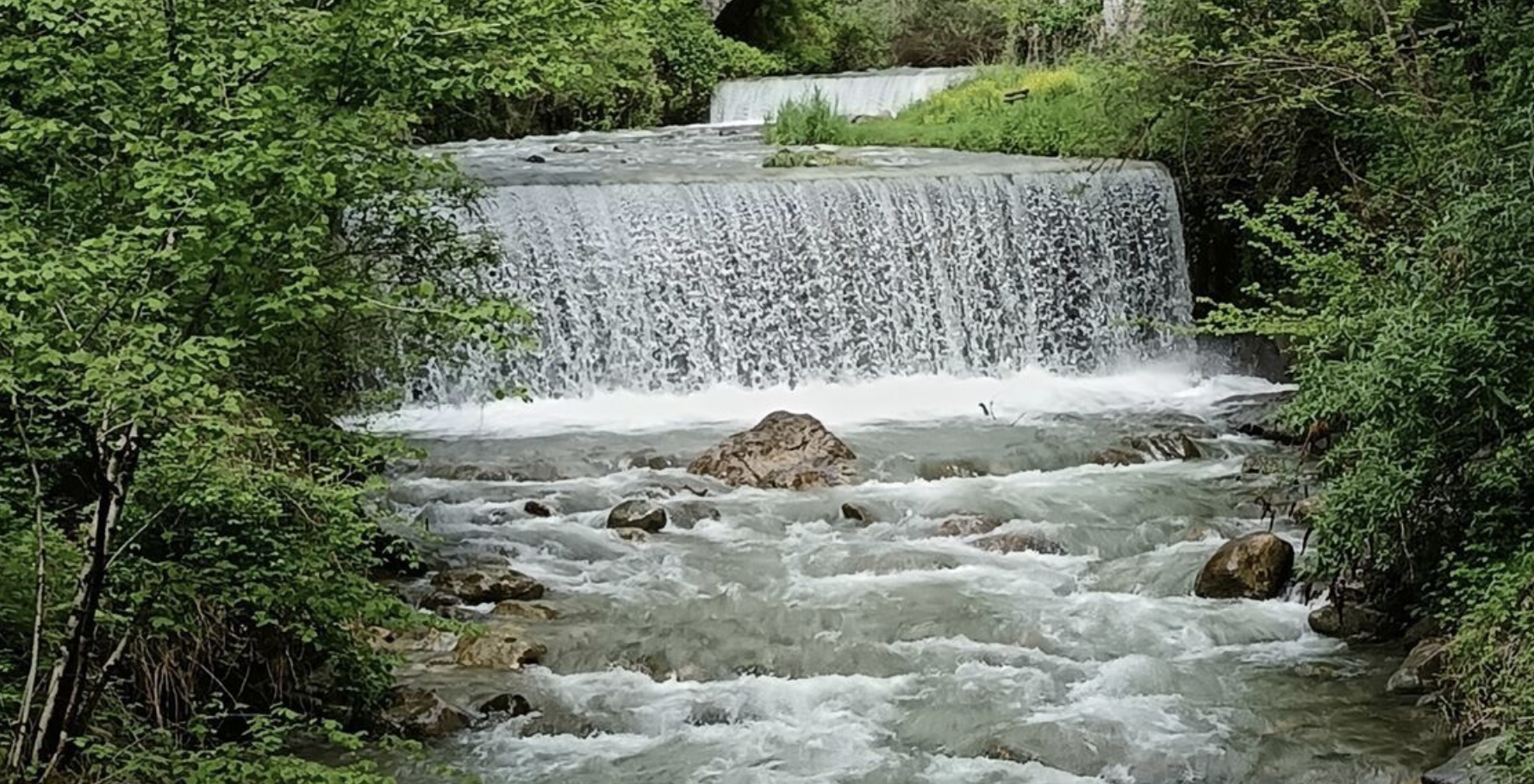
Lately I have been thinking about waterfalls, which in this town is like daydreaming about icebergs in the Mojave. Davis ranks among the flattest places in the United States. The flatness explains why we have more bicycles per capita than any other American city, and it explains why we have so little falling water.
The nearest waterfall belongs to an unlikely landlord: UC Davis, my employer for the last 36 years. It sits in Stebbins Cold Canyon, about twenty miles west: to find it, drive to Winters and then keep going. Logic says our waterfalls should lie to the east, in the Sierra, but the closest one drops off the Coast Range, instead. In October, it drops nothing at all. By my unscientific count, Davis has seen about half an inch of rain in the last six months, and the creek in Cold Canyon waits, dry, for winter.
I use the public pianos of Davis as my prospective rain gauge. Yesterday I noticed that the public piano at Second and E Streets had vanished, wheeled away to whatever warehouse shelters our street pianos for the season. Locals read that empty corner the way farmers read clouds: when the piano disappears, rain soon follows. After a big storm, I watch for water in the south fork of Putah Creek on my walks through South Davis. The falls in Cold Canyon must wait for winter.
T. S. Eliot, who occupied much of my doctoral dissertation, imagined country like this in The Waste Land. Eliot writes “Here is no water but only rock / Rock and no water and the sandy road.” At least the dry land that Eliot imagined had mountains. Ours in Davis has greenbelts and bike lanes.
Other members of my family, meanwhile, have had waterfalls to spare. Recently my wife Kate flew to Buffalo, and my son Truman rode the bus up from Ithaca College to meet her. They went straight to Niagara Falls, bought disposable parkas against the mist, and ziplined in helmets and laughter past the falls. They viewed the falls from Canada and came home praising polite Canadians.
At Niagara, Truman saw waterfalls even more impressive than those of Ithaca, where he lives during the school year. As you may know, Ithaca sells bumper stickers that read “Ithaca Is Gorges,” and the town earns the pun. In the summer of 2025, Truman guided my son Jukie and me to his favorite cascades, and our Ithaca undergraduate still texts photos with captions like “These are the falls I took you and Jukie to.” In one week, my family’s group chat stretched from dry, flat Davis to Niagara Falls.
On their wistful way back from Canada, Kate and Truman discovered that the Google Maps on their phones labeled Lake Ontario as “Lake America.” After a petty and misguided presidential decree in late August, Google relabeled the lake for American users, citing the federal Geographic Names Information System, known as GNIS. Canadians still see Lake Ontario, and Ontario Premier Doug Ford planted a sign on the shore declaring it Lake Ontario, now and forever.
I thought first of the generations of schoolchildren who have memorized the Great Lakes with the word HOMES: Huron, Ontario, Michigan, Erie, Superior. Now they’ll need HAMES. The old mnemonic already carried layers of history. “Huron” comes from the name French traders gave the Wendat people, and “Ontario” comes from an Indigenous language, a name the lake carried long before France or England arrived to divide the shoreline between them.
GNIS brought my thoughts home. On August 2, 1979, the database recorded the name Luphers Run for the Pennsylvania stream that cuts through our family’s land. My grandmother Vera and my mom, Mary, bought the property on Reservoir Road in Beavertown in the 1950s.
My mom brought my brother and me there nearly every summer, from about 1971 until I left for college in 1985. In later decades, whenever she phoned from the cabin, she reported the creek’s depth. The creek has a tiny waterfall, a drop of maybe three feet. WPA workers built up the creek bed in the 1930s, pouring concrete over the rocks, and my grandmother remembered talking with them while they worked. When I was six, I hauled stones to a half-built island just below the falls, attached a paper flag to a stick from the woods, and declared the island mine. I sat there reading books, wrapped in the same cool mist and roar that soaked Kate and Truman at Niagara.
Looking back, I see how my flag resembles a child’s rehearsal of what nations do: plant a marker, declare ownership, assign a name.
My mom died in 2024. In the summer of 2025, my brother came from Los Angeles with my niece, my two sons came from Davis, cousins came from Detroit and Portland, and my dear friend Amanda MacKaye came from Washington, D.C. We celebrated the lives of my mom and my Uncle Chuck, and we spread their ashes beside that little waterfall. My mom loved the cabin. When the original fell down around 2002, she built a new one, still without running water. She trusted the creek to provide.
The U.S. Board on Geographic Names accepts naming proposals from the public, though its rules require a five-year wait after the person’s death. Our waterfall is too small for most maps to notice, but its creek used to cool both watermelons and six-packs of beer for my mom.
I propose we call it Mary’s Falls.
Author’s Note: I recorded a video of me drafting this essay while out for a walk. Find it on my new YouTube channel.
After last week’s afternoon’s rains, I feel lucky to have gentle sunshine this afternoon. Last week and every week remind me that I love hosting events outdoors, as long as I can work with a strong sound system, such as what we have at Sudwerk on Wednesday nights. Last week we had more than 30 teams, which is a lot, so come early to grab a table (or call ahead for a reservation.) Also, take heed that the quiz is a svelte 879 words long, if you include the answers. Wordsmiths will do well tonight.
In addition to topics raised above, tonight’s pub quiz will feature questions on actors, actors, athletes, bands, bands, bartenders, basketballs, bishops, campaigns, cards, championships, charts, chocolates, cities, comics, commercials, deserts, dystopias, elements, emperors, encores, explorers, footballs, fortunes, gamers, goals, groceries, guilds, harvests, instruments, kingdoms, magazines, metals, metals, migrants, movies, musicians, myths, newspapers, notes, novels, plays, politicians, pumpkins, pyramids, rappers, records, religions, sales, sitcoms, stadiums, statues, sweets, twins, unions, whistles, current events, books and authors, and Shakespeare.
Thanks to all the patrons who have been enjoying fresh Pub Quiz content. Ryan has just joined at the silver tier! Thanks also to new subscribers Janet, Jasmine, Joey, Carly, and The Nevergiveruppers! Every week I check the Patreon to see if there is someone new to thank. I also thank The Original Vincibles, Summer Brains, The Outside Agitators, John Poirier’s team Quizimodo, Gena Harper, the conversationally entertaining dinner companions The Mavens who keep attending, despite their ambitious travel schedules and the cost of avocado. Thanks to everyone who supports the Pub Quiz on Patreon. I would love to add your name or that of your team to the list of pub quiz boosters. I appreciate your backing this pub quiz project of mine!
Best,
Dr. Andy
Three questions from last week:
21. Books and Authors. A survey of writers and literary critics compiled by The New York Times ranked what Toni Morrison novel as the best work of American fiction from 1981 to 2006?
22. Film. The 2026 documentary film You Can See Everything had two directors. Name one of them.
23. Youth Culture. Which Pixar film features The Triple Dent Gum jingle, which the Mind Workers keep sending up to Headquarters?