


Dear Friends of the Pub Quiz,

Recently I learned that during the filming of the 1945 film Brief Encounter, the cast and crew took a day off for the celebration of VE (Victory in Europe) day. The director, David Lean, later famous for Lawrence of Arabia,wanted the people on his set to be festive, but rather because the motion picture cameras were needed to film the celebrations in the streets.

Has the United States or England breathed such a sign of relief since the end of World War II? We thought the “end” of the Vietnam War, then the longest and most unpopular of all our wars, had come after five years of negotiations with the 1973 Paris Peace Accords, but the peace did not hold. In the United States, we knew neither the jubilation of victory nor the satisfaction that comes with the cessation of hostilities. 

The people harmed by Saddam Hussain or Osama Bin Laden (and I suppose that includes all of us) might have been gratified by their executions, but no death brings the relief that comes with the end of a war. 

And some bad news stories seem intractable. The death of former Sacramentan Tyre Nichols reminds us again of another instance of disproportionately brutal treatment of African-American men by police officers. His friends tell us that Tyre loved skateboarding and sunsets. One Black skateboarder tweeted this: “I’ve never been more proud of my Memphis Skate Community. They way Black skaters have been supported & the entire skate scene in Memphis has been front & center with the Nichols family. We’ve lost one of our own. We’re all grieving.” The tweet includes footage of Nichols doing amazing skating tricks that he learned while a Sacramento youth.

Domestic terrorists and insurrectionists have received vocal support from members of Congress. The incremental warming of our planet leads to droughts, loss of habitats, shrinking glaciers, and increasing threats of megafloods here in California. In a world marked by interdependence, the war in Ukraine is worsening the humanitarian crisis in Yemen.

Closer to home (and a problem throughout the world), the ongoing pandemic continues to afflict so many in our communities with new infections, with the health complications associated with long Covid, and with lingering anxieties concerning both gathering with strangers (Is it safe? Probably not), and staying apart. The isolation, alienation, and apprehension we feel colors how we see our lives and the world.

The sudden progress reported in the news is typically technological rather than spiritual or cultural or, dare I say, meaningful. I’m reading a book now titled The Code: Silicon Valley and the Remaking of America in which Margaret O’Mara tells us the story of the personal computer being followed by the iPhone and then wafer-think table computers and ebook readers. In the last three month, ChatGPT has made us all aware of the early possibilities of conversational AI. Last week Microsoft announced a $10 billion investment in ChatGPT’s creator, OpenAI, its new partner.

The problems with these sorts of advancements, and the social media applications and services that drive the conversation about these instances of tech progress, is that they often serve to overstimulate us, and thus to drain us intellectually and emotionally in ways that we may not even notice. We are assisted in communicating, sharing, and accomplishing tasks faster, but we still sense that something is missing. Speaking in the context of “duhkha,” the Tibetan term for “unsatisfactoriness” (is that a word?) or “unease,” the tenth-century Buddhist monk Tilopa said, “It is not the outer objects that entangle us. It is the inner clinging that entangles us.” In our lifetimes, the Vietnamese monk Thich Nhat Hanh said, “Stillness is the foundation of understanding and insight.” Whether or not you believe that popular technologies and services are “invasive,” as a reporter suggested in a recent piece in The California Aggie for which I was a source, we can be sure that most of these tools do not bring stillness.

So, I thought I would share with you some good news, news that might provide you a pause of stillness and a bit of encouragement during what many would see as a dark time.

  • As I suggested regarding movie night that my son Truman organized in our house on this past Saturday, most of the world’s notable films are available for streaming or downloading right now. This is true also for the world’s books. My film critic dad accumulated one of Washington DC’s largest private film libraries because he wanted some control over the films he watched for pleasure. Today all of us can exert some of that control.
  • The Giant Panda and the Manatee are no longer on the endangered species list. Perhaps Jack Black and John Lithgow are in part to thank? I hope the numbers of these beautiful creatures continue to grow.
  • The nonprofit organization Ocean Cleanup is working to extract the hundreds of miles worth of floating plastic from the world’s oceans.
  • The rains of January have enlivened all our Davis nature walks, despite what my wife Kate calls “the tree carnage.” One can smell the negative ions in the air, with the cold afternoons feeling so fresh and clean.
  • During the Obama administration, veteran homelessness declined by 50%. Some of those veterans are still fighting the war in Vietnam decades after they came home.
  • UC Davis professor Delmar Larsen founded a 501 nonprofit online educational resource project called LibreTexts that provides free and open access to hundreds of online textbooks that have been accessed by about a quarter-billion students from around the world. Those students have spent over a millennium of “confirmed reading.” One of the book projects that I mentioned in last week’s newsletter will be added to this list of OER textbooks.
  • In May of 2021, during a fire at the Philippine General Hospital in Manila, two nurses rescued 35 babies from the fourth floor neonatal intensive care unit, including those on ventilators. Congratulations to national heroes Kathrina Bianca Macababbad and Jomar Mallari.
  • Costco offers cases of Orgain organic nutrition nutritional shakes in creamy chocolate fudge flavor. I don’t drink coffee, but I reward myself with one of these on most evenings if I got some writing done that day. 16 grams of protein!
  • Norway’s last arctic coal mine has been transformed into the 1,000-square-mile Van Mijenfjorden National Park. Imagine the gratitude of the 20 million birds that nest on the islands there, not to mention the 3,000 polar bears that see the park as their hunting grounds.
  • In Berlin, Germany, a new place of worship called House of One houses a church, a mosque, and a synagogue in one building, with a communal area that connects them, a place for interfaith dialogue and social activities. The House of One is a place of peace that stands firm against religious and sectarian prejudice and hatred.
  • Somehow the three colonies of bees living on its sacristy roof of the Notre-Dame Cathedral in Paris were unbothered by the flames there, as well as by the smoke or the water that followed the fire. The beekeeper Sibyle Moulin, which is a fun French name to speak out loud, says this of the 30-45,000 insects in the three hives: “The behaviour of the colonies is perfectly normal.”
  • Bessie Coleman, first Black person to earn an international pilot’s license (in France, in the 1920s), is being honored with her own Barbie doll. Coleman was a widely-popular stunt pilot who nevertheless refused to perform before segregated audiences.
  • Up from just 2,000 in 2020, researchers counted nearly 250,000 monarch butterflies in California in 2021. Welcome back, monarchs!
  • Great people model good choices and phenomenal creativity. For example, the poet Dr. Maya Angelou inspired generations of readers, listeners, and viewers with her writings and her performances. I got to see her perform in Boston in 1988, and upstairs at Freeborn Hall (the same building where I host my weekly radio show), about five years later. Angelou once said this: “I’m convinced of this: Good done anywhere is good done everywhere. For a change, start by speaking to people rather than walking by them like they’re stones that don’t matter. As long as you’re breathing, it’s never too late to do some good.” 

I hope this good news is doing you some good. Feel free to respond with your own encouraging words. Thanks for reading to the end, and enjoy the coming week!

Andy


If you would like to support this newsletter and/or the Pub Quiz that comes with it, please consider supporting this effort on Patreon. My patrons make all of this possible. Thanks especially to the Outside Agitators, The Original Vincibles, Quizimodo, and the other teams that support my Quizmaster work month after month!

For them, and for you, here are three pub quiz questions from last week’s Pub Quiz:

  1. Pop Culture – Music. Lous Reed was part of what rock band that formed in the 1960s, and that was known for their experimental sound and their influence on the development of punk rock, alternative rock, and indie rock? 
  2. Sports. What is the national sport of Japan? 
  3. Science. William Harvey was the first known physician to describe completely, and in detail, the systemic circulation and properties of blood being pumped to the brain and the rest of the body by the heart. In what century did this physician to James I make his discoveries? 

P.S. Poetry Night on Thursday at the Natsoulas Gallery features two first-time features: Rooja Mohassessy and Teresa Pham-Carsillo. Find the details at https://poetryindavis.com/archive/2023/01/rooja-mohassessy-and-teresa-pham-carsillo-read-in-davis-at-7-pm-on-thursday-february-3rd-2023/

P. P.S. Also, check out these upcoming poets, all starting at 7 PM with an open mic at 8 PM:

February 16: Robert Thomas and Beverly Burch

March 2: Dr. Andy Jones with Siri Ackerman

March 16: Former California Poet Laureate Dana Gioia

April 6th: Maya Khosla and friends

April 20th: Julia Levine and Susan Cohen

May 4th: Pam Houston with Talia Lakshmi Kolluri

May 18th: Lois Jones with William O’Daly

June 1st: New York Times best-selling author Mary Mackey
The writer’s duty is to keep on writing. – William Styron

When my disabled son Jukie and I started our daily greenbelt walking habit in the spring of 2020, I would often don a cloth mask about 20 yards before we encountered people walking towards us, and then remove it again as soon as we passed them. Jukie didn’t understand this new practice, so he gestured at my face to communicate that he wanted me to remove my silly mask.

While he never embraced either mask wearing or Zoom school, I made sure that Jukie would at least get some physical education during quarantine. He and I walked every day in 2020, when I averaged 4.6 miles a day, and in 2021, when I averaged seven miles a day. Jukie lost some of the weight that he had gained as a side effect of his medications, and we both explored the streets of Davis. As if to indicate that he was having fun, about four times a walk he would catch up with me and give me a side hug, atypically looking me right in the eyes.

With Jukie’s help, I aspired to walk 2,746 miles in 2022, or the distance between Davis, California and my birth city of Washington, D.C. That would require me averaging 7.523 miles a day. I’m proud to say that I trounced that goal by walking a full eight miles every day in 2022, a total of 2920 miles. You can imagine that I was eyeing that round number goal of 3000, but a variety of factors killed my averages in the last two months of the year – I would have to settle for eight miles a day.

Still, that’s more than I had walked in any other year of my life, even when I was committed to distance running in high school or during my first year in Berkeley. And although I’ve run greater daily distances – there was that one day in 1989 that I got lost while visiting Orinda from Berkeley on foot, so I just ended up running all day – 2022 taught me that consistency matters most whenever you are trying to complete a big task. As John Quincy Adams said, “Courage and perseverance have a magical talisman before which difficulties disappear and obstacles vanish into air.” 

Along with my meditation habit, I found that the regular physical exertion, my time on the tree-lined greenbelts of Davis, and the fresh air supported my mental health and overall well-being. I felt a sense of accomplishment every time I hit my monthly target, even if I had to add a number of late-night audiobook bonus walks on those evenings when I was falling behind my audacious eight-mile goal.

In 2022, I did write a 100-poem book of poetry, much of it dictated to Google Docs while I was out on my walks, but I also glanced often at my list of unfinished book projects, regretful that I hadn’t devoted more time to writing non-fiction as well as poetry. I knew that if I truly wanted to make finishing and publishing these books a priority, I would have to make some sacrifices.

So, while my low-impact exercise regimen has supported my physical health, this writer also needs to write. Teaching the book The War of Art to my Writing in Fine Arts students at UC Davis, I came across this reminder from Steven Pressfield, one that seemed to be written for me: “The most important thing about art is to work. Nothing else matters except sitting down every day and trying.” 

I shall pump the brakes on my walking obsession in 2023 – I’m aiming for five miles a day, rather than eight – and instead dedicate more time to finishing book projects. I agree with Maya Angelou: “There is no greater agony than bearing an untold story inside you.” Instead of agonizing over unfinished manuscripts, I shall complete and release them. Perhaps I will see if any of those uncaged birds will sing.

I’m already enjoying the new opportunities that have resulted from my change in schedule. Typically on Sundays I would catch up with my weekly mileage quota by strolling to morning meditation in Chestnut Park, taking Jukie on a long walk, and then later walking with him to an outdoor dinner at a favorite Davis restaurant. As I seek to embrace new experiences, on this most recent Sunday I met with more than 20 new friends to play bocce ball, a yearly tradition for this friend group. Because I spent so much of my boyhood throwing things – Frisbees, , rocks, shuriken – I did pretty well at bocce, or so I was told. My team came in second – 30 points to the winning team’s 32 points – and I was even voted “Rookie of the Year.” I’m now the proud owner of a new gift card to YoloBerry, the best frozen yogurt shop in town.

As I walked to my car – yes, I actually drove to this event – I realized with a laugh that I was the only rookie this year. I look forward to many such realizations in 2023, including realized ambitions. I hope the same will be true for you.


Thanks to everyone who subscribes to the weekly pub quiz, as I hope you will do via Patreon. You keep me going on this particular writing project. Here are three questions from last week’s quiz.

  1. Internet Culture. Starting with the letter H, what toy company owns Wizards of the Coast, the company behind Dungeons and Dragons?  
  1. Cars. Starting with the letter S, what full-size SUV introduced in the year 2000 has the longest lifespan of any SUV at 296,509 miles?   
  1. Sports. The first African American coach in NBA history, who was appointed as player-coach for the Boston Celtics in 1966?

In my most recent podcast, I interviewed the Sacramento poets Brad Buchanan (who has an incredible medical story to tell) and Frank Dixon Graham. I also chat about ChatGPT with a reporter from the California Aggie. Please listen and subscribe to Dr. Andy’s Poetry and Technology Hour wherever you get your podcasts, or find the show at https://poetrytechnology.buzzsprout.com/. On the first and third Thursdays of each month, I host the Poetry Night Reading Series at the John Natsoulas Gallery, 521 1st Street in Davis. Find out more at www.poetryindavis.com (where you can sign up for the mailing list). 

Dear Friends of the Pub Quiz,

I asked an artificially intelligent chatbot to do some gratitude research in support of this newsletter.

As a result, I discovered a new quotation from Cicero: “Gratitude is not only the greatest of virtues, but the parent of all the others.” Speaking of gratitude, my mom has been facing some health challenges, so I’ve been thinking about how much I appreciate my parents, their friends and the shrinking number of people of my parents’ generation.

Recently I told my wife Kate the story of the time I first beat my mom in a foot race. I was about ten years old, and I prided myself in being fast (back then, small and fast). My teacher, Jack Petrash, gamified running and all sorts of physical play such that at recess, we held foot races like the ancient Greeks did. I knew the speed ranking of the fastest girls (such as Jessica Case and Andrea Humphries) and the fastest boys (Robbie O’Hara and Aaron Gilmartin) in my third grade class. I was not as fast as those classmates, I remember telling myself, but I had other skills that came in handy for someone who played some version of tag every day. As I knew how to dodge, to pivot on the fly, I would not be caught.

So I knew that I could provide my mom some competition when we lined up next to each other on the blacktop of Stoddert Park around dusk on a summer evening. I raced as fast as I could, and I could hear that my mom was with me for the entire run, but somehow I crossed the finish line first. I wondered at first if my mom had let me win, but she voiced her incredulity during the entire sunset walk home to Tunlaw Road. As this was the late 1970s, I believe we were both barefoot. Our race was fast, but our time together was unhurried.

As a girl, my mom was athletic rather than social, she once told me. After school and on weekends, she would hang out at the Turnvereine, a German-American gymnastics and cultural center where my mom learned to swim, to do gymnastics, and to play volleyball. I don’t know that the family thought itself as being particularly German, but my mom’s grandfather on her dad’s side and my mom’s great grandfather on her mom’s side both came from Germany (though the great grandfather met a nice woman from Harrisburg named Catharine Jones, so I have Jones’s on both sides of the family).

One time about 30 years ago my mom was visiting our Sacramento apartment, and we happened to walk past 3349 J Street where one can still find one of the oldest extant Turn Vereine center in the United States, founded in 1854, just four years after the city was incorporated. Seeing the place triggered all sorts of memories for my mom, memories that she shared with us as we walked back to our Midtown home.

She’s not able to share such memories today, but she still depends upon the strength of habit and of body that she developed in Detroit back in the 1940s and 50s to sustain her during these more difficult times. As one of the resident writers in our family, I am called upon to keep memories of her memories, sharing them here to keep alive the spirit of our forebears whose dreams and sacrifices provided us the foundations we needed to show them that we turned out all right, and then to thrive in their absence.


Mostly I was thinking about gratitude because of how thankful I am to the more than 125 people who have donated to my fundraiser for the Smith-Lemli-Opitz Foundation, a non-profit organization that supports research into the rare syndrome that has so significantly affected my son Jukie. As you can see from the Facebook page for the fundraiser, we have reached 82% of our goal of raising $10,000. I really appreciate all of you who have helped out. I wonder if we will make it to $10,000 on Facebook. Many (including some readers of this newsletter) have also given via the Foundation website. Thanks, everyone!

Here are five questions from last week’s Pub Quiz:

  1. Horror Actors Named Williams. Who had the female lead in the horror films Get Out and M3gan?  
  1. Pop Culture – Music. Dan Reynolds, the co-founder of the LGBTQ+ advocacy group LoveLoud, is also the lead singer of what imaginative band responsible for the hit “Radioactive”?  
  1. Sports. What Oklahoma professional sports team plays its home games at Paycom Center?  

P.S. I’ve been researching genealogy on Martin Luther King Day. My dad knew Coretta Scott before she was married, so I wondered if we were related to her. It turns out that she is the “wife of my tenth cousin, once removed.” As Reverend King said, “We may have all come on different ships, but we’re in the same boat now.” Enjoy the holiday.

“As there are a thousand thoughts lying within a man that he does not know till he takes up the pen to write.” William Makepeace Thackeray, The History of Henry Esmond

Dear Friends of the Pub Quiz,

Happy New Year! The rain on New Year’s Eve day kept the people indoors, but today brings the sunshine of a new year. Perhaps, like me, you are making plans.

Now that our kitchen is complete and the presents have been put away – I’m excited about my new socks – we can turn to our plans and resolutions. My plans involve writing projects of various sorts. Like my son Truman, I would like to finish at least one book this year. To have occasions to write is like visiting an oasis, like watching an unexpected rain shower on a summer afternoon in Davis. I agree with Gloria Steinem who said that “Writing is the only thing that, when I do it, I don’t feel I should be doing something else.”

I’m reviving an ancient assignment for the Silicon Valley Journalism class that I’m teaching this winter. The philosopher Seneca said, “We should hunt out the helpful pieces of teaching and the spirited and noble-minded sayings which are capable of immediate practical application–not far far-fetched or archaic expressions or extravagant metaphors and figures of speech–and learn them so well that words become works.” But what do we do with these “pieces of teaching” after we have found them? We collect them in what Webster’s Dictionary calls “a book in which extracts, poems, aphorisms, etc. are copied down for future reference, often together with one’s ideas and reflections.” We call this a Commonplace Book.

I suppose I work on three such commonplace books every week: I have a huge Google doc where I collect ideas for poems and book projects, I have another huge such repository for all my topics for Pub Quiz questions, and I have the collections of ideas and quotations that appear in these newsletters that I share with you every week. 

David Allen said that “Your head is for having ideas, not holding them.” What method should we employ to have and to hold one’s ideas? In his book Building a Second Brain, Tiago Forte explains what he calls his CODE method for building a “second brain” that focuses on holding: the CODE acronym stands for “Capture, Organize, Distill, and Express.” You can imagine how these elements work: first one captures all the data, with a focus on wisdom and not just facts; then one organizes or categorizes the information is such a way that it is actionable; then one distills the most useful information from the whole; and then one expresses it to an audience, such as I do with these newsletters.

Commonplace Books invite tangents. For example, speaking of distillations, I remember now that Pulitzer Prize-winning poet Gwendolyn Brooks said that “Poetry is life distilled.” I think of that quotation from my own commonplace book when I try to enrich this one precious life of mine with the distilled lives of others.

I will ask my students to make at least small eight additions to their commonplace book every week, averaging at least 400 words a week. Their entries will come from the following categories, with the first five being mandatory:

  1. Two or more quotations and aphorisms
  2. Response to a compelling paragraph from a news story concerning Silicon Valley (paste the paragraph)
  3. Responses to assigned readings (assigned for our class or for another class)
  4. Response to a friend’s or classmate’s blog or commonplace book
  5. Response to an original photograph or a royalty-free photograph that you share
  6. Responses to topics brought up in class by Dr. Andy, guest speakers, or peers
  7. Links to five or more discovered resources (including articles, podcasts, books, websites)
  8. Reflection on a digital tool (such as one you use or are investigating) or social medium 
  9. Goals for the week and reflections on your previous week’s goals
  10. Contemporary analogues to people or phenomena covered in O’Mara’s book Code
  11. Responses to non-assigned readings
  12. Quotations from your correspondence with others
  13. Up to 50 words of redacted writing that you don’t want others to read (you can substitute Lorem Ipsum)
  14. Topics and resources that you are researching for a future assignment
  15. An anecdote about something you did this week
  16. Responses to examples of discovered innovation, entrepreneurialism, or productive collaboration 
  17. An update on your path towards professionalism as a writer
  18. Meta-analysis of your own work as a blogger, thinker, writer, student, or keeper of a commonplace book.

400 words is not very much (this newsletter already over 800 words so far), so I think the students can handle it. I hope that this assignment will both build writing habits in my students and help them see the connections between the downtime or low-impact writing that they should be doing all the time in order to prepare themselves for any sort of intellectual or journalistic work in the future. Flannery O’Connor said that “I write because I don’t know what I think until I read what I say.”

On this first day of the year, I have so much more to say about 2022, and so much that I plan to say in 2023. As was the case with poets of yesteryear, some of that composing I will do while walking, as I did this year. During his 1831 tour of Scotland, Wordsworth would sometimes walk 20 miles a day. Of course, he did not have access to light rail or tour busses. Whereas I did surpass the 20 mile mark on occasion in 2022, I will save the summation of my yearly miles, of what Wordsworth called “very much pedestrianizing,” in a future newsletter. 

In other news, next week we celebrate my son Jukie’s 22nd birthday, so that will mean a fundraiser for the Smith-Lemli-Opitz Foundation. Check out the new website now so that you are in the mood to give! In preparation for next week, and my eventual pitch to you, my reads, I will see what persuasive quotations I can find in my commonplace book.

Happy New Year, and thanks for your support and readership!

Dr. Andy


P.S. Thanks to all the individuals and teams who support this endeavor every week. I continue because of my supporters on Patreon. Here are three questions from last week’s quiz:

  1. Mountain Ranges. The San Jacinto Mountains are found in what county that starts with the letter R?  
  1. Pop Culture – Television. Netflix on December 12, 2022 disclosed that 60% of its 223 million global subscribers (134 million) regularly watch original BLANK content. What K word fills in the blank?  
  1. Another Music Question. Born Brenda Gail Webb in 1951, who had a 1977 hit with “Don’t It Make My Brown Eyes Blue”?  

P.P.S. Allegra Silberstein (she’s 92!) is our featured poet with Jean Biegun on Thursday night at 7. Join us! See https://poetryindavis.com/archive/2022/12/allegra-silberstein-and-jean-biegun-read-at-7-pm-on-thursday-january-5th-2023/ for details.

Gold, Frankincense, and Neckties: A Christmas Story

Dear Friends of the Pub Quiz,

We knew that 2003 would be the year of my dad’s last Christmas. When my wife Kate, and our children Geneva and Jukie, and I arrived at my dad and step-mom’s Las Vegas home, decked out with familiar holiday finery, dad offered to help me with the suitcases. I politely told him that we would carry our own bags. After he gave me a hug, dad complimented me on my new green wool sweater, one that I happened to wear while wrapping presents this afternoon.

As an actor and magician who focused on mentalism, my dad had amazing powers of concentration, memory, and willpower. Harry Houdini was a hero of his, though I never saw my dad escape anything more death-defying than an exuberant conversation with an inebriated fan on the streets of Washington D.C. Instead, my brand of dad’s magic depended upon audience participation, humor, and his powers of suggestion. With his ability to amaze (and perhaps deceive) an audience, my dad could have been a con man, but as a civic-minded artiste, he made sure that all his “marks” left his performances with much more than whatever they brought to his shows.

Soon after the initial diagnosis, a Halloween conversation in which doctors told my dad that he had only a few months to live, he learned that a cancerous tumor was applying pressure on his diaphragm, triggering a case of hiccups. As the hiccups kept him from catching his breath or from resting, the oncologists and nurses were concerned. One never knows what will exacerbate a fatal condition and end up hastening one’s end.

Reading the room and the sensing the implications of his hiccups, my dad knew that he had to do something, especially if he was going to see his sons and his young grandchildren later that month for Thanksgiving. He asked if the doctors and the nurses would give him a couple dozen minutes without interruptions. For one of his last magic tricks, and summoning his innate power as a wizard, my dad calmed his breathing, settled his stomach, and ended his hiccups.

When we visited him that Thanksgiving, dad was well enough to see his son Oliver get married to his longtime girlfriend Sarah, and to spend time with visiting family. As always, he was dressed formally and impeccably – sometimes we wish to make memorable first impressions, and sometimes memorable final ones. We were also impressed with all the “get well soon” cards dad was receiving from professional musicians, from friends at the TV station where he worked throughout my childhood, and the actors in the more than 1,000 theatrical productions that he directed over his lifetime.

One of the more histrionic cards (understandably, from an actor) asked the question how American theatre could continue without Davey Marlin-Jones. When asked how we should respond to such concerns expressed about the cancer diagnosis of a man who had inspired and guided so many actors, my dad responded with four memorable words: “Tell him, ‘All shows must close!’”

My son Truman was born a year and a half after my dad died, but in many ways, he has sustained my dad’s legacy. As my dad was, Truman is taller than me, he’s an actor, he has an encyclopedic knowledge of films, and he’s a writer. Truman also dresses formally – I don’t know that any of his high school friends have seen him in a T-shirt – though I haven’t yet taught him how to tie a tie.

Ties play an important part in my family traditions, and not only because my dad knew how to dress ceremoniously for every gala he ever attended. Thinking about whether Truman was expecting any neckties under the tree this holiday, I recalled something that my dad said to Oliver and me during the week of Christmas, 2003: “Sons, it’s time to play King Lear with the ties.”

Unlike King Lear, we did not come from a wealthy family. My dad had no kingdom of property that he wanted to divide among his children, as Lear did, nor did he want to divide the portions of his gifts to his children according to our professed affection for him, as Lear did, asking, “Which of you shall we say doth love us most? / That we our largest bounty may extend / Where nature doth with merit challenge.

My dad was renown instead for his collection of ties, many of which he wore on television while reviewing movies in the 1970s and 1980s. His fraying ties from the 50s and 60s he once gave to seamstresses he knew and asked them to create two quilts, one for each of his sons. Though the quilts long since fell apart due to overuse, they comforted us, connecting us with dad when he was out of town directing plays or movies.

Perhaps the quilt commission was a rehearsal for that evening in late December when dad invited Oliver and me to pick out 30 each of our favorite of his ties, each of us alternating so that the colorful “kingdom” would be fairly distributed. Dad compounded the giving by telling us the story of each tie, such as who gave it to him, or on what occasion he wore it. Today I have in my closet the especially fine necktie that my dad wore to his interview at the Department of Theatre at the University of Nevada, Las Vegas, where he would go on to win numerous teaching awards, despite the fact that he had a mere B.A. in Theater from Antioch College, having taken classes there with Coretta Scott (later, Coretta Scott King) while Harry Truman was still U.S. President.

Having reviewed films on TV for two decades, my dad spent more time being filmed than anyone else I know, but I wish we had filmed that interaction among a beloved dad and his two sons – he passed away three years before the first iPhone was released. I think of that night often. I still have all 30 of those ties dad gave me, and over the years, I have shown them to my three kids, but without my dad’s mesmerizing theatrical gusto. As I look at our tree in the living room, and prepare for our own holiday reunion, I think fondly on Truman’s Grand-Davey and what he shared with us that evening. The Christmas memories, like the colorful neckties, will stay with me for the rest of my days.

Thanks to all of you who have supported this Pub Quiz endeavor this year with your subscriptions via Patreon. I miss the days when we all used to gather together.

Here are three questions from last week’s quiz:

  1. Internet Culture. Who or what is Elden Ring: An AI startup CEO, a book titled by Kim Stanley Robinson, a video game, or a wearable technology?  
  1. Tunnels. The first ever international vehicle tunnel starts with the letter D, sharing a name with what city?  
  1. Sports. Born in 1947, what athlete-turned-actor’s films have grossed over $4 billion worldwide?  

Merry Christmas!

Dr. Andy

P.S. I tweeted about the 92 year-old Davis poet Allegra Silberstein yesterday, and for some reason, it earned over 60 likes. Allegra reads in our poetry series on January 5th, 2023.

The Ache of Doorless Door Jambs

Dear Friends of the Pub Quiz,

Unscrew the locks from the doors!
Unscrew the doors themselves from their jambs!

Walt Whitman

We knew something was wrong with our house when our doors seemed no longer to fit their frames. Some doors would require lifting at the handles to close them correctly, while others seemed too large for their doorframes. We felt safe because a robber couldn’t walk in our front door even if it was unlocked.

We had the opposite problem at my DC home in the 1970s. Having read about lock-picking and infiltration, I was curious to know if I could “break into” my own home. Back then only I was small enough to crawl in our front basement window, and only I figured out how to lift the glass door enough out of its frame to clear the simple lock. Once on a return trip from Beavertown, Pennsylvania, my mom realized that she had left her housekeys a few hours away at the Cabin. “Allow me,” I said self-importantly, muscling open the door to a house that we had left “locked” but unsecured for previous three weeks.

I lived in a secure building in Boston in the late 80s, but my best friend Tito never asked to be buzzed in during his surprise visits. He would just appear at my front door with a big smile on his face. He told me that he was thinking of coming in my open window, but it was a third-floor walkup, and his mountain climbing skills would attract attention. A charismatic rogue, stealthy Tito had an impressive climbing speed. 

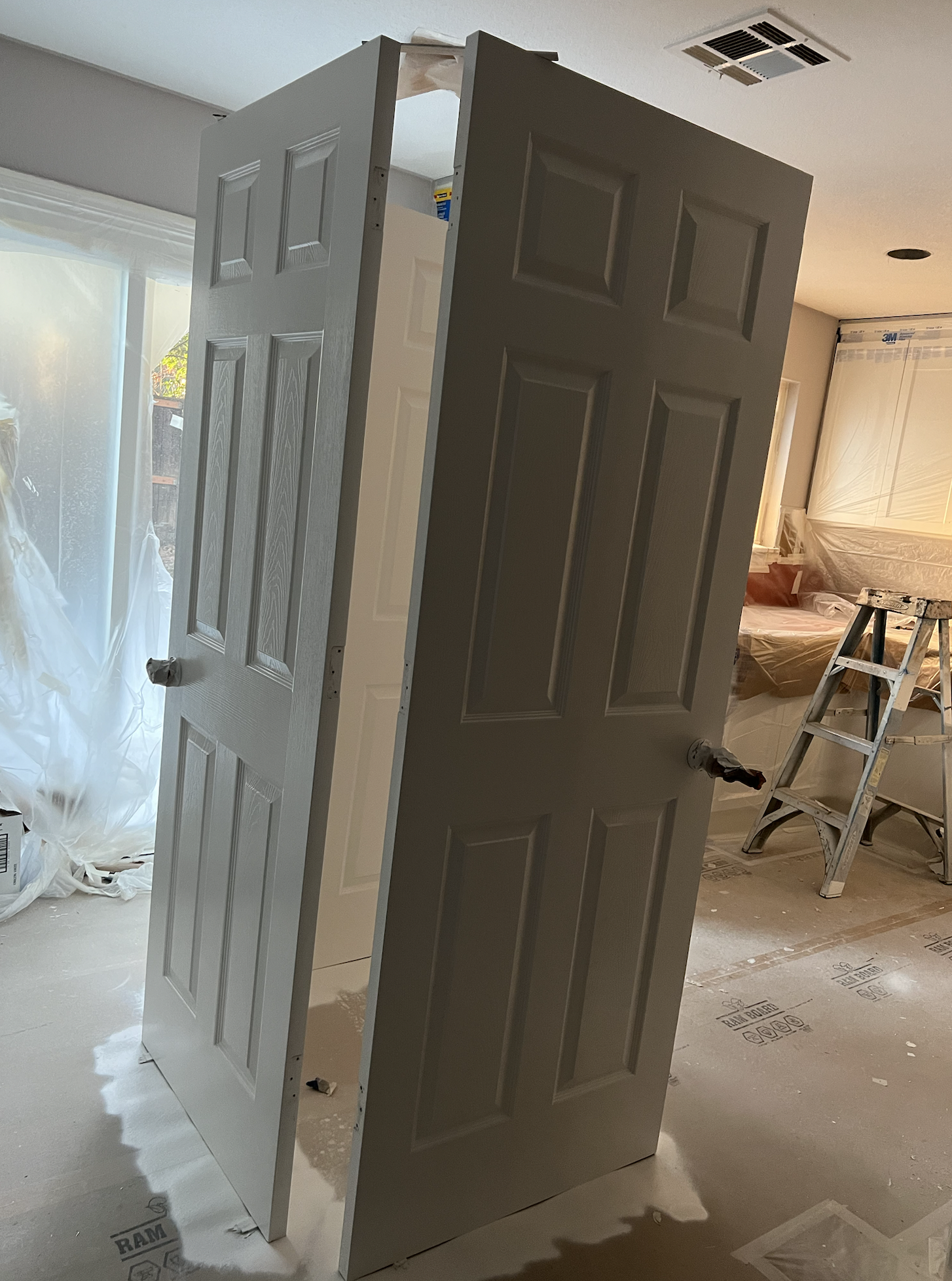
Recently the painters working on the first floor of our home propped our four downstairs doors, at perpendicular angles, to dry after they had been painted. The image looks like something from Dr. WhoMonsters, Inc. introduced children to the concept of magic doors that could transport one anywhere in the world. Discovering in my Facebook memories photo comments from people who are no longer with us – I’m looking at you Merlyn Potters, Roy Meachum, France Kassing, Francisco Alarcón, and John Davenport – I wish I could walk through magic doors to rooms where I could again converse with these old friends.

Because of the work of a team of structural engineers and some amazing local contractors, the doors to our home now open smoothly, and soon we look forward to walking in the door to our remodeled kitchen. As I write these words, the door sculpture created by our painters is being disassembled, and the perfectly painted doors returned to their frames.

At a time when we are all closing and opening metaphorical doors, as happens at the end of each year, I am reminded of a door poem that I wrote when I was the poet laureate of Davis. Back then (as now, I suppose), whenever someone asked me to compose and write a poem for a public event, I would do so, especially if it were an event celebrating alumni donors to scholarships for UC Davis students. Let’s see if “Open Doors” holds up after six years:

Open Doors

Anything that can be imagined is real says the painter,

painting bulls and roses in mid-air, 

but the rest of us appreciate a door.

Sometimes the unprepared student thinks that the door is a wall.

Who shall open the eyes of the student?

Will it be a cup of CoHo coffee, sipped at dawn?  

Will it be a Delta breeze, promising rain?

Will it be a morning bike ride along the Quad?

Will it be an earbud extended riff by Hendrix or Buckethead?

(Like you, Microsoft Word did not recognize Buckethead, but my students do.)

The student needs more than motivation to find the door.

The student must first find that there is a door,

before she can walk through it.

That’s where you come in.

“A very little key will open a very heavy door,” Charles Dickens said,

and in your pockets and purses I hear the jingle of little keys.

“Be an opener of doors,” Ralph Waldo Emerson said,

and in this room I see people who turn handles.

Tonight, in this place, 

are people who wear the boots

that kick doors open.

Tonight, gathered in this room, are Aggies,

and for them we shall open doors.

In my classroom, and in the classrooms you remember,

and in this grand recital hall of a classroom,

students follow Eleanor Roosevelt 

in discovering that they will “do the things 

that they could not do,” for they must.

“In between things known 

and things unknown are the doors.” 

Or so Jim Morrison taught us.

You have opened eyes and hearts as Jim Morrison did.

You have provided courage as Eleanor Roosevelt did.

You have handed over the keys as Charles Dickens did.

You have opened a door, as Emerson did.

Who steps through the door, inspired, resolved,

and ready to grow even further?

An Aggie steps through that door,

representing one hundred 

or one thousand 

or ten thousand other Aggies.

And we know them by their eagerness, 

by their curiosity, by their creativity, by their ingenuity.

We know them by their resolve.

They are grateful; they are legion; 

and they stand together, ready to change our world for the better.

Happy holidays to you and your families. I hope you will consider, at the end of this year and as we approach the beginning of the next, what doors you can kick open for those who would benefit the most from your action and your support.

Dr. Andy


Every week I write a pub quiz for subscribers. If you still have friends on your gift list whom you’d like to impress or delight, I invite you to buy them a yearlong subscription to a weekly Pub Quiz. Thanks to all the players and teams who support this effort every month via Patreon.

Here are three questions from last week’s Pub Quiz:

  1. The Sinai. What country spans the northeast corner of Africa and southwest corner of Asia via a land bridge formed by the Sinai Peninsula?   
  1. Science. What do we call the scientific study of life that existed prior to, and sometimes including, the start of the Holocene epoch?  
  1. Books and Authors. Which British Romantic poet wrote Songs of Innocence and Songs of Experience

P.P.S. In my most recent podcast, I interviewed the poets Beth Suter (the Davisite who has published a new book of poetry) and Andrew Hemmert. Please listen and subscribe to Dr. Andy’s Poetry and Technology Hourwherever you get your podcasts, or find the show at https://poetrytechnology.buzzsprout.com/. On the first and third Thursdays of each month, I host the Poetry Night Reading Series at the John Natsoulas Gallery, 521 1st Street in Davis. Find out more at www.poetryindavis.com (where you can sign up for the mailing list).

Dear Friends of the Pub Quiz,

Most of the poets that I introduce people to when hosting my podcast or my bimonthly reading series write stronger poems than I do, but I have a special poetry talent that most people in the field don’t share: I can write passable poems on the spot.

Most would rightly see this as a questionably useful talent, the way one looks at people who can juggle bananas, braid the stems of sweetbriars, or list the countries of South America in alphabetical order.

I have deployed this talent most often at a Sunday afternoon poetry series that took place at the Davis Arts Center before the pandemic. Hosted by our then Davis poet laureate, the talented, prolific, and genial James Lee Jobe, the series featured poets who I typically knew well because of my advocacy work in the field. Bringing a large hardback journal that was gifted to me decades previously by my actress stepmother, I would compose a draft of a poem while the featured poets read their works, creating a barely-connected series of images, allusions, and associations. Because the varied stanzas strayed in different directions, I would have to prominently number the sections so that when I read these simplified hypertext works out loud, a new and seemingly purposeful order would be presented.

As the featured poets were friends of mine, the speed-poems I presented often became light roasts, opportunities for me to repurpose lines from their performances in such a way that playfully pointed out their patterns of privilege or pretension. Some lines were improvised while I was reading the new poem, sometimes connecting an element of Jobe’s introduction, or the discovered cause of a quizzical look that I was receiving from someone in the audience. Attendees were likely not as impressed by the quality of the poem produced as they were that I had written it since everyone had sat down for that very event.

The paper notebook was crucial for this exercise, for its large pages allowed me to jot notes to myself, ideas for stanzas, and favorite lines of the roasted poet in different margins of different pages, and then bring them all together for the performance. Phone-composing wouldn’t have worked: nobody wants to see Dr. Andy rudely speed-thumbing on his iPhone during a poetry performance. A paper notebook encourages one to be present in the moment, or deep in thought, while a smartphone encourages one to be preoccupied with faraway distractions of texting or, for some, TikTok, rather than enjoying a performance. 

Fast-forward to this past Thursday, and I got to deploy this inessential skill again. As part of The (Sacramento) Crocker Art Museum’s celebration of Festivus, regional poets were being recruited to turn the museum’s members and other attendees’ grievances into poems, written onto paper thought-bubbles about the size of a small plate. Sign me up, I told the Crocker.

As an undergraduate at Boston University, I switched from Psychology to English not only because of the world-class English Department (where I took classes with a future U.S. Poet Laureate, a Future Oxford Professor of Poetry, and a future Nobel Laureate), but because I didn’t want to spend my professional life listening to people air their grumbles and protests. Ironically, fielding complaints was exactly my job description Thursday night, and I can’t imagine enjoying such a job more.

Of course, I loved this experience in part because I got to attend a boisterous party with live music in an art museum. I haven’t attended an event that fun for years, at least not one that I wasn’t also hosting. I felt like I was traveling back to the carefree days of 2019.

I wore a mask because these days are not, in fact, carefree.

And I wrote a bunch of really short poems. Sometimes they started off as tweets, but then I would add some wordplay or affix an image. My talented poet coworkers, Traci Gourdine and Rhony Bhopla, fit more words onto their paper-plate thought bubbles, but I think I powered through more individual poems. Although Gandhi said, “It is the quality of our work which will please God and not the quantity,” my attitude better matched that of the actor Steve Schirripa: “There’s no such thing as quality time; there’s only quantity time.”

The quality of my work is debatable – some of my poetry students might call some of these poems “rushed.” Some examples would prove them right. When one party guest directed me to write a flash-poem about menopause, I came up with this:

The heinous hated heat is on.

At night I stare into the dark unblinking, 

Like the red glare of my clock.

Sometimes I feel the years are waning,

But my friends and I are all gaining.

Where is the pause button?

At least that one included a simile – the perimeter of my circular writing space mercifully “paused” the poem. 

Someone else took a while to explain to me her dislike of soap scum. I asked her the inevitable response question: “Really?” And then I wrote this:

“Soap Scum”

How much soap is too much?

My body is clean,

the marketers tell me,

but now my mind is busy,

much like my tub’s drain,

brimming with soap scum,

vegetable oil and alabaster colorants.

Ask not what soap can clean for you,

but what your whistling Irish Spring I

must shower stall sacrifice

to clean it.

Another lady complained that her FOMO friends check their smartphones too often when out to dinner with her. In my poem, I imagined that her friends were irreligious ketosis fanatics:

First Date

A religious couple on a first date.

Bowed heads over keto grain bowls?

Nope! My naiveté rather than their crudités!

Soon I saw their Bluetooth earbuds, 

Their vulture necks crooked downward,

Immersed in media, rather than prayer,

Sidetracked by TikTok under the table!

Speaking of tweets, I edited that down a bit to fit into a tweet. Although Rhony and Traci and I had posted almost 100 poems on the wall for museum-goers to review, will any of our lines be remembered? A tweet will make even more impressions. With so many of us snappish, social media doom-scrollers expect some complaining.

Happy Festivus!


Every week I write up a 31-question Pub Quiz for subscribers, and I would love to count you among their number. Also, this coming Thursday, December 15th, the birthday of Muriel Rukeyser (1913) and others, I’m hosting a poetry reading with Beth Suter and Bethanie Humphreys.

Thanks, and be well.

Dr. Andy

P.S. Here are three questions from last week’s Pub Quiz:

  1. Pop Culture – Music. Composed in 1852, what English language nursery rhyme and a popular children’s song whose five-word title includes one word appearing three times in a medley on the 1961 Bing Crosby album 101 Gang Songs?  
  1. Sports. Babe Ruth’s first and final games as a Major League Baseball player was for teams in what city?  
  1. Science. Which of the following scientists invented the rubber balloon in 1824: Michael Faraday, Alfred Nobel, Joseph Priestley, Nikola Tesla?  

“Although I know it’s unfair, I reveal myself one mask at a time.” Stephen Dunn

Dear Friends of the Pub Quiz,

I recently taught my last class of the fall quarter, so now that I am spending time with a final stack of submitted essays, I’ve also been thinking about my students and how much I’ve enjoyed their company.

Many of my students believe they are already strong writers when they enroll in my class, so I have them submit their first essay assignment early in the quarter. In most cases, they are startled by the discoveries that I share about their prose and the grade their essays have earned. Then they buckle down and get to work.

The students who visit my Zoom office hours learn the most. Not only do their receive personalized attention – visiting office hours is like taking an essay in to the doctor for a check-up rather than merely watching some educational videos on exercise and nutrition – but in Zoom office hours, we also get to see each other’s faces. The “face-to-face” conversations in a Zoom room remind us that authentic communication entails facial expressions, the sort that at least I took for granted before I started teaching my classes from behind a mask.

Using the sort of theatrical gesticulations that I learned from my actor father, when teaching as a masked man I gesture a lot more and draw bigger diagrams on the whiteboards. The performer in me enjoys telegraphing my lessons. For instance, sometimes in class I make a point to tell students what I’m thinking, using phrases such as “I’m curious about what you just said,” or “You’ve made some smart choices in this paragraph, showing me evidence that you are thoroughly revising your prose.” Sometimes I point out what might once have been obvious: “You are really attending to the needs of your reader.” Before the pandemic, my facial expressions would communicate some of these messages. 

I suppose that, as is the case in our interpersonal relationships, people in a writing class like to hear expressions of praise and admiration, rather than just sense such affirmations through eye contact and smiles. For wisdom on such matters, I turn to a book that I have also given to former students as a wedding present: The Seven Principles for Making Marriage Work, by Dr. John Gottman. Notice how what Gottman says here could apply to teaching writing, as well as love relationships:

“People can change only if they feel that they are basically liked and accepted the way they are. When people feel criticized, disliked, and unappreciated they are unable to change. Instead, they feel under siege and dig in to protect themselves.”

I really admire and appreciate my students, appraisals that I communicate by praising the insights they offer and assertions that they make about topics that matter to them. In my Writing in Fine Arts class, for instance, my students’ first assignment – a multimedia autobiography – gives them a chance to introduce themselves with a few paragraphs of prose, with a photograph that includes their (unmasked) faces, and with a representation of one of their creations so I can unabashedly laud their creative output. I note their imaginative strengths and artistic flair while pointing out that I could not hope to accomplish what they have done in their creative field.

Then I turn to the organization, emphasis, style, and clarity of their prose and gently show them where and how they are missing the mark. I promise to help them eventually match the clarity of their prose to the clarity of their thinking. No matter one’s previous experiences as an academic writer, writing about the arts or about any topic can feel like a struggle to translate one’s inherent wisdom into a language that can be received by a reader.

As one our assigned composition theorists, William Zinsser, says, “Clear thinking becomes clear writing; one can’t exist without the other.” With examples, many of them taken by authors enrolled in the class, I show them how clear thinking functions as the foundation of their essays. If they are majoring in design (and I have more design majors in my Writing in Fine Arts classes than those from any other disciplines), I remind them what data visualization guru Edward Tufte says: “Good design is a lot like clear thinking made visual.” If they are artists, I remind them what the poet W.H. Auden said: “Great art is clear thinking about mixed feelings.” If they are wrestling with loss or confronting social injustices, I present them with a favorite Ernest Holmes quotation: “Healing is the result of clear thinking.” Before the quarter is over, students are workshopping and submitting prose that contains what expository prose expert Maxine Hairston lists as the qualities of successful writing: Substance, clarity, unity, economy, and grammatical correctness. 

Lao Tzu said that “When the student is ready the teacher will appear,” and likely each of us can think of a teacher or professor who appeared at just the right time for us (and allow me to share a shout-out to Will LaymanCarolyn Williams, and Sir Christopher Ricks). Anticipating the sudden and mysterious exit of elderly Obi-Wan Kenobi, Lao Tzu also said that “When the student is truly ready… The teacher will Disappear.” 

I don’t know if my students were ready for me, but it’s with a mix of satisfaction and regret that I will disappear from these students’ lives. I hope they feel prepared to think and write clearly about what excites them to be artists. I will keep an eye open for their publications, art openings, and performances, as well as the day when we can all congregate again without our masks. 


Eighty people came to the most recent poetry reading that I attended. I remember when 80 people could fill the indoor seats at de Vere’s Irish Pub on a Monday night for a Pub Quiz. If you were among that crowd, thanks for participating. Katie Peterson, Director of the MFA in Creative Writing Program at UC Davis, called it “the biggest crowd for a poetry reading, ever.” I appreciated the exaggeration!

Every week I write and publish a Pub Quiz of 30 trivia questions for subscribers on Patreon. Would  you like to join us there, and receive the trivia fruits of all that labor? This week’s quiz includes question on topics raised above, as well as dog breeds, breakfast cereals, U.S. senators, genetics, MCU actors, trotting possums, and other topics you might know something about. If you plan to gather with friends or family this holiday season, I hope you will ask me for a sample so you can host or participate in a form of entertainment that doesn’t involve a screen (unless you are quizzing via Zoom). Or, you could just visit the Patreon page to show your support there. Thanks to all the patrons who make these weekly missives possible.

Be well. Enjoy the rain!

Dr. Andy 

P.S. The aforementioned W. H. Auden described the aforementioned Sir Christopher Ricks as “exactly the kind of critic every poet dreams of finding.” I’m glad I found him!

P.P.S. Here are some questions from last week’s Pub Quiz:

  1. California Culture. The 1938 film The Adventures of Robin Hood was filmed in Bidwell Park. A municipal park, it’s the third largest in California and one of the 25 largest in the US. Name the city.  
  1. Countries of the World. What is the name of the German-speaking microstate located in the Alps between Austria and Switzerland?  
  1. Science. The second largest order of mammals after rodents comprises about 20% of all classified mammal species worldwide, with over 1,400 species. Name this mammal recognizable by most schoolchildren.  
  1. Books and Authors. Published in 1937, what short novel set in California tells the story of George Milton and Lennie Small, two displaced migrant ranch workers? 
  1. Sports. Born with the first name Ferdinand in 1947, what American former professional basketball player played 20 seasons in the National Basketball Association (NBA) for the Milwaukee Bucks and the Los Angeles Lakers?  

Dear Friends of the Pub Quiz,

I rarely watched the TV show MacGyver when I was a kid, but I understood the concept. 

My dad taught us more concepts than skills. His father was entirely conversant in auto repair and maintenance, but grandpa was surprised by how little Oliver and I knew about these topics. I had friends who were Boy Scouts, but for my Quaker dad, the uniforms seemed too military in their appearance. For the same reason, we were not allowed to play with toy guns or Army Men.

But this admirable pacifism came with an opportunity cost. When I wanted to learn about all the blades on a Swiss Army Knife or the many uses of an Erector Set, I turned to friends in the neighborhood. I went camping only on school trips. We cooked food in our kitchen rather than over coals. I watched other people bait hooks rather than doing so myself. Although in the early 1990s I changed a number of flat tires on my 1978 orange four-door Datsun B210, I’ve never rebuilt a carburetor.

I did have other strengths. Growing up, I knew more about Boris Karloff, Gene Kelly, The Magna Carta, and Norse gods than most of my parents’ adult friends. I could recite entire poems by Lewis Carroll and Alfred, Lord Tennyson. I could tell you the titles of all four of Nat King Cole’s #1 singles from the 1940s, and by the time John Lennon was assassinated, I had read more than a dozen books about The Beatles. In conversation or with a drawing pad, I could also helpfully illustrate the salient differences between orcs, goblins, and kobolds. These important bits of information rarely served any purpose in the field.

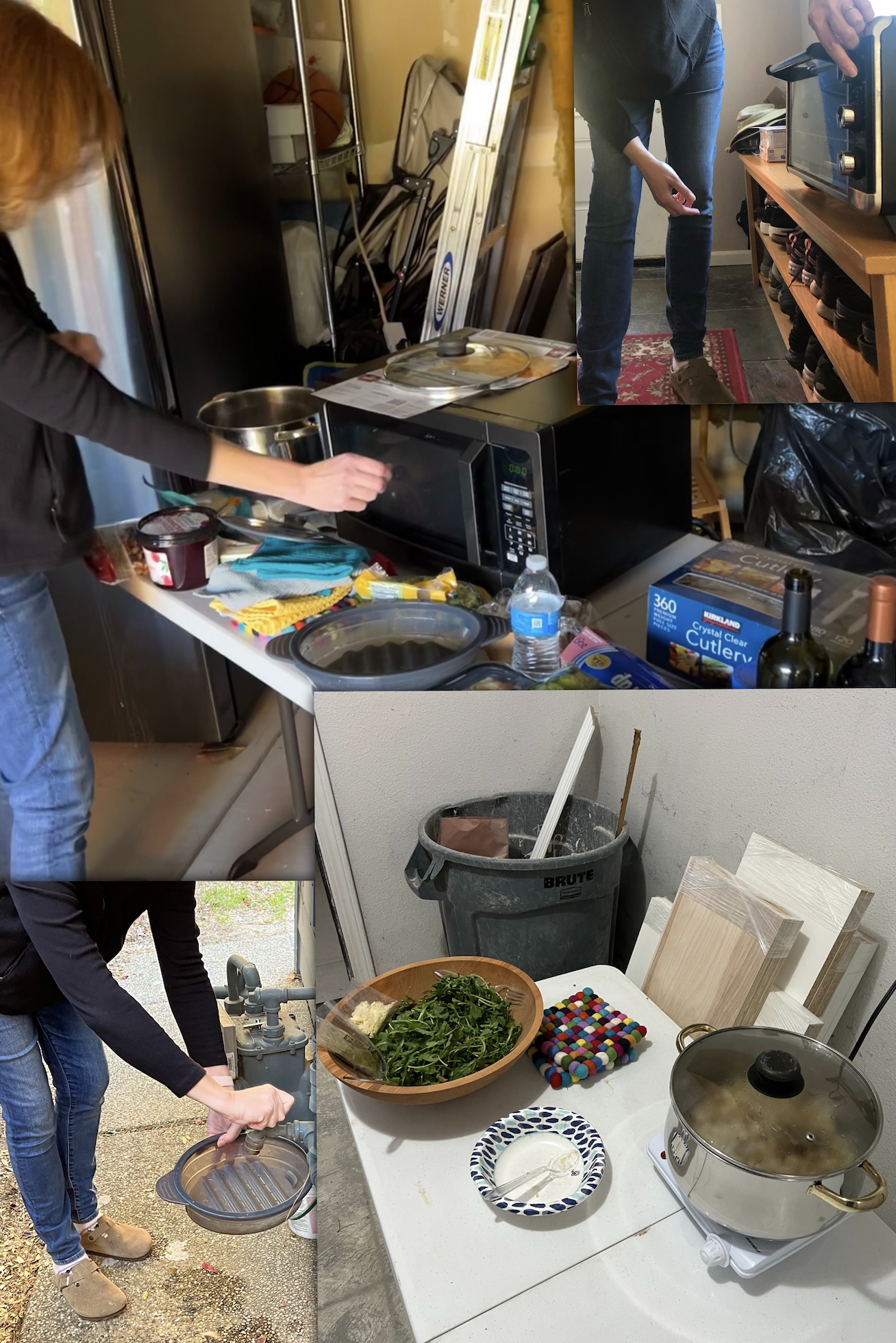
As we fast-forward to the present, the MacGyver of our household is my wife Kate. Because of our first-floor remodel, she has come up with ingenious ways to make do as we continue to live without access to a functioning kitchen or laundry facilities at home. When friends heard that she was planning a full-course Thanksgiving meal without a kitchen, stovetop, or oven, they offered her their sympathies, as well as their kitchens and slow cookers. Kate, however, felt determined to challenge herself to create her traditional feast all on her own, a Thanksgiving we’d always remember. 

Regular readers know that I am working my way through the 684-page biography titled Emerson: The Mind on Fire by Robert D. Richardson Jr., and that self-reliance was one of Ralph Waldo’s favorite topics. In his 1841 essay “Self-Reliance,” Emerson says, “It is easy in the world to live after the world’s opinion; it is easy in solitude to live after our own; but the great man is he who in the midst of the crowd keeps with perfect sweetness the independence of solitude.” A practicing introvert, Kate relished her own company and that of her own ingenuity as she worked with a microwave, a toaster oven, and a hot plate. Because our garage electrical system would not allow any two of these three appliances to be working simultaneously, she used the microwave in the garage, set up the toaster oven in our entryway, and the hot plate on a card table in the empty laundry room.

The challenge – and the joy – of our celebration was heightened when we heard that a friend’s family Thanksgiving was cancelled because of the cook’s Thanksgiving eve broken collarbone, so we invited him and a bottle of his favorite wine (a Cabernet Sauvignon) to join us for the vegetarian feast. Part of the fun of this holiday is the pleasure one takes in the company and the stories of beloveds who don’t already live under the same roof. With my daughter Geneva returning home to enjoy a glass of that wine and the delicious feast, we all got to catch up with each other’s lives in ways that transcend what one can find in a post on a social medium.

And what a feast it was! Sitting outside on an afternoon when it was warmer outside than in, we enjoyed what Kate created in a variety of disassembled and partially-remodeled first floor rooms in our nearly unheatable home. We dined on spinach quiche, steamed veggies, stuffing, cranberries, scalloped potatoes, an arugula salad with lemon basil vinaigrette and chopped almonds, fluffy dinner rolls, and pumpkin pie!

After dinner, some of us watched a movie that my dad the film critic had introduced to Kate during the first Thanksgiving that she and I spent as a married couple. On Thanksgiving Day in 1992 and 2022, Kate and my son Truman, respectively, got to watch for the first time a favorite film about extended families: The Godfather.

All credit for the success of our Thanksgiving goes to our resident culinary MacGyver. I bet that Thursday night Kate felt all the more triumphant because of the challenges she overcame to make us such an ambitious, tasty, and seasonal meal. As George S. Patton said, “Accept the challenges so that you can feel the exhilaration of victory.”

I bet when Patton was a child, he knew the purpose of every blade on a Swiss Army knife.


This year I am deeply thankful to all the friends who support this writing project via Patreon. Most subscribers get a weekly Pub Quiz with questions on a variety of topics, including current events, history, popular culture, technology, books and authors, sports, retirement options, and science.

Of all the supporters on Patreon who make this happen, I’d like especially to thank the Outside Agitators, the Original Vincibles, Potent Potables, and Quizimodo. I’m always grateful to the team captains who pledge for their entire team, and thus sustain this enterprise. 

Enjoy the rest of this holiday weekend.

Best,

Dr. Andy

P.S. Here are three questions from last week’s Pub Quiz:

  1. The U.S. Government. The U.S. Department of Education was founded in what odd-numbered 20th-century decade?   
  1. Science. Starting with the letter M, what branch of biology deals with the study of the form and structure of organisms and their specific structural features?  
  1. Books and Authors. What American wrote the books Breakfast at Tiffany’s and In Cold Blood?  

P.P.S. Please listen and subscribe to Dr. Andy’s Poetry and Technology Hour wherever you get your podcasts, or find the show at https://poetrytechnology.buzzsprout.com/. On the first and third Thursdays of each month, such as this coming Thursday night at 7 with Katie Peterson, I host the Poetry Night Reading Series at the John Natsoulas Gallery, 521 1st Street in Davis. Find out more at www.poetryindavis.com (where you can sign up for the mailing list).

“Poems for me work like flashlights in a cave; they’re a way to explore the dark without dying. Also, because other poets over the years have given me such beauty, to the point of changing my life, I’d like to give something back, if I can.” – Lola Haskins

Dear Friends of the Pub Quiz,

I saw a play (The Lost Claus) Friday evening in which an elf had the worst time understanding his comrades when they used figurative language. He kept a little notebook in which he would jot down aphorisms and euphemisms that his Elfin friends had used over the centuries, trying to keep up, treating figurative language as a second language. Sometimes Santa and the other elves would use more gruesome phrases, such as being “so nervous that they might jump out of their skin,” just to watch him flinch and blanch. Congratulations to Jason Kuykendall for being the heart of this new holiday classic.

As a poet, as a collector of images, juxtapositions, and little fragments of dialogue, Jason’s character of Henry McCallow appealed to me. Like him, I keep a little notebook in the form of an iPhone Google doc in which I collect intrigues and images for future poems, and topics for future newsletters.

Watching the play (which was better written than most original Christmas plays that Kate and I have watched over the last 20 winters of our subscription at the B Street Theatre), I noted that I was enjoying myself immensely. I had just enjoyed dinner with our boys, I had the company of my lovely wife, and we were spending date night watching our favorite merry band of actors attempting a new take on Christmas in 2022.

How does a thoughtful person approach theatre? Insofar as theatre spreads delusion, both Plato and The Buddha were against it. We can read these words by The Buddha in The Talaputa Sutta: “When sentient beings are still not free of delusion, and are still bound by delusion, a dancer in a stage or festival presents them with even more delusory things. And so, being heedless and negligent themselves, they’ve encouraged others to be heedless and negligent. When their body breaks up, after death, they’re reborn in the hell called ‘Laughter.’”

Perhaps a play is a distraction from the mindful and the spiritual, but it might also be called a welcome respite from all the atomizing distractions of modern life. The artist helps us with inconvenient truths and realizations. James Baldwin said, “A society must assume that it is stable, but the artist must know, and he must let us know, that there is nothing stable under heaven.” Life disappoints us, but with the people left who love us, we persevere. As Gwendolyn Brooks says, “You are the beautiful half of a golden hurt.”

Less golden hurts also await us. Take social media, for instance. Elon Musk‘s announcement that he’s welcoming Donald Trump back to Twitter just as Twitter itself is shedding all of its employees, along with its responsibilities and self-regulations, indicates that Musk is welcoming back the well-poisoner in chief, our nation’s most famous and most effective purveyor of misinformation and lies. Peter Ternes, my favorite Detroit communications manager, likened the return of Trump to Twitter as “Pouring crude oil into a stream.” 

Twitter is a former boom town that has gone bust. The World Cup next week, typically one of the busiest times for the social medium, will tax the last remaining overstretched employees, as well as the Twitter’s three main US data centers, one of which, in Sacramento, is scheduled to be shut down as part of Musk’s cost-cutting.

I need to learn to put my phone down more often, and instead to take the hand of a family member and see what they are doing. Marcus Aurelius asks, “Stop whatever you’re doing for a moment and ask yourself: Am I afraid of death because I won’t be able to do this anymore?” We probably never think about that about our Instagram feed.  

For me, attending a play or a poetry reading, or taking a long nature walk that is free of agendas or action items, reminds me the pleasures afforded to our precious human lives. When it comes to social media, we should remember that for every hour that we lose to doom scrolling, we also miss an opportunity to see a play, write a poem, embrace a beloved, or reconnect with our own thoughts through journaling, meditating, or sitting by a favorite nearby body of water.

I wish for you to enjoy all of these during this Thanksgiving week, and that you begin December refreshed and inspired.

Thanks for your continued readership. Would people miss the hints if I were to leave them out this week? I am always seeking to simplify. 

Please subscribe so I can send you the full quiz every week! Here are three questions from last week’s Pub Quiz

  1. Global Warming. In 1979, the Art Deco Historic District was listed on the National Register of Historic Places in the city in the United States that is most immediately threatened by climate-driven sea-level rise and flooding. Name this famous beach city of 83,000 people.   
  1. Pop Culture – Music. The biographer Nicholas Jennings said this about what musician born in 1938: “His name is synonymous with timeless songs about trains and shipwrecks, rivers and highways, lovers and loneliness. He is unquestionably Canada’s greatest songwriter”?  
  1. Sports. What former Chicago Bears football player remains the heaviest player to score a touchdown in the Super Bowl and has the largest Super Bowl ring at size 25?  

Be well,

Dr. Andy