



Dear Friends of the Pub Quiz,

We all lose things. We lose friends, family members, and beloved pets to death. Some friends fade from our lives due to neglect or a falling out. Others just disappear. Some people I know are slowly losing their minds, while others might lose a decade because they weren’t paying attention.

Some people, such as myself, lose our looks, while some of us seem particularly well preserved. For example, the waiter who carded my lovely wife Kate at a Sacramento restaurant recently guessed wrong on her age (that is, too young) by 17 years. This was one of many birthday presents for her that night. Meanwhile, by contrast, someone recently asked me if I had plans to play Santa Claus this year.

I believe the Santa remark concerned my whitening beard, not my girth. If  you are curious, and I feel compelled to share even if you are not, my belt size is holding steady at 32 inches. If I were a mixed martial arts fighter, I would compete in the lightweight division, reserved for scrappers who enter the octagon weighing 70.3 kilograms. Perhaps our not having access to a kitchen this month has caused me to lose some weight.

The daily walking routine helps with this, though I have been losing steam now that the afternoons have grown dark and the air has turned frigid. I’m only averaging about seven miles a day this month of November. What have I got to lose by easing off from my daily quota now that I’ve almost made it to the finish line? Of course, the answer is so much.

Rather than measuring out his life with coffee spoons, or with miles logged, my son Truman has a monthly quota of classic movies viewed. Today my son Truman and I watched the 1948 classic Oscar-winner The Treasure of Sierra Madre, which features characters who gain and lose a great deal, though some of them remain sanguine about the losses. The Spanish spoken in the film by banditosFederales, and Indios was not accompanied by subtitles, so I tried to keep up as best I could, translating poorly in my head. Surely something was lost in the translation.

My parents knew Frances “Scottie” Fitzgerald in Washington DC in the 1960s. I wonder if she felt lost after both her parents died in their 40s. Scottie was a locally famous hostess and a big proponent of the arts. My parents lost touch with her after she moved down to her mom’s home town of Montgomery, Alabama in 1973.

A scene near the end of The Treasure of Sierra Madre reminds me of something Scottie’s dad, F. Scott Fitzgerald, a member of what Gertrude Stein called “The Lost Generation,” wrote in in his 1922 novel The Beautiful and the Damned: “Things are sweeter when they’re lost. I know–because once I wanted something and got it. It was the only thing I ever wanted badly, Dot. And when I got it, it turned to dust in my hands.”

Sometimes we make new friends to make up for all the losses. For instance, yesterday I had lunch with a new friend who speaks five languages. When I asked her three children what the fifth language was – I remembered only Italian, Spanish, French, and English – one of them asserted that it was Chinese. I checked with their dad whom I have known for 45 years, but who I haven’t seen in almost 40, and he corrected them: It’s German. The kids, who moved seamlessly from English to Italian themselves, had lost track of what their impressive mom knew. I bet German is spoken in the house less than the other four languages.

If I wanted to say “I was groping on the floor for a lost contact lens” in German, I would get to use the most delightful 18-letter term for “lost.” Check this out: “Ich tastete auf dem Fußboden nach einer heruntergefallenen Kontaktlinse.” Alphabetically, the first 18-letter word in English is “ABSENTMINDEDNESSES.” Both this word and heruntergefallenen indicate a loss, but I bet only one frequently accompanies a professor. The German translation of “professor” is “der Professor.” I thought I had lost all my German, but evidently I still speak it from time to time.

Whether in the dojo, the octagon, or the chess board, men sometimes prefer to speak the language of competition rather than the language of understanding and negotiation. I used to win online games of chess with my friends Joe and Brad, but now I lose more often than I win. C.S. Lewis once said that, “Like a good chess player, Satan is always trying to maneuver you into a position where you can save your castle only by losing your bishop.” I prefer the virtual company of Joe and Brad to that of Satan, whom I know best from long poems by Dante and Milton. 

Speaking of Bishops, Elizabeth Bishop is one of my favorite American poets. And just as I never got to meet F. Scott Fitzgerald (he died decades before I was born), I can relive his genius through his novels and through the stories I remember my parents telling me when I was a young English major. Likewise, I never got to see Bishop read, but I have learned important lessons about poetry from two of her students, Robert Pinsky and Dana Gioia, two living poets who continue to write and publish important poems.

Bishop’s most-anthologized poem is a villanelle about losing titled “One Art.” It begins this way:

The art of losing isn’t hard to master;

so many things seem filled with the intent

to be lost that their loss is no disaster.

Lose something every day. Accept the fluster

of lost door keys, the hour badly spent.

The art of losing isn’t hard to master.

Then practice losing farther, losing faster:

places, and names, and where it was you meant

to travel. None of these will bring disaster.

You can read the rest of this short Bishop masterpiece online. I myself am aware of losing places – four different apartments in three different cities where I have lived with Kate – and of losing names. For instance, I keep mistaking Owen Wilson, the writer and voice actor who loses races but gains friends as Lightning McQueen, and Wilfred Owen, the solider poet who lost his life in the closing days of World War I.

I assume I am losing faces, too, for people in Davis still “recognize” me or greet me by name even though I don’t always know who they are. My famous but blind father taught me how to deal with this situation: Greet everyone as if they were an old friend. Let kindness compensate for the awkwardness. People forgive quirkiness.

As a film buff, like the grandson he would never meet, and as a film critic, my father likely watched over 10,000 films in his life, many of them in the movie theatre where I worked as a teenager. Almost all of the 30 or so Washington DC theatres where he and I watched films together have been lost – the palaces have been closed. I was with him for the last film he ever saw, watched from his room during my last visit with him not long before he died. That film was Lost in Translation

We might rebrand loss to become more comfortable with it. As an article published last week in the Journal of the American Medical Association tells us, a mindfulness course can be just as effective as medication at helping us deal with anxiety. This is how Dr. Elizabeth Hoge and her co-authors summarized their findings: “In this randomized clinical trial of 276 adults with anxiety disorders, 8-week treatment with mindfulness-based stress reduction was noninferior to escitalopram.” 

From this study, and from this blog entry, I hope you will take my suggestion that we should practice treating people, experiences, and even losses as “noninferior.” I will leave you, but I hope not lose you, with these wise and antidotal words by the Brazilian lyricist who authored The Alchemist, Paulo Coelho:

“Let things go. Release them. Detach yourself from them. Stop turning on your emotional television to watch the same program over and over again, the one that shows how much you suffered from a certain loss: that is only poisoning you, nothing else.”


Thanks for reading that longer-than-usual essay on loss.

Every week I share a Pub Quiz with subscribers who make all of this possible. I would love to include you among their number. Visit and join us at Patreon at whatever level you please. Some people say that joining in person or virtually with other quiz-loving friends keeps them from losing their marbles. Perhaps the same will be true of you.

I hope you get to see this week’s Pub Quiz. Expect questions on topics raised above, and on the following: Japanese companies, independence, hurricanes, lions, people named Zoe, Kings named Henry, discs, election results, the effects of quakes, The Beatles, Asian cultures, favorite journalists, big films from yesteryear, angels, numbers and letters, identified millennia, large rings, ruinous gates, peanuts, people who are lost, astronomy, first cousins, temperatures in Fahrenheit, spheres with sides, great American pairings, Canadians, large appliances, climate changes, shipwrecks, co-ed institutions, things that come from Boston, current events, mottos and slogans, and Shakespeare. 

Aren’t you intrigued? Subscribe!

Yours in letting go,

Dr. Andy

P.S. Find here three questions from last week’s Pub Quiz:

  1. Food and Drink – Blueberries. Blueberry jam is made from blueberries, sugar, water, and fruit WHAT?  
  1. Pop Culture – TelevisionThe Sopranos aired for what even number of seasons?  
  1. Another Music Question. What color is the “note” in the name of the most prolific, influential and respected jazz labels of the mid-20th century?  

P.P.S. Poetry Night happens indoors on Thursday with international flavor. Expect to be entertained by André Naffis-Sahely and Natachi Mez!

P.P.P.S. Also, In my most recent podcast, I interview poet Suzanne Frischkorn and two students from my first-year seminar titled Bravery Studies: Three Poems A Week. Please listen and subscribe to Dr. Andy’s Poetry and Technology Hour wherever you get your podcasts, or find the show at https://poetrytechnology.buzzsprout.com/. As you know, on the first and third Thursdays of each month, I host the Poetry Night Reading Series at the John Natsoulas Gallery, 521 1st Street in Davis. Find out more at www.poetryindavis.com (where you can sign up for the mailing list).
“Poetry is an echo, asking a shadow to dance.” Carl Sandburg

Dear Friends of the Pub Quiz,

I attended a Waldorf elementary school, so my classmates and I were introduced to the natural world before language. As first graders, we held hands on the grounds of the National Cathedral in Washington D.C., sharing rhymes while rotating together in slow circles. We developed wonder in the stories we were told about wild animals who talked to children, and in the mazes and shrubberies of the Bishop’s Garden.

Eventually we were taught equivalencies between nouns and letters. From one of the fairy tales, we drew a green dragon, and then from the “D” of his shape, learned how to draw an upper-case D. We eventually learned to do the same with a snake, with mountains, with the horizontally stretched branches of a tree.

Years later, I was introduced to Ralph Waldo Emerson’s great 1836 book-length essay titled Nature. The chapter on language echoes principles that informed how we were taught at The Washington Waldorf School:

“Every word which is used to express a moral or intellectual fact, if traced to its root, is found to be borrowed from some material appearance. Note: Right means straightwrong means twistedSpirit primarily means windtransgression, the crossing of a linesupercilious, the raising of the eyebrow. We say the heart to express emotion, the head to denote thought; and thought and emotion are words borrowed from sensible things, and now appropriated to spiritual nature. Most of the process by which this transformation is made, is hidden from us in the remote time when language was framed; but the same tendency may be daily observed in children.” 

When it came to my early schooling, I lived in two worlds. At home, I learned to read from The Washington Post, and sometimes I would accompany my journalist dad to the local TV station where the news of the day was presented by anchors who during commercial breaks would ask me how things were going at school. Because my dad reviewed movies soon after the sports stars who would offer learned commentary, in the early 1970s I got to know quarterback Sonny Jurgensen (whose NFL number will be retired this year — he’s now 88!), and Martina Navratilova. 

At school, we trafficked in wonder and magic, rather than the worldly concerns that appeared on Eyewitness News on (then) WTOP or in The Washington Post. Taught to dance, to draw, and to listen patiently to stories and poems, my classmates and I were immersed in a world of play and imagination. Rather than being hurried into a world of symbols, grades, or assessments of any kind, we enjoyed art classes, field trips with naturalists, and a morning and an afternoon recess. When it came to words, we were taught, as Emerson would write, that “All the facts of nature are nouns of the intellect, and make the grammar of the eternal language.”

Although he is 21, my son Jukie still lives in such a world. He understands most of what we say to him, but he lives a life unencumbered by language, preferring instead to grasp the world by beholding a rising moon, or examining in his hand the leaves pruned from a tree he has just visited. Last night, Jukie and I dined at Dos Coyotes, the neighborhood Tex-Mex restaurant named after the two Coyote brothers who founded it. Jukie has stared up at the restaurant’s coyote art since he was a toddler, though these days he will excuse himself from the table to sit in the nearby courtyard until I finish my oversized salad (with extra Brussel’s sprouts that Jukie likes to steal).

Despite our meandering pace along one of the quiet greenbelts of south Davis, our long walk home kept us warm on this chilly evening. I was holding Jukie’s hand as I have done for more than 20 years of such walks, and Jukie was yodeling as he does, amusing himself with sounds that a kindly woman on a restaurant patio recently said sounded like an opera singer warming up. 

As I was reflecting on Emerson’s assertion that “Particular natural facts are symbols of particular spiritual facts,” I began to hear multiple distant replies to Jukie’s plaintive song. From across the fields far to the south of Putah Creek, reminding me that the story-time magic of my childhood lessons can still be available if we make room for it, we could hear that Jukie’s yodels were being answered by the howls of actual coyotes.


Every week I create a trivia contest for subscribers, and I would love to share it with you. If you would like to consider subscribing, drop me a line so I can send you this week’s quiz! In it you will find questions about the following: I hope you get to see this week’s Pub Quiz. Expect questions on topics raised above, and on the following: promises of a better life, incessant emails, attempts to save daylight, MSNBC hosts, leeches, fools and wise men, mavericks, branches of biology, cabinet secretaries, Anglo-Saxon cemeteries, empires, rhythm, gay icons, places that start with a particular letter, the Persian Gulf, people not known for their poor mercy, synesthesia and music, gangsters, blueberry jams, trail time with horses, field goals, living musicians, highways, people who are liked, current events, mottos and slogans, and Shakespeare.

Thanks to all the supporters on Patreon who make all this happen, especially the Outside Agitators, the Original Vincibles, Potent Potables, and Quizimodo. I’m always grateful to the team captains who pledge for their entire team, and thus sustain this enterprise. Please subscribe so you can share the fun of the Pub Quiz with your friends and neighbors!

Poetry Night returns on November 17. I think we will have to move it inside. Mask up and join us! Also, please consider subscribing to my podcast.

Be well.

Dr. Andy

P.S. Here are six questions from last week’s Pub Quiz:

  1. Newspaper Headlines. About how many billions did Elon Musk pay for Twitter?  
  2. California Cities. What California city was recently listed among most “breathtaking” vacation spots in the world by National Geographic?  
  3. Halloween Movies. The most famous scenes of the film Hocus Pocus were filmed in what city?  
  4. Pop Culture – Music. In 1948, Music Digest estimated that one man’s recordings filled more than half of the 80,000 weekly hours allocated to recorded radio music in America. Name the singer.  
  5. Sports. On October 31st in what year ending in a zero did the Big Cat, Earl Lloyd, becomes the first African-American to play a game in the NBA, scoring 6 points on debut for the Washington Capitols?  
  6. Science. In biology, what T word do we use for the cellular organizational level between cells and a complete organ?  

Dear Friends of the Pub Quiz,

It’s Halloween, and our house seems to be haunted.

In Davis, a seller is not required to reveal if the home in question has been subject to any paranormal activity, and our home, bought the year my father died in 2004, has been free of spooks, as far as I know.

But this week, as these stories sometimes go, workmen were doing some work in the house, some digging. We didn’t expect them to turn up anything unusual, but we did expect them to scare up a bunch of dust, so we asked them to cover our living room and dining room furniture with plastic sheets.

The translucent material is so light that every time we open the front door, which itself is at best a semi-permeable membrane protecting our home, the resulting breeze causes all the sheets to flutter like ghosts whose haunted home is being disturbed by unwelcome visitors.

With all the color in our living room muted by these seemingly-animated plastic covers, I was reminded of a favorite Wallace Stevens poem:

Disillusionment of Ten O’Clock

The houses are haunted  

By white night-gowns.  

None are green,

Or purple with green rings,  

Or green with yellow rings,  

Or yellow with blue rings.  

None of them are strange,  

With socks of lace

And beaded ceintures.

People are not going

To dream of baboons and periwinkles.  

This town of monochromatic houses is interrupted at the end of the poem by “an old sailor, / Drunk and asleep in his boots” who “Catches tigers / In red weather.” One hopes that the sailor’s colorful dream could exorcise (or dis-illusion) the town of its unimaginative listlessness, and its ghostly people who seem like nothing more than “white night-gowns.” 

Meanwhile, back at our house, as the kitchen remodel has only just begun, so much has been moved into the garage. This chilly new home to our refrigerator and microwave, our makeshift kitchen, is also home to my boxes of books and old letters from friends, some of whom haunt my dreams with unfulfillable promises of reunions. 

In the garage we have letters from my dad, who sometimes also sent postcards of Dali paintings and Buster Keaton portraits; letters from my best friend Tito, who filled me in on his time working as a pilot in Alaska; letters from my Boston University dorm-mate Kevin, arranging one of his many visits to our homes in Sacramento and Davis; letters from our DC neighbor Beverly Price, who encouraged me to get started early on my dissertation; and letters from John Davenport, who used to tell me stories of his work as a DC cab driver to afford himself time to work on his novel. 

You can imagine how much I appreciate that all these beloved people flew to Chicago to attend our wedding 30 years ago this month, Tito in his own plane. All of them died before our 20th anniversary. Some of the deaths might have been expected, but some continue to shock us in their suddenness. Beverly was 40 years older than me. Tito, eight days. 

Meanwhile, the temporary cellophane ghosts keep waving to us as we come and go in our haunted house, making us remember all the people they stand in for on this Halloween.


This week’s Pub Quiz asks some questions about Halloween. I hope you get to see this week’s ghastly Pub Quiz. Expect questions on topics raised above, and on the following: French phrases, buyer’s remorse, the European Union, Jamie Lee Curtis, mortal murders, Major League Baseball, fundraising Jokers, biological color palates, people who seem to be named after elves, Christmas composers, Box Office Mojo, pumpkins and other seasonal vegetables, states that start with the letter I, literary expanded diet possibilities, countries I have never visited, Andrew Marvel, sicknesses and health, first ladies, scary movies, cellular organizations, Washington Capitols, Music Digest, California cities, current events, mottos and slogans, and Shakespeare.

Thanks to all the supporters on Patreon who make all this happen, especially the Outside Agitators, the Original Vincibles, Potent Potables, and Quizimodo, the members of which I got to visit with last week as Quizmaster. I’m always grateful to the team captains who pledge for their entire team, and thus sustain this enterprise. Please subscribe so you can share the fun of the Pub Quiz with your friends and neighbors!

Be well.

Dr. Andy 

P.S. Here are three questions from last week’s Pub Quiz:

  1. Books and Authors. What mononymic French author is best known in the English-speaking world for her 1944 novella Gigi?  
  1. Sports. What is the only California MLB team not to have won a World Series?  
  1. Shakespeare. The Shakespeare co-written play The Two Noble Kinsmen is based on a knight’s tale by what “Father of British Literature”? 

P.P.S. Did you know that you can register your interest in attending this coming Thursday’s Poetry Night via Facebook?

Dear Friends of the Pub Quiz,

The question at the after party Thursday night was this: “What drew 100 people to Poetry Night tonight?”

Many theories were batted about. One was that Margaret Ronda, a much-loved English Department faculty member with family ties to the community, gives only occasional poetry readings, and her friends wanted to support her.

Another is that one of my colleagues brought an entire class of students to the reading, and even a small graduate class can make a poetry reading look crowded.

Another is the well-designed fliers that I posted in the English Department. Another is the graduate student instructors who have been telling their creative writing classes that the Poetry Night open mic is a place they can try out their new poems.

Another is that the event was advertised in the Facebook group Events in Davis, which I created about five years ago to publicize Poetry Night and the pub quiz. While the Poetry in Davis group (which is about 15 years old) has now topped a thousand members, the Events group now has more than five thousand, or about 15% of the population of Davis.

Ernest Hemingway wrote a famous line in The Sun Also Rises that has informed how we understand economic downturns: “How did you go bankrupt?” Bill asked. “Two ways,” Mike said. “Gradually, then suddenly.” 

I think that’s how our Poetry Night audience grew. Gradually, over the last 15 years, and then, Thursday night, all at once.


The Poetry Night reading series now meets on the actual rooftop of the John Natsoulas Gallery, in a sculpture garden that offers some of the best views of the city. We enjoy the last wisps of sunset while starting to set up at 6:30, with the local director, actor, and musician Timothy Nutter providing top-rate sound equipment and enough theatrical lighting to impress upon people that they would get to see a “show.”

We had chairs set up for about 50, and it looked at 6:55 that that would be sufficient, but then more and more people emerged from the five-floor staircase or the lugubrious elevator. Some of them agreed to help my event producer Kat fetch more chairs, with more people and more chairs emerging as I began my introductions.

Our opener, Augusta Funk, and our headliner, Margaret Ronda, delighted the polite crowd. Atypically, people sat silently after each poem – so many people were attending for the first time that they didn’t know that crowds typically make noises in between the performances, even if only light applause.

I had fun introducing our opening poet, who I had talked to the day before on my radio show, now also a podcast (to which you should subscribe!). Recalling my time listening to funk songs on Washington DC radio stations when I was a youth, I quoted a favorite Parliament song: “We want the Funk. Give us the Funk,” and then brought on Augusta Funk.

I have known our second poet, Margaret Ronda, for years, so I was looking forward to her performance. Ronda wrote a bunch of epistolary poems during the pandemic, poems addressed to people she knows, people she knew, and admired poets from generations before, such as the Romantic poet John Clare. Each poem was titled “Dear Friend,” and each one compelled me to buy the book where they will eventually be published.

Perhaps people familiar with Ronda’s new project knew that Poetry Night would be their opportunity to hear her new work, and that is why 100 of them recently packed the roof of the John Natsoulas Gallery, to enjoy an evening of poetry under the stars.


I hope you get to see this week’s Pub Quiz. Expect questions on topics raised above, and on the following: medications, celebrity holders of Guinness records, The Marx Brothers, knights, baseball teams, people who overdo it, French people, cows, pigments, obscure airlines, new countries, board games, world-builders, people with alliterative names, directors, Marvel movies, entities named Karen, goliaths, impossible missions, different sized workouts, British bands, long American rivers, periods in history, unexpected memoirists, soul musicians, populous cities, ghosts, Republicans, consoles, solutions, current events, mottos and slogans, and Shakespeare.

Thanks to all the supporters on Patreon who make all this happen, especially the Outside Agitators, the Original Vincibles, Potent Potables, and Quizimodo. I’m always grateful to the team captains who pledge for their entire team, and thus sustain this enterprise. Please subscribe so you can share the fun of the Pub Quiz with your friends and neighbors!

Be well.

Dr. Andy

P.S. Here are three questions from last week’s Pub Quiz:

  1. Halloween Preparations. In the films Hocus Pocus and Hocus Pocus 2, the three main witches were played by Bette Midler and two other actresses. Name one of those two.  
  1. Sports. The jazz standard “Sweet Georgia Brown” eventually became the theme song of what sports team?  
  1. Science. In the world of medicine, what S-word do we use for a tubular support placed temporarily inside a blood vessel, canal, or duct to aid healing or relieve an obstruction?  

P.P.S. Our next Poetry Night, featuring Joshua McKinney and Matthew Chronister, takes place on November 3rd, the day before my wife Kate’s birthday!

Dear Friends of the Pub Quiz,

I think my favorite line from Virgil’s Aeneid appealed to me originally because of the misinterpreted image of a succulent disco:

Non ignara mali miseris succurrere disco.

Robert Fitzgerald translates that as “Through pain I’ve learned to comfort suffering men.”

As we are celebrating the famously agrarian poet Virgil this weekend (his birthday is October 15), I’ve been thinking about the ethos of care that underscores this line of poetry. Many of us who are not Classics scholars remember Virgil as being the helper and guide who meets and supports Dante in the first canto of Dante’s Inferno.

Speaking of needed support, our weekend started with my wife Kate supporting a family in Romania (a country that the Romans first “visited” during Virgil’s lifetime) who needed her particular knowledge and experience. Kate is the Director of Communications and Family Support for the Smith-Lemli-Opitz (SLO) Foundation, so parents turn to her when they need SLO questions answered. Often they reach out to her upon first learning of the rare syndrome and about the varied challenges that will likely await their families.

One particular mom wrote to Kate with heartfelt and heartbreaking questions about her daughter: “What could I do for my girl being still at a young age? To help her in time?” These are the questions all parents of newborns with Smith-Lemli-Opitz Syndrome ask. Later in the conversation she channeled all such parents when she said, “I want her not be very affected. I want to help her as much as I can.”


I got to attend TASTE Saturday night, a celebration of local food and drink that raised funds for the Student Farm, a place set aside at UC Davis “where students can learn, practice, and model an ecologically, socially, and economically sustainable agriculture and food system.” At TASTE I encountered university colleagues, friends from the community, and friends that I first got to know at the live Pub Quiz that I used to host in town.

I visited tables offering samples from some favorite food groups (vegan salads, rich chocolate bars, and Davis Food Co-op cheeses), as well as some popular liquids, including wine, beer, cider, almond milk (?), and tea. Pushing the tea and tea culture was my multidecade friend Katharine Burnett, also the chair of the Art History Program at UC Davis. I had previously interviewed Katharine at the Summer Institute on Teaching and Technology that I host, as well as on my radio show (now also a podcast) to discuss her Global Tea Initiative. Tea is a multi-billion dollar industry, I remember us discussing. She hopes that UC Davis can do for tea in California what our Viticulture and Enology Department has done to support the wine industry.

Seeing that Katharine and her cozy tea friends had just started to pack up their two tables’ worth of porcelain displays, tea samples, and Madeleine cookies as the TASTE event had ended, I offered to help them move their stuff to their vehicle(s). Perhaps daunted by the many jugs of undrunk water that had been set aside to make tea that evening, Katharine took me up on my offer, and I got to catch up with an old friend while we walked back and forth to her car with all her bins and boxes.

After each of the passenger seats and the entire trunk of her undersized car was filled, Katharine repeated my name in thanks, almost the way that Dante does when thanking Virgil in Canto 30 of Purgatorio, just before Beatrice takes over as Dante’s guide.


Speaking of Italian culture, after TASTE I told an Italian-born French friend of mine that I was ready to Zoom with her to discuss her application for a faculty position, due at midnight that evening. I work with second-language writers every week in my writing classes, but rarely do I get to wrestle with sophisticated literary analysis concepts that have been translated from my second language, French, into my native language.

Pouring over a shared Google doc that would be soon reviewed by a hiring committee at one of California’s most prestigious universities, my Francophone literature expert and I discussed the wording of key phrases and the relative merits of different theoretical approaches to multilingual literary study. At the end, we both agreed that the word “exotic” should be spelled the French way: “exotique.” I felt bad “correcting” that term on her final draft.

Like Virgil, and like Kate, I was reminded on Saturday of the many rewards of “comforting suffering men,” or, in this case, women who were suffering through some task or another. Kate and I probably benefitted the most from our good deeds, from our lessening of others’ burdens. As the Dalai Lama says, “The more we take the welfare of others to heart and work for their benefit, the more benefit we derive for ourselves. This is a fact that we can see.”

I hope you get to support a friend or stranger this week!

Dr. Andy


I also I hope you get to see this week’s Pub Quiz. Expect questions on topics raised above, and on the following: chickens, baby names, bears, soccer, layoffs, wizards, canines, inventors, capital cities that  you may never have heard of, art history, men who wear black, elegies, fast cars, zombies, mournful tunes, busses, chromosomes, Jupiter and other planets, flowers, lush generosities, psychologists, energy bills, small-time villains, hoaxes, jazz standards, games of chess, hotels, sequels, fictional high schools, headphones, social media trails, witches, current events, mottos and slogans, and Shakespeare.

I send significant thanks to all the supporters on Patreon who make all this happen, especially the Outside Agitators, the Original Vincibles, and Quizimodo. I’m always grateful to players who pledge for their entire team. Please subscribe so you can share the fun of the Pub Quiz with your friends and neighbors!

P.S. October 20th means another poetry reading is coming to the Natsoulas Gallery, this time featuring UC Davis English Department professor Margaret Ronda. See you then at 7!

P.P.S. Here are three questions from last week’s Pub Quiz:

  1. Films Directed by David Lynch. Four David Lynch films have place names in their titles. Name one of them. 
  1. Sports. How many baseball teams are there in Major League Baseball?  
  1. Science: Italian Physicists. What Chevy was named after an electrical unit that was named after an Italian physicist?     

Dear Friends of the Pub Quiz,

The only litmus test I have for candidates for friendship is kindness.

I have friends who vote Republican, friends who hunt, friends who smoke, friends who support different Davis City Council candidates than I do (for example, I would vote for Gloria Partida if I lived in her district). Some friends support rival sports teams of those that I supported in my youth. 

As an aside, I wonder if the Sacramento Kings feel, as I do, that they have no rivals because none of the other teams are competing with Sacramento’s spot in the rankings. Perhaps the Kings agree with musician Roger Waters who said, “I’m in competition with myself and I’m losing.”

OK, back to my friends. I have friends who have neglected to invite me to parties, friends who have ghosted me, and even a friend who once jokingly responded to my instructional design faculty forum invitations with a plea to “please stop meddling in my classes.” Actually, none of that sounds particularly kind, but I am a forgiving sort.

Sometimes there are schisms in academic departments or in other units on campus. When this happens, I’m typically seen as friendly to people in all the factions. I like theatre, but I’m not drawn to drama.

Even the Sacramento poetry scene has endured a split. People’s terms on boards were ended without ceremony. Hard feelings were expressed. Old friendships dissolved. Some of us on the outside wondered if there are enough poetry-lovers to support two competing Sacramento poetry scene offshoots. Luckily the region has enough talent to draw audiences even during the ongoing feud.

Sometimes chess pieces stand in for arguments among friends. Every day I play remote games of chess with poets whom I deeply respect. One of them I have missed every day since he moved to North Carolina about 20 years ago. Before he moved away, we used to play chess OTB (over the board) at the Weatherstone Caféin Boulevard Park. The other, a cancer survivor, impresses me with the quality of his poetic works and performances – he will be reading from his new book in my poetry series in January. 

I know some women who meet regularly for lunch to catch up with each other’s lives and to offer mutual support. Sometimes men get together to compete with each other in sporting events, the way that my Sacramento professor friend and I do over the chess board. Each new war across the board (via Chess.com – here’s my profile — rather than OTB) strengthens our friendship.

Sometimes the conflicts are closer to home. We all might remember when Dr. Peter Venkman warned a fictional Mayor of New York City that releasing captured ghosts into the city will lead to “Human sacrifice, dogs and cats living together… MASS HYSTERIA!” Well, this morning I tried out my diplomatic powers on helping a dog and a cat get along.

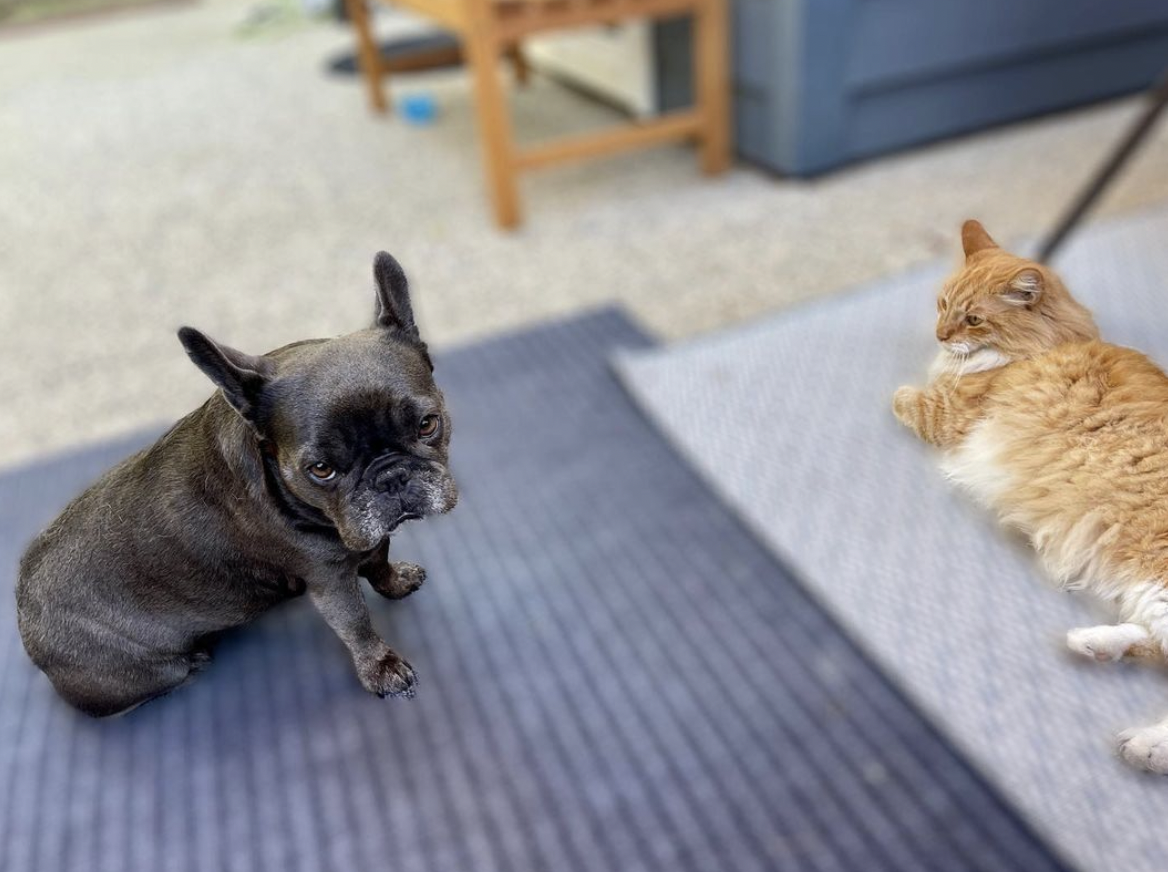
Almost every day this year, Charlie the neighborhood orange tabby cat has spent a few hours on our property – mostly lounging in our back yard where he can find fresh water, shade, and a trampoline. Our French bulldog, Margot, initially chased him out of her territory, but soon Charlie figured out that Margot treats cats the way she treats members of our household – with harmless playful exuberance. 

This morning the two animals engaged in what child development experts call “parallel play.” Each reveled in the physical attention they received from me, and each did a relatively good job of not aggressively sniffing or smacking the other.

Reflecting on conflicts in the world, our country, and our city, I conclude that if these two species of beast can co-exist, then surely we can find a way to spend some social time with people who differ from us in almost every way, except for in their need for eye contact, compassionate connection and, we someday hope, an indoor drink together.

Be well.

Dr. Andy


I hope you get to see this week’s Pub Quiz. Expect questions on topics raised above, and on the following: questions of milk, flawlessness, places that are emptying, hosts, California agriculture, thieves, Yeezy, provincial lives and ivies, woody stems, short titles, the Sea of Japan, momentous months, notable books, rivers, numbers that end in zero, boy scouts (exemplified by Keith David Watenpaugh, whose birthday is today), place names, libraries, trigger warnings, burial chambers, unusual words that almost rhyme, nomad poets, thin flakes, stage names, unusual job duties, marine biologists, groups of competitors, fencing with neighbors, current events, mottos and slogans, and Shakespeare.

Thanks to all the supporters on Patreon who make all this happen, especially the Outside Agitators, the Original Vincibles, and Quizimodo. I’m always grateful to players who pledge for their entire team. Please subscribe so you can share the fun of the Pub Quiz with your friends and neighbors!

P.S. Here are three questions from last week’s quiz:

  1. Film. Set in a small Sicilian town, what film that centers on the friendship between a young boy and an aging film projectionist revitalized the Italian film industry in 1988? 
  1. Countries of the World. Sharing Lake Victoria with Kenya and Tanzania, what landlocked country in east Africa has been named the likely fastest-growing African economy of the coming decade?  
  1. Sylvester Stallone. Against his wishes, which of Stallone’s movie characters was made into both action figures and an animated TV show for children: Rocky Balboa, Judge Dredd, John Rambo, or Barney Ross from The Expendables?  

P.P.S. Tonight I will speak briefly at Stories on Stage, Davis. Thursday I host another outdoor poetry reading. It would be fun to see you at one of these events.

Dear Friends of the Pub Quiz,

Sometimes I don my Ph.D. in poetry hat, grab an anthology, and stand ready to profess about topics cultural and poetical. That said, on the weekend I’m not typically spending social time with people who are demanding my literary insights and interpretations. So I will try a few out on you.

In honor of the 100th anniversary of T.S. Eliot’s The Waste Land, one of the subjects of my doctoral dissertation, I’ve been rereading “The Love Song of J. Alfred Prufrock,” the best of Eliot’s early poems, and reliving its sublimity and explorations of anxiety.

To look at this favorite work after all these years, I had to engage in what the Russian formalist critic Victor Shklovsky called “Defamiliarization,” an attempt to see something one knows well outside the familiar context, which for me includes teaching the poem in a dozen or more classes over the last 32 years. Like many teenagers, I was introduced to Eliot’s first major poem in high school, and I remember sympathizing with the title character immediately. Few other writers I had encountered could so fittingly represent the awkwardness and discomfort teenagers such as myself felt when interacting with opposite sex peers.  

For example, when J. Alfred Prufrock imagines a young woman surveying him and saying “That is not it at all,” he echoes the fears of rejection and general apprehensions of many adolescents, this despite the seemingly sophisticated veil of urbanity that the speaker of this poem employs to protect himself from what Prufrock interprets as the poem’s frightening aggressors, women who use social customs to manipulate others. Prufrock seemed urbane for me when I first read his work, though I doubt I even knew what “urbane” meant back then. I just knew that I enjoyed the music of his poetry:

And would it have been worth it, after all,

Would it have been worth while,

After the sunsets and the dooryards and the sprinkled streets,

After the novels, after the teacups, after the skirts that trail along the floor—

And this, and so much more?—

It is impossible to say just what I mean!

But as if a magic lantern threw the nerves in patterns on a screen:

Would it have been worth while

If one, settling a pillow or throwing off a shawl,

And turning toward the window, should say:

               “That is not it at all,

               That is not what I meant, at all.”

While the poetry itself is magical to me, rereading Prufrock’s thoughts in the context of one’s original discovery of the poem is much like reading the diary from years one would sooner forget. Speaking from a place of barely-concealed insecurity, Prufrock speaks to a common need to mistrust the already provided answers and expectations–about religion, about human relations, about the universe–while being forced to cope with more immediate and less grand crises, social gatherings, meaningless chitchat, and tea-time menu choices.  

Many of Prufrock’s social anxieties, when looked at individually, seem typical of a man who is rooted in the customs of interacting with and thinking about women that we associate with the Victorian age. Yet, when looked at as a whole, the patterns of anxiety in “The Love Song of J. Alfred Prufrock” do not merely reveal the study of a historically dated persona; rather they portray a man who, as I was when I studied this poem as a high school student, seems flustered and confounded by the women about him. Prufrock’s frustration and confusion regarding the poem’s women is so complete that I believed his anxiety transcends merely Victorian-era shyness. 

My youthful reflections on unstable poetic narrators such as Prufrock not only informed my eventual dissertation, but they also helped me make sense of my own literary, creative, and even social obstacles and goals. Rereading the poem today is like opening an emotional time capsule, a historic cache of goods that reflects my own early attempts at intellectual interpretation and artistic awakening.

I’m curious to know what works of literature, music, or art spark similar aesthetic nostalgia for you.

Thanks to everyone who subscribes to the Pub Quiz. I hope you get to see it this week – it’s challenging in a crafty way. Expect questions on topics raised above, and on the following:  places to get equipment, Davis schools, elephants outside the room, flip-flops, challenging approaches to hockey, an uncle’s court, Asian countries, people named Max, animated TV shows for children, sunlight, fast-growing economies, inside and outside of walls, film projectors, magic words, days of the week, Christian traditions, woeful names, penitent jellies, music festivals, sandwiches, straps, modesty, bowling, 19th-century creations, leaves, warships, shoes, Greek and Roman gods, mottos and slogans, news of the world, and Shakespeare. 

Thanks to all the supporters on Patreon who make all this happen, especially the Outside Agitators, the Original Vincibles, and Quizimodo. I’m always grateful to players who pledge for their entire team. Please subscribe so you can share the fun of the Pub Quiz with your friends and competitors!

I’m hosting three Thursday-night poetry readings this month. I invite you to join us for one or more of them. Find details at PoetryinDavis.com.

Best,

Dr. Andy

P.S. Here are three questions from last week’s Pub Quiz:

  1. Know Your American Rivers. Starting with the letter S, and at 444 miles long, what is the longest river on the East Coast of the United States? 
  1. Etymological Confluences. What language was named after a beverage that was named after an island? 
  1. Science. Lipase and amylase are both examples of what E word? 

P.S. I received the sweetest note from a new reader named Judy in response to last week’s Star Wars-focused newsletter, a version of which also appeared this weekend in The Davis Enterprise:

Andy,

Your article in the Davis Enterprise brought back some fond memories. When Star Wars came out, we were visiting my sister-in-law took us to the Grauman’s Chinese Theatre to see it because she knew we were all sci-fi nerds. What we saw was a line from the box office to around the corner. We went home and saw it in our hometown theater in Michigan. When the giant spaceship rumbled across the screen, I fell in love with the movie. So did my husband, my daughter age 9, and son age 7. 

The kids’ favorite story involves the second movie. When the Empire Strikes Back  came to town in 1980, the first showing was at 3 p.m. on Friday. The only problem was the kids didn’t get out of school until 3:30. So I wrote a note that said I would be picking up both my kids at 2:30 because they had appointments. We were some of the first people in line and enjoyed watching the show while munching on popcorn and candy bars. It was a worthwhile “appointment.”

May the Force be with you,

Judy

Dear Friends of the Pub Quiz,

My friend Bob says that Star Wars has replaced the western in cinematic culture, and I suppose he’s right.

Bob and I have been using the video walkie-talkie (as we call it) iPhone application Marco Polo to stay in touch, conversing about deep and quotidian subjects just as we did when we first met as freshman-year roommates, and then again as we drove across the country during the summer before our junior year, each of us eager to visit California for the first time after reading Kerouac and giving into our automobile wanderlust.

As a communication tool, Marco Polo offers certain advantages, such as the understanding that you won’t catch your friend at a bad time – he will decide when to watch your video – and the understanding that you won’t be interrupted. One downside that I am used to from 22 years on the radio is that you won’t hear your audience laughing at your jokes. I guess I sometimes also experience that sort of silence in the classroom.

Recently I made a Star Wars allusion to Bob in a Marco Polo video, and Bob responded with a series of exclamations and anecdotes about his own love of everything Star Wars. For example, Bob saw the first Star Wars movie when he was about ten years old in 1977, and then when George Lucas re-released A New Hope20 years later in 1997, Bob got to take his younger brother, who was then also ten years old, to see Star Warsin the theater and experience through the young man’s eyes the magic that so informed Bob’s childhood. Bob’s brother complained that they had to wait two weeks before the sequel would be released. Bob explained that the rest of us had to wait three years for The Empire Strikes Back.

In response, I told Bob that I had three Star Wars stories (one for each of the first three films) to offer him in a subsequent Polo. Even though Bob and his lovely wife Susi are two of my most devoted newsletter readers in New Hampshire, I will represent the stories here even before I get to them in Polo form. I present them in reverse chronological order and reversed order of importance (at least to me).

In 1983, when Return of the Jedi came out, I had two summer jobs: I was working as an usher at the Tenley Circle movie theatre, and I was still babysitting a young man named Micah (now Mical). Micah’s mom Miraa, a Rolfer, was highly protective of the sort of content her seven-year-old son saw at the movies, but she approved of the latest Star Wars film, so the young man and I saw that film together at least a half-dozen times. And because of my movie theatre connections, the tickets were always free. We had to pay for our own popcorn.

As an aside, I haven’t spoken to Mical since the mid-1980s, and, prompted by this reminiscing, I just looked him up and now have a phone number. Mical may even live in California! Perhaps I will update you in a future newsletter on the resulting phone call if anything comes of it.

So that covers Jedi. My Empire Strikes Back story (which I have previously shared in this forum) was more momentous and more memorable. Because my father, Davey Marlin-Jones, was the film and theatre critic for the local CBS affiliate in Washington DC, he was invited to openings, screenings, and gala events of all sorts. He was still seen on TV several nights a week at the time that that The Empire Strikes Back had its U.S. premiere (May 17th, 1980) at the Kennedy Center in Washington, D.C. Of course my dad was invited, and he brought his two sons along. Now that I think of it, he probably attended primarily for his sons, and to catch up with a friend from his days as the Artistic Director at the Washington Theatre Club.

As soon as we arrived, Oliver and I saw an opportunity. Each of us grabbed a Star Wars paper plate from the buffet and proceeded to pester all the celebrities attending that event for autographs. Minus Sir Alec Guinness and Anthony Daniels, who was sick, the entire cast was there, and we got to meet them all, including Carrie Fisher, Harrison Ford, Billy Dee Williams (my dad’s theatre friends), and Kenny Baker. I especially enjoyed chatting with Mark Hamill and Frank Oz, both of whom I have corresponded with subsequently.

You would think I couldn’t top that, but actually my first Star Wars story is my favorite. Jack Valenti, then President of the Motion Picture Association of America, took my dad aside at some function and told him that he thought his son Andrew would really enjoy this new space opera which would be released soon, so my dad took me to the critics’ screening room at the American Film Institute to see it. Just as the room was darkening and the curtains were parting, I asked my dad this question: “Dad, what’s the name of this movie again?” He responded, “Son, I don’t remember.” Then I looked up at the screen and saw these words:

A long time ago in a galaxy far, far away . . . .

My youthful imagination could not easily process everything I experienced in that film, but I do know that I had never felt more enthusiastically about a film. That said, because I was likely the first child in America to see the film Star Wars, I had no one but dad to talk to about it. None of the kids at school had any patience for my talk of Wookiees, “Luke Skywalker,” or “Darth Vader,” whatever that was, but they would.

Star Wars, Marvel, and to a lesser extent, The Muppets, came to dominate cinematic culture for the coming four decades. Disney bought up all these foundational intellectual properties of my youth (they thankfully haven’t yet acquired Dungeons and Dragons), and because the folks at The Walt Disney Company are experts at creating sequels and other forms of narrative repackaging, Bob and I, our siblings, and youthful enthusiasts of subsequent generations will likely continue to turn to Star Wars stories for the rest of our lives.


I hope you get to see this week’s Pub Quiz. It’s a bit easier than usual. Expect questions on topics raised above, and on the following:  kumquats, sinners, airplanes, words that start with Q, literary genres of politicians, eggplants, countries on different continents, bayonets, peaks and changelings, films from the 1970s, subway stations, Saturday Night Live, towns that may be in California, state capitals, iris elements, actresses that appear in songs, subtitles, world capitals, car insurance, stolen cars, Connecticut stories, cello standouts, lovely rivers, famous islands, candles, catalysts, deadpan comedians, infatuations, mottos and slogans, news of the world, and Shakespeare. 

Thanks to all the supporters on Patreon who make these newsletters and pub quizzes happen, especially the Outside Agitators, the Original Vincibles, and Quizimodo. I’m always grateful to players who pledge for their entire team. Please subscribe so you can share the fun of the Pub Quiz with your friends and neighbors!

Be well!

Dr. Andy

P.S. Here are three questions from last week’s Pub Quiz:

  1. Maritime Boundaries. What P country shares maritime boundaries with Denmark and Sweden?  
  1. Pop Culture – Television. What part did the late Efrem Zimbalist Jr., the son of renowned Russian-born concert violinist Efrem Zimbalist Sr., play in 54 of the 85 episodes of the TV show Batman: The Animated Series?  
  1. Another Music Question. What Frank Sinatra 1964 recording became closely associated with NASA’s Apollo space program?  

P.P.S. “The point of a knighthood for British actors is to enable them to play butlers.” Sir Alec Guinness

Dear Friends of the Pub Quiz,

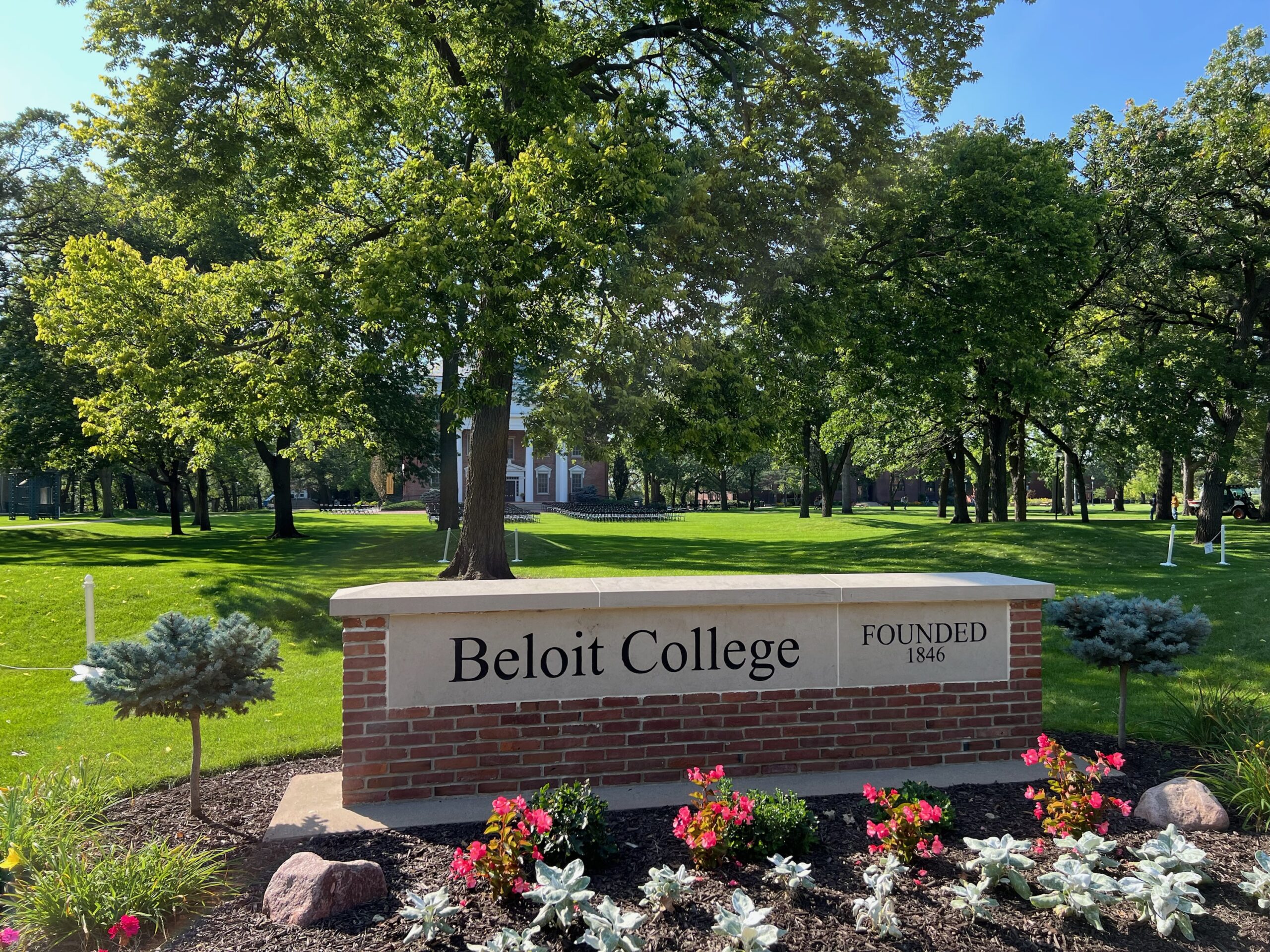
My wife Kate and our oldest and youngest children are in Wisconsin this weekend for my daughter Geneva’s graduation from Beloit College. Close readers of past newsletters will remember that Geneva finished school in 2020, but she never had a proper graduation. On March 17th of that year, Kate and Truman flew to Chicago to rent the largest possible van to move Geneva home. Here’s how Kate put it in the blog entry that she published yesterday:

“Many of you remember our National Disaster Massive Road Trip (NDMRT), as Truman named it. We rented a huge van, which we immediately named The Beast, and which still barely fit all of Geneva’s belongings, and we drove four days back to California. On the NDMRT, we encountered many fellow unhinged cross-country travelers, everyone trying to get somewhere fast, all of us eyeing each other with trepidation as we sought to keep our distance from one another, both on the road and at every rest stop. 

The trip felt both surreal and perilous, as if we were living out a real-life disaster film. On the third day, we white-knuckled The Beast through a blizzard atop a Wyoming mountain pass, a heart-pumping, frightening experience of unplowed roads and icy white-outs. At the hotel that evening, I was filled both with relief that we had survived the day’s drive, and with the sense of trauma we were all just beginning to experience; we were never going to forget this NDMRT or the earliest days of our new pandemic mindset.”

By contrast, today for the big ceremony the weather was sunny, the Beloit President cheerful in his commencement speech, and the grass lush and green. Evidently in other parts of the country, it rains during more than one season. After all the names were read, the new graduates drank a champaign toast, received a standing ovation from their families, and then greeted well-wishers while Motown music played. 

Now preparations are underway for a gala, and Geneva is not expected to be seeing her family again until tomorrow. When I graduated from Boston University and UC Davis (twice), the organizers of those events totally forgot to throw me and my fellow graduates a gala. Also, the word “alumni” came up often during the ceremony at Beloit College today. I’m sure Geneva and her parents will remain on the Beloit alumni mailing list. The good news is that, with the help of Joe Biden and Biden-Harris Administration’s Student Debt Relief Plan, this may be the year that we make our last payment for Geneva’s education. 

Now we are saving money for the higher education of Truman, my Facetime cameraman for today’s ceremony. He is also treating today’s visit to Wisconsin in temperate September as a college scouting trip. Who knows what will happen? Perhaps in two years, our payments to Beloit will start anew!

Meanwhile, Jukie the dog and I are enjoying perpetual jazz, and no TV. Jukie is rediscovering his library. I am reminded of a poem I wrote during one of Kate’s previous trips to Chicago. I will excerpt the relevant stanzas from “Seven Steps to Heaven” right here:

Ours is an unhurried August Saturday morning.

My wife is visiting Chicago for a fortnight,

while Miles Davis fills the kitchen.

The trumpet croons. How can something so cool, born in 1957, be so old?

The title of our chosen British underground internet radio station, 

“Giants of Jazz Radio,” seems more oxmoronic with every passing moment,

but here we are, dancing like oxymorons.

The bulldog dances too, yelping, and nipping at our legs,

wondering what strange game we are playing.

When I told Truman that for the next three weeks

we would dance to jazz anytime we felt compelled to reach for the remote,

he gave me a high five.

No one will stop us from acting rashly.

I suppose like all of us, Jukie and I are acting less rashly in 2022 than we did in 2014, but the soundtrack is the same, jazz rather than Motown. I miss my family in Wisconsin, and wish that I could have joined the celebrations, but the music filling the jazz is helping. As Bob Marley said, “One good thing about music, when it hits you, you feel no pain.”

Congratulations to the new graduates at Beloit, and good luck to the new students at UC Davis, or wherever you find yourself. Be well!

Andy


For existential and logistical reasons, my parents could not attend Geneva’s ceremony in Wisconsin today, but Kate’s parents did. Both of them are Beloit graduates who met there in the early 1960s. I think they would get at least five of the questions right on this week’s Pub Quiz. In addition to topics raised above, expect questions on the following: car companies, search engines, majestic animals, spoons, maternal health in Connecticut, famous marriages, southern exports, volleyball scandals, unresolved issues, German theatre directors, third countries, treachery, intelligence quotients, cocktails, ninth and tenth spots, entertainers, literary communities, variety shows, spinning horses, best pictures, dancing mice, trains, blessings, nerds on the radio, telephoned requests, other worlds, fairies, red flags, billionaires, faraway counties, musical instruments, fire powers, people named after birds, top contenders, starting gods, long drives to corporate cities, mottos and slogans, news of the world, and Shakespeare. 

Thanks to all the supporters on Patreon who make these newsletters and this trivial output possible, especially the Outside Agitators, the Original Vincibles, and Quizimodo. I’m always appreciative to those stalwart players who pledge for their entire teams. Please subscribe so you can share the fun of the Pub Quiz!

P.S. Here are three questions from last week’s Pub Quiz:

  1. Film. What parodic four-film franchise was developed by Keenen Ivory Wayans, Shawn Wayans, and Marlon Wayans, and grossed over $900 million at the worldwide box office?  
  1. Countries of the World. What country whose name starts with the letter N has coastlines on both the Atlantic and Pacific oceans?  
  1. Science and Engineering. Starting with the letter M, and created by a Scottish engineer, what sort of road construction involves crushed stone placed in shallow, convex layers and compacted thoroughly?  

P.P.S. “We will explore the mysteries of science and harness the power of technology and innovation. We will realise the opportunities of the digital world. Our youth will learn more from – and with – each other.” Narendra Modi

Dear Friends of the Pub Quiz,

What a busy time this has been for me! Recently I gathered all the documentation needed to apply for a merit pay raise at the university where I work, I hosted our annual Summer Institute on Teaching and Technology (more on that below), and I celebrated my 30thwedding anniversary with my wife Kate.

Wednesday, September 7, 1992 was particularly warm, so we decided not to eat outside at one of Sacramento’s fancier restaurants. Instead, Kate and two of our kids got vaccinated with the new bivalent vaccine that day, as they are traveling to Wisconsin next week. We are going out for dinner on September 10th, instead. Next week I will tell you about the presents we got each other.

This week, I will share with you the poem I wrote for The Summer Institute on Teaching and Technology, a gathering of scores of UC Davis faculty who wish to share and learn on innovative teaching. I am so impressed with my faculty colleagues, especially those who presented either live or asynchronously.

Blooming in the Unquenchable September Sun:

A Poem for the Summer Institute on Teaching and Technology at UC Davis

The powerful play goes on, and you may contribute a verse.

–Walt Whitman

Once it felt hopeful when we would hold SITT in September.

Davis schoolchildren, some of them our children,

Had been filling their Trapper Keepers for almost a month,

But we had gathered in our air-conditioned rooms

Pretending at our personal growth camp that it was still summer,

Pretending that we had plenty of time yet to prepare for fall.

But now, as if she were hosting a barbecue required of all Californians,

The molten earth herself has warmed to our idea of an extended summer.

The U-Hauls that moved so many of our undergraduates 

Between leased Davis apartments in late August

Now bake in Bunsen burner parking lots, 

Itching, like all of us, to be useful for the students once again.

I seek to comment wittily on our scorched earth,

But my poet’s brain has been enduring rolling brownouts.

We can see why. I mean, the Queen is dead, 

and here in Davis, it’s almost too hot for metaphors.

Around here, SITT happens only in the morning

With the understanding that by mid-afternoon

All of us will have bunkered down like Saharan sand beetles.

And just as those beetles need a hint of fog for their outstretched wings

To collect sufficient moisture to survive another day,

So do all of us need these Zoom-tiled moments

Of community, of discovery, of innovation, and support.

Our speakers, asynchronous and those present,

Outstretch their wings for us, show us where the droplets can be found.

The overstuffed maw of every double-parked August U-Haul 

Reveals students who have packed too much for college.

This starts early. Driving for the first time into Davis this September,

And wondering if they are enrolling in UC Death Valley,

The new student brings not only too much luggage to the dorm room

But also excess baggage to the classroom.

Memorizing and strict attention to instructions have gotten them this far,

But what happens when our students find the syllabus to be incomplete,

The professor herself demanding that they contribute a verse?

Surely they thrived in small classes in high school, waiting for the bell,

But what happens when even in their large UC Davis classes,

Our students find themselves put on the spot,

Expectations raised as much by peers in their groups

As by the professor asking just the right iClicker question?

Like their U-Hauls, our new students have much to unpack.

The most confident of our high school overachievers, 

Audacious but not yet what every fall we would call “oriented,” 

Must often be eased away from their preconceptions and unhelpful habits.

We must guide them, as Yoda says, to unlearn what they have learned,

To remain receptive as they climb the scaffolds we build for them.

If indeed we sit on the top of the pyramid, teeming with creativity,

Let us strive to connect our classroom ethics to our students’ work ethics.

If “A man is worked upon by what he works on,” as Frederick Douglass says,

Let us present them with transparent classroom models, inspirations in overalls,

Showing them with every interaction why we work to teach what we love.

Piece by piece, let us give away the contents of our own overheated U-Hauls, 

Mobile receptacles of our libraries, our anecdotes, our formative assessments.

The nourishment we bring can be sunshine, food, or fertilizer.

Like watering-can gardeners seeking to irrigate a parched planet,

Let us use our tools, our unmute buttons, our renamed drop-in office hours, 

our taxonomic Blooms, to help our eager students bloom!

I’m still recovering from SITT and our anniversary celebrations, as well as my own shot in the arm. We will return to regular weekly programming next time!


Thanks to all my ongoing Pub Quiz subscribers. They drive me to keep writing trivia for all of you. Lately I have been posting occasional trivia questions from my Twitter account for my 6K followers to enjoy. The first friend or stranger who answers a tricky question without Googling gets a copy of that week’s quiz. To keep things regular and dependable, I recommend that you just subscribe via Patreon. Thanks to especially to the following teams: the Outside Agitators, the Original Vincibles, and Quizimodo. I’m always grateful to players who pledge for their entire team. Please subscribe so you can share the fun of the Pub Quiz with your friends and neighbors!

This week’s quiz will ask questions about topics raised in my poem, as well as the following: contraptions, food with personality, pests, big fans, two people with the same job title, shortstops, the southern border, maritime borders, French titles, changed names, convex layers, words from history that begin with the letter M, breaks from everyday duties, fear factors at the movies, wasps, clouds, February mishaps, unusual fears, famous Americans, musical knots, walks in the forest, beaks and bills, patriotic songs, breadbaskets, animals in books, NASA, what violinists produce, European countries, mottos and slogans, news of the world, and Shakespeare.

Thanks for your support. Poetry Night on Thursday will take place on the roof because normal weather is BACK! The poets will be Mischa Kuczynski and Jordan Karnes.

Dr. Andy

P.S. Here are three questions from last week’s quiz:

  1. Last names of fictional characters. What is Thor’s last name? 
  2. Pop Music. What is the stage name of is the drummer for the hip hop band The Roots? 
  3. Anagram. What famous socialist’s speech denouncing American participation in World War I led to his second arrest in 1918? Hint: His name is an anagram of the phrase BUNGEE SEED.

P.S. “Only a life lived for others is a life worthwhile.” Albert Einstein