



Dear Friends of the Pub Quiz,

“One good thing about music, when it hits you, you feel no pain.” Bob Marley

As a functionally blind theatre director, my father could not rely on notes when observing the run-through of a play during rehearsals. As a result, he had to pay special attention during a performance, organizing in his head all his various encouraging or corrective comments for his actors, lighting and sound technicians, and assistant directors so that his “vision” of the play could be realized in time for opening night.

My dad running a rehearsal was a marvel for me to behold not only because I knew better than anyone else in the room how blind my dad was, but also because of how masterfully and authoritatively my dad communicated all the “notes” that he had gathered for the members of the production. I once remember him telling an actor, rather cuttingly, that she was “answering a question that no one was asking.” The people on stage knew just what he meant.

I saw a similar maestro (in this case, maestra) take the stage at the Richard Brunelle  Performance Hall at Davis Senior High School this morning. After a Concert Band performance, which included my son Truman on alto saxophone, Susan Hamre came out of the audience to talk to the musicians. Hamre is the outgoing director of the Symphonic and Concert Bands and the Musical Theater Ensemble at American River College (where I have also taught), and someone who knows her craft exceptionally well.

Maestra Hamre was clearly meeting these apprentice musicians (at the “Earth and Alchemy” Music Festival) for the first time, for she spent her first few minutes orienting herself to the location and numbers of the musicians who made up the concert band. And then she started with the lessons, asking groups of musicians to play certain parts of the classical pieces that they had previously performed, and pointing out to them what makes the pieces lush, bracing, exhilarating, or sublime. She explained why she needed more gusto from the supporting instruments, and why she needed the higher-pitched instruments, such as the flutes, to play more quietly. By breaking works and movements into combinations of sounds, with different tempos and musical emphases, the visiting conductor helped the students and parents in attendance hear magic in the music that they would not have otherwise noticed, or reveled in.

While I felt lucky to be in the audience for this 20-minute lesson, I also found myself wishing that I had taken musical performance classes in high school or college. Nostalgic for my college days, I found myself also missing those times in my life when I could sneak into Boston University classes that I was not enrolled in, just to hear a great speaker analyze or reassemble a great work of literature. During my last two years as an undergraduate, the combination of “stolen” classes and public lectures made me feel like my mind and heart were constantly brimming with facts and performances.

When I arrived practically penniless in Berkeley as a new college graduate, I continued this habit by slipping into the back of lecture halls at Cal, learning about classical music history and theory from a Music 27 large lecture class (“Introduction to Western Music”) taught by a seemingly venerable but energetic professor who taught while sitting and playing at a grand piano. (He was probably about the age that I am now.) A couple decades after illegally taking that class at UC Berkeley, I helped Kern Holoman, an equally charismatic authority on classical music, figure out how best to use our campus learning management system to share music files with UC Davis students in Music 10: Introduction to Music. That welcome assignment required that I sit in on some of Kern’s lectures – what a treat! I was reminded what Billy Joel once called music: “an explosive expression of humanity.” 

While now my artsy conversations with my dad take place in my memories and in my dreams, I do feel lucky in this life to have had so many opportunities to learn from, interact with, and gain inspiration from great teachers, including music teachers. When I retire in a dozen years or more, I might have the time and budget to return to instruction in a musical instrument or two. Perhaps by then I will be teaching Zoom classes while sitting at my own piano, whether warranted or not.


This week’s Pub Quiz will feature topics raised above, as well as the following: Quantum mechanics, shadowy figures, faraway cities, replacement playboys, green lawyers in other languages, prisoners of war, friends with Mercury, eye color, playing catch, Nobel Prizes, names in the news, chemical properties, Patreon, big cities, rarified sports, the all of vision, detanglers, poetry, keys, confirmed prisons, the importance of action, winning the acronym, ablation concerns, youthful athletes, NPR designations, kennels, common last names, current events, and Shakespeare.

Julia Levine reads with Frank Gaspar this Thursday night at 7 atop the John Natsoulas Gallery. It’ll be a warm day, so dress in layers!

Thanks for reading to the end. Be well.

Dr. Andy

P.S. Her are three questions from last week’s pub quiz. Please SUBSCRIBE via Patreon to receive 31 questions every week.

  1. Pop Culture – Music. With its passionate vocal and sweeping orchestration, the 1960 release of the song “At Last” is often chosen for weddings and wedding receptions. Name the musician who famously performed the 1960 version of this 1941 classic.  
  1. Science. What sort of jawless fish may be characterized by a toothed, funnel-like sucking mouth?  
  1. Pop Culture – Television. Of the four primary actors in the TV show I Love Lucy, who died first?  

Dear Friends of the Pub Quiz,

One of my favorite quotations by the current Dalai Lama is a long one: “Every day, think as you wake up, today I am fortunate to be alive, I have a precious human life, I am not going to waste it. I am going to use all my energies to develop myself, to expand my heart out to others; to achieve enlightenment for the benefit of all beings. I am going to have kind thoughts towards others, I am not going to get angry or think badly about others. I am going to benefit others as much as I can.” 

Yesterday I came across someone who sought to benefit others. It seems that an entire high school robotics team was visiting Davis for a competition, and all 20 of them (including drivers and chaperones) got in line at the south Davis Guadalajara just before my son Jukie and I arrived at one of our favorite places to dine outside. We beheld the unusually long line and secured a table.

Jukie doesn’t mind waiting for me outside of Mexican restaurants while I go in to place our burrito order, especially during this era when I try to keep our little obsessive anti-masker out of all public buildings. Once while I was placing an order at Dos Coyotes, I came out to the patio and was told by four elderly women at a table close to Jukie’s that they so delighted in hearing the crooning sounds he was making, as if he were warming up for an operatic performance.

Like any of us, Jukie sings to bring himself pleasure. His inability to form actual words with his singing or speaking voice does not keep him from exercising his vocal cords, and on our long walks (we did about eight miles together yesterday), I let him sing as much as he wants. 

In and outside restaurants, however, or when I am taking a particularly important phone call, I use sign language to tell Jukie that he needs to quiet down. Yesterday, however, while I was standing in line about 30 feet from my boy, I could not convince him to keep quiet, and diners at the other tables were noticing. Liberated by the physical distance between himself and his minder, Jukie was yodeling louder than Heidi.

That’s when a dad in line behind me told me that I should go sit with my boy, and that he would wave me down when it was time for me to order. So I thanked him and then walked right over to Jukie, giving him a kiss on the top of his head, and then texted to my wife Kate that our town is filled with such kind people, proclaiming “It’s like that dad just handed me a Disneyland fast pass!”

So today I salute this man, his parents, and even his out-of-town robotics team, all in their matching T-shirts. At a time when war is ravaging Ukraine, Yemen, and Ethiopia; when partisan divides escalate caustic rhetoric; and when judge Ketanji Brown Jackson is berated for a variety of issues and past events that have nothing to do with her or her work on the bench, we need more people like this “good and decent man” who, as Ted Kennedy said at his brother Robert’s funeral, “saw wrong and tried to right it, saw suffering and tried to heal it.”

I bet you will have an opportunity to act compassionately towards a stranger, whether that person be a refugee on the other side of the world or a person you encounter in town who could use your help. I hope you will act on that opportunity, for, as Anne Frank wrote, “No one has ever become poor by giving.”


Thanks to new Patreon patron Brooke who will be enjoying weekly trivia questions in San Diego. Like my friend James Lee Jobe, I will sometimes use Patreon to share new poems. National Poetry Month starts in a few days, and all of us should feel invited to participate. I hope to write a poem a day next month, and I will be posting at least a poem a week for you and other subscribers to review. Join us there to enjoy all this sweet content!

This week’s Pub Quiz will feature questions on topics raised above, as well as on the following: staying ahead, texts from a new widow, athletes named Michael, moral banks, California governors, sonnets, flames, the state of Virginia, neighbors, founding fathers and mothers, collateral, examples of rockabilly, poems for departed friends, push-ups, desalination projects, inadvertently destructive oafs, secret sharers, monarchs to cheer for, pilots, Academy Awards, big cities, citron dust storms, country music, people named Fred, underwater monsters, brackets, wedding receptions, foods and drinks, book collections, current events, and Shakespeare.

Stay safe, and welcome to springtime!

Dr. Andy

P.S. Find here three questions from last week’s Pub Quiz:

  1. Books and Authors. Zelda Fitzgerald, Erich Fromm, and Margaret Mitchell were all born in the same year ending with a zero. Name the year. 
  1. Greek Mythology. In Greek mythology, what is the name of the Cretan princess who is best known for having helped Theseus escape the Minotaur?  
  1. Science. What do we call baby peacocks and peahens?  

The Oversharing Homeric Dreams of Home Edition of the Pub Quiz Newsletter with Dr. Andy

Dear Friends of the Pub Quiz,

Today is the most overcast day that we’ve had in a month, but if my wife Kate and I had stepped outside on a day like today when we lived in London, it probably would have been the sunniest day we could have enjoyed during the fall of 1987, a rainiest of all autumns when the two of us met and moved in together.

I remember finally returning home from studying abroad that December, perhaps a week before Christmas, setting my huge black rucksack by the front door of my Tunlaw Road house in the Glover Park neighborhood of Washington DC. I collapsed in the recliner my parents had bought a decade earlier when they were still together in that house, a place that resonated with all the influences upon my nascent identity. Both my (then) living grandparents had joined us for dinners in that house. My (then) living best friend Tito had slept over perhaps 100 times. I was 20 years old, and I was just beginning to understand who I was, or who I might be. Younger than my years, I was probably unable to grow a proper beard.

Returning to my DC home should have brought me comfort and relief. After all, everything was pretty much the same as when I had left four months earlier. Along the walls of our living room I saw the familiar high-end replications of paintings by Gustav Klimt and Friedensreich Hundertwasser (we seemed to love the Austrians), movie posters from my time working at the Tenley Circle Theatre, and an upright piano that none of us knew how to play with two hands. What’s more, my row-house had central heating, a working stove, and a shower that maintained a steady temperature.

Any of those luxuries would have been relished in the closet-less, phoneless, shower-less hardscrabble fourth-floor walkup barely-heated Hampstead flat where Kate and I lived. We weathered the pervasive autumn rains when our tall windows wouldn’t close all the way, but the November frost necessitated additional measures: more visits to the landlord, more woolly jumpers, more blankets, and more closeness.

I appreciated all the ways that Kate found humor in hardship, joking that while we were approaching the end of the 20th century, we had somehow chosen to study abroad in the 19th century. Denizens of the Underground, takers of long walks, our eyes seeking out the spires of Christopher Wren churches, we did not see the inside of a car during our entire time in London. As residents of our street did 100 years previously, we took baths and bought groceries from the shops across the street. We could see from our window if our local market was stocked with fresh oranges, KitKat bars, or Ribena blackcurrant juice.

I had never met anyone as lovely and charming as Kate; recollections of our conversations sustained me during the long flight back alone. Back in DC, the December skies were bright, but my mood was dim. I had no firm reason to believe that I would see my “beautiful London roommate” again. I remember on the plane staring at the scant photographs I had of my Chicagoan, my London co-explorer, my Indian restaurant dinner companion, my whisperer of stories after the lights were out. I feared that we might have shared our last dinner, our last kiss. I had returned “home,” but peculiarly the only house I had ever known did not feel like home. 

Soon after my return, I was rereading The Odyssey and came across a line in book six, “Shew me the city,” that Odysseus speaks to Nausicaa, a Phaeacian princess, and it reminded me of Kate, an American “princess” that I had encountered unexpectedly, and who had helped to show me the city of London. Odysseus continues: “And for thyself, may the gods grant thee all that thy heart desires; a husband and a home may they grant thee, and oneness of heart—a goodly gift. For nothing is greater or better than this, when man and wife dwell in a home in one accord, a great grief to their foes and a joy to their friends; but they know it best themselves.”

As Odysseus suggests in this clearly heteronormative passage, home is not a location, but rather a place where one can start a new family, what he calls a “oneness of heart,” with one’s beloved. I did not know how or when (and frankly, the odds were against me), but upon returning to the shores of the Potomac, I knew that one day I would reunite with Kate so that we could start living our life together, one that we had rehearsed when we lived so far away. As Odysseus says, “Nothing is better than this.” 

So as I look again at this overcast day, I brim with gratitude that the rain was so intense and so consistent in the fall of 1987, and that my future wife Kate and I had to spend so much time inside getting to know each other. Any Odysseus is lucky indeed to have a Penelope waiting for him to get his act together, to let memories of her love guide his travels, and to return home.

I hope you get to see this week’s Pub Quiz. In addition to topics raised above, expect questions about the following: Happy Days, astronauts, shared passwords, rich celebrities with one thing in common, big cities that are not in Texas, Oscar-winners, hair implements, revelatory hearts, baby birds, palaces, merciful deaths, sadnesses, misspelled words, cushioned people who sleep, Alabama, popular TV shows, famous battles, odd words with columns, young inventors, Mount Everest, wolves, words and pages, the quality of mercy, repeated answers, odeons, yearly Christmas trees, golden globes, years that end in zero, gazelles, current events, and Shakespeare.

Please subscribe so I can send you quizzes!

Thanks to the 50 people who joined us on the roof last Thursday for poetry by Jabez Churchill and Katy Brown. On April 7th, we welcome Davis Poet Laureate Julia Levine!

Be well.

Dr. Andy

P.S. Here are three questions from last week’s pub quiz:

  1. European Cities. What B city of now 1.7 million people was overrun by Soviet tanks in 1956?  
  1. Instagram Accounts. As of September 2021, one magazine’s Instagram page has 191 million followers, the most of any account not belonging to an individual celebrity. Name this magazine founded in 1888.  
  1. Books and Authors. Marlon Brando earned his first Academy Award nomination for Best Actor in a Leading Role for reprising the role of Stanley Kowalski in the 1951 film adaptation of what Tennessee Williams play? 

Dear Friends of the Pub Quiz,

Shakespeare wrote plays that are worth the effort to (decipher and) enjoy. This becomes all the more clear when another playwright takes on a plot that approximates one of Shakespeare’s and then renders it for a modern audience in heroic couplets.

Such was the case with Lovers and Executioners, a play that my wife Kate and I saw last night at Sacramento’s B Street Theatre, where we have been subscribers for more than 20 years. It was adapted from Antoine de Montfleury’s La Femme juge et partie (1669). Montfleury was a contemporary of Molière, and, along with his father, also a playwright, a rival to the much more famous creator of modern French comedy.

Part of Montfleury’s plot was adapted by John Strand for a play commissioned by Arena Stage, the famous Washington DC theatre where my father directed many productions, and where my stepmother acted in many more. Arena Stage is also about three blocks from my mom’s apartment in Washington DC, so she has worked as a volunteer usher there after she retired from many years as a librarian. The 1998 production of this play premiered six years before my dad’s passing, so I was left to wonder if my dad saw or read the play. Surely he knew John Strand.

Ambitiously, and somewhat awkwardly, Strand has written the entire play in couplets. A poet myself, I would sometimes let my imagination drift from the improbable action of the plot to pay attention to the clever rhymes. I could see why Ezra Pound advised T.S. Eliot to remove the huge section of The Waste Land that was written in couplets, for Alexander Pope and John Dryden had already mastered that form, Pound said, and Eliot could not match their prowess. Eliot wisely took Pound’s advice, thus emphasizing the modern parts of the century’s seminal Modernist poem. 

How does one write an entire play in rhyming couplets in the modern era? With the help of technology. A website that I use when crafting love poems for Kate, Rhymezone, had launched while Strand was working on Lovers and Executioners, so one could conject that the playwright used this service or another to find rhymes for his more ambitious lines. Consider this example:

BEATRICE:

Deliver me from secrets. To the keeper, they’re a plague.

GUZMAN:

It’s by secrets and deception that the great are made,

And undone.

That couplet anticipates a major theme of the play. Some of the rhymes in Lovers and Executioners were awkward, such as when lines keep ending with verbs (or, “such as when the lines with verbs do end”), leading to a stilted way of speaking that, I suppose, might mimic what we could hear in the 17th century French original.

The lover of Shakespeare will find insufficient subtext in this and most other plays written in verse. Pulling off the linguistic matches time after time is a sufficient feat, we might think, but this approach leaves insufficient room for puns, allusions, and other forms of multilayered wordplay that delight people who can track Shakespeare’s clever complexity in real time. Some of us lament the difficulty of Shakespeare’s language, but when viewing a play written in the same century as Hamlet, the absence of that linguistic and sometimes discursive difficulty makes the mere plot of a lesser playwright or translator (and perhaps every author is lesser than Shakespeare?) into the point of the play, and plots can wear thin without the language and characterization to make them come alive.

The B Street actors did a fine job, as we have come to expect. Kate and I have seen so many productions now that we feel we know the regulars, so we anticipate the treat of seeing how they will bring their own brand of humor, energy, and even pathos to their roles in each new production. My favorites include diminutive John Lamb as the earlier-quoted Guzman, exuberant pratfall artist Amy Kelly as the earlier-quoted Beatrice, and Peter Story as the apoplectic and bellicose Don Lope. Don Lope gets to cross swords with Melinda Parrett, the talented actress who in this one production plays the multiple roles of love interest, swashbuckling rival, and presiding magistrate for Kevin Kantor’s (lead) Bernard. Playgoers interested in gender and sexuality politics will find relevant themes in Parrett’s identity struggles as she wields both a rogue’s rapier and a judge’s gavel.

Is it safe to return to the theatre again? One hopes so. Each of our vaccination cards was checked at the door, and attendees were mostly (though not exclusively) masked. As someone who contracted Covid late last month from some Davis location or another, despite my avid adherence to mask and vaccination protocols, I am perhaps more Covid-paranoid than most. Not all the seats were filled for this enjoyable production, though word of mouth and the lessening fear of omicron may help with attendance. I was happy to attend. Theatres and musicians have been hit hard by the pandemic, so they deserve our support and patronage.

As an aside, radio and other forms of oral media, such as podcasts, also deserve wider recognition in this era. I was told by The B Street Theatre staff that my press credentials were being withdrawn because an audit revealed none of my reviews of or discussions about B Street Theatre productions. As the host of a radio show on KDVS since 2000, I have discussed all the B Street productions I have seen, sometimes with actual actors and playwrights. Once I was stopped on the street to discuss my recent on-air interview with Jack Gallagher as he was plugging his one-man-show A Stand-Up Guy. All that said, I do not publish transcripts of my show. A philosophical question: If an on-air personality lauds a play on the radio (remember radio?), does he make a sound? 

For once, I have written up some thoughts here, so perhaps they will be discovered during the next audit of local journalists. Should that happen, I will just thank Buck Busfield, Jerry Montoya, Lyndsay Burch, and, our favorite, Dave Pierini for all their work bringing such engaging and meaningful theatre to the Sacramento Valley. As I do regularly on my audit-escaping radio show, in discoverable print I hereby encourage readers to visit and support local theatres in Davis and Sacramento, especially The B Street Theatre.


I hope you get to see this week’s Pub Quiz. Expect questions on topics raised above, and on the following: Visas and passports, data packets, cyclones, science fiction properties, passages of time, Alzheimer’s disease, Star Trek: The Next Generation, Bohemians, famous casters, evacuations, inter-metallic compounds, popular Instagram properties, Soviet tanks, synesthesia in the 1980s, baptisms, opportunities to marry an Arab in Detroit, telephone men, dropouts, inspiring characters, words that rhyme and that taste sweet, Dominican friars, acids, soulful men, current events, and Shakespeare.

Thanks especially to my regular subscribers, including the members of Quizimodo, Original Vincibles, and Outside Agitators. Someone tell Keith David Watenpaugh that there’s a Star Trek question in this week’s Pub Quiz! If you would also like to subscribe, please visit https://www.patreon.com/yourquizmaster. I would love to send you the quiz every week.

Poetry Night is Thursday night at 7. We are meeting on the ROOF of the Natsoulas Gallery. You are invited.

Dr. Andy

P.S. Here are three questions from last week’s Pub Quiz.

  1. Internet Culture. Every day, almost every writer glances at the letters BIU. What does the letter B stand for?  
  1. Newspaper Headlines. UC Davis recently announced that it will begin using a nonlethal noisemaking machine to drive what “pest” away from a field on the west side of campus?  
  1. European Geography. If one were to drive from Kyiv, Ukraine to Berlin, Germany, what capital city would one most likely pass through along the way?   

Dear Friends of the Pub Quiz,

Word on the street is that today in Kyiv a woman knocked down a Russian drone from a balcony with a jar of cucumbers. Clearly we need to send the Ukrainian people more cucumbers!

One hopes these trends continue, that the people of Ukraine, depending upon antiquated technologies, guerrilla warfare, and home-court advantage, can stop, thwart, and functionally defeat one of the world’s largest and best-equipped military forces. Sadly, a desperate and internationally ostracized Vladimir Putin is now running a terror campaign, targeting civilian population centers in order to compel everyday Ukrainians to demand that their political and military leaders capitulate in order to halt the bloodshed of innocents.

I would like to think that even if Putin succeeds in his military campaign, his country will lose. US, UK, and EU sanctions are functionally disabling the Russian economy. The ruble has lost most of its value, Russian banks have been barred  from buying and selling goods and commodities, and tens of billions of dollars in accounts have been seized by authorities in the countries where Putin and his band of oligarchs have been storing the money that they have functionally embezzled from the Russian citizenry. It’s like everyone has been given simultaneous permission to respond to Russian corruption and aggression, rather than just going along with it.

I need to meditate on why I feel such glee when Russian oligarchs’ villas and yachts are sized by Italian authorities, as was the case in the last 24 hours. Alexei Mordashov, who Forbes calls the richest man in Europe, had one of his yachts impounded in the Italian city of Imperia. Over the last few decades, Mordashov, whose name almost sounds like that of a Harry Potter villain, has been buying up mining companies, banks, telecom companies, and even American steel companies. Even though he was worth almost $30 billion before the ruble crashed, a divorce court in St Petersburg revealed that he was paying only $620 a month to support his ex-wife and son. I’ve concluded that vengeful people with obscene wealth are not to be trusted.

When it comes to class issues, western journalists have highlighted the middle-class status and even the race of the Ukrainian refugees fleeing the country. One expert on the BBC, Ukraine’s Deputy Chief Prosecutor, David Sakvarelidze, said, “It’s very emotional for me because I see European people with blue eyes and blonde hair being killed.” A senior foreign correspondent for CBS, Charlie D’Agata, said that Ukraine “isn’t a place, with all due respect, like Iraq or Afghanistan, that has seen conflict raging for decades.” Instead, D’Agata said, “This is a relatively civilized, relatively European — I have to choose those words carefully, too — city, where you wouldn’t expect that or hope that it’s going to happen.” 

To speak the obvious out loud, we would not “hope” that unprovoked shelling a civilian areas would not take place in any part of the world, even outside Europe. The value of people is not determined by their country of origin or the pigmentation in their skin or hair. Also, isn’t Mesopotamia, the area that is now Iraq, known as the “Cradle of Civilization”? As James Baldwin used to say on the lecture circuit, in the 1960s schoolchildren were taught about American patriots who took up arms to establish and defend their country during the American Revolutionary War, but politicians and the press simultaneously lamented that people of color, African-Americans and indigenous people here in the United States, would propose similarly protecting themselves from violence.

When I read someone on Twitter say that watching the war coverage in Ukraine is so unsettling because Americans have never been bombed in their own cities, I am reminded of watching TV news footage of the May 1985 bombing of an entire Philadelphia city block by the police in that city. The police thought it justified to use explosive demolition devices that are typically reserved for war combat, if even then. The goal was to bomb members of MOVE, a black liberation group. Eleven people were killed, including five children. Sixty-one homes were destroyed. And we did that to ourselves. So obviously if you ask the people of Philadelphia or Birmingham, Alabama, Americans have known the sort of violence that is taking lives, dividing families, and breaking hearts in Ukraine.

All these groups of people, like the technologically-outgunned but plucky Ewoks or Na’vi that we cheer for in our movie theatres, deserve our sympathy and support.

I hope you and your families continue to be safe and healthy.

Dr. Andy

I hope you get to see this week’s Pub Quiz. I welcome new subscribers and celebrate my sustaining supporters! Expect questions on topics raised above, and on American kingdoms, people named Clark, US capitols, mothers with two jobs, Ecuador, collaborations, double-doubles, boldness, significant plays, revolutions, Cuban anniversaries, farmlands, tarmac stays, noisemakers, problems with Texas, Canadian imports, apologist lamenters, superheroes, wind speeds, military installations, peninsula, musical groups, “Art” projects from 50 years ago, sunsets, people with white hair, blindfolds, The Beatles, baseball players who never got to meet particular presidents, folds, home games, first dances, current events, and Shakespeare.

Thanks to all of you who came to fill up the Natsoulas Gallery on Poetry Night this week. I had to miss it because Covid. Our next event is on St. Patrick’s Day. I remember when that day was such a big deal around here.

P.S. Here are three questions from last week’s Pub Quiz:

  1. Mottos and Slogans. What tire company uses the slogan “A Better Way Forward”?  
  1. Internet Culture. What Apple product is being used to track people and cars? 
  1. Newspaper Headlines. What mobile application will now let users share their real-time location with friends: Facebook, Instagram, Snapchat, Twitter, Friendster?  

Dear Friends of the Pub Quiz,

Democracy dies in darkness, the newspaper motto tells us. 

I read today that The Kremlin is trying to keep secret its invasion of nearby Ukraine, the second largest country in Europe (with Russia being the largest). Imagine having such control over the media that one could keep such a secret from 150 million people in Russia. An exception would be the 150,000 Russians, most of them young men around the age of my UC Davis students, who make up the invading troops. When Ukrainians tell them to go home, the invaders will likely understand them, for 30% of Ukrainians speak Russian.

For the one percent of newsletter readers who speak Russian, that would be иди домой! For the record, Microsoft Word feels that I spelled both those words incorrectly.

Outside of Putin and Trump, I don’t know of any other notable people in the world who support the invasion of Ukraine that was launched this week. I do know that more and more people are learning the name of the increasingly notable Ukraine President Volodymyr Zelensky, early favorite for the 2022 Time Person of the Year. Today Zelensky walks the streets of Kyiv with everyday militia members, giving them hope. The Los Angeles Times today asked if Zelensky is Ukraine’s George Washington. One imagines future generations will see his likeness not only on postage stamps, but represented in statues and murals in Ukraine, and perhaps elsewhere. I hope he writes a memoir at the end of a long life.

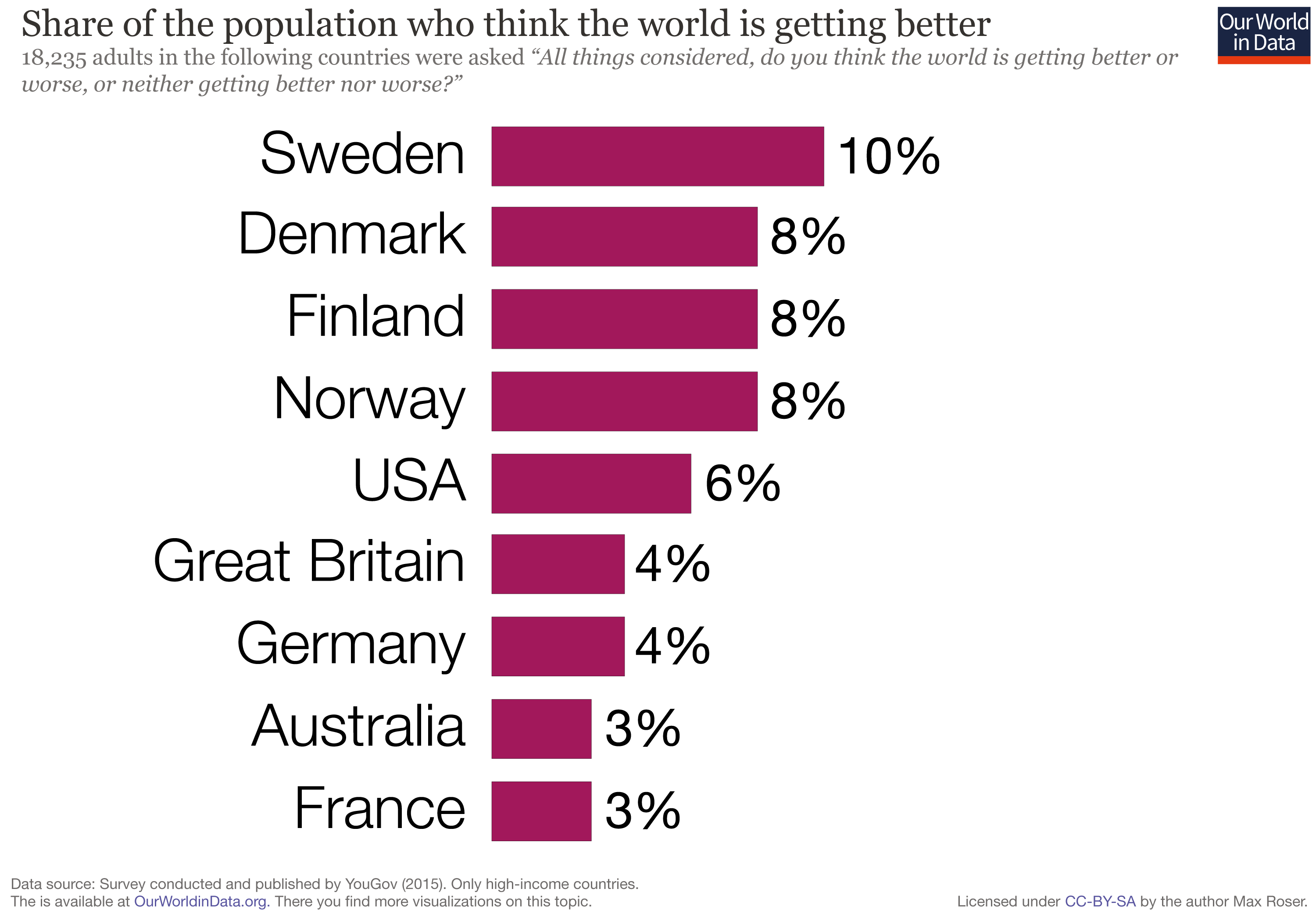
Meanwhile, Americans are doom-scrolling via social media, typically for more than two hours a day (some of our scrolling is less troubled), and the malaise they feel, encounter, or promulgate reflects growing cynicism about political discourse, the effectiveness of government to solve problems, or even facts themselves.

Gurwinder Bhogal provides some context for the sort of pessimism we sometimes feel in his 2019 article “How Progress Blinds People to Progress.” Bhogal says this:

“The Harvard psychologist Steven Pinker has noted that there’s a tendency for people to become selectively blind to social progress, particularly in Western nations. Despite the West (and the world) making huge advances across almost all major metrics, from crime to poverty, many believe the world has made no progress, or is getting worse.

Pinker blames this phenomenon largely on what the media chooses to report. This affects judgement by exploiting two quirks of the human mind: the availability heuristic, which causes people to overestimate the explanatory power of recently received or frequently repeated information, and the negativity bias, which causes people to overweight pessimistic news stories.”

Even I succumb to negativity bias sometimes, prompting me to take a break from the news to meditate in the park, play a game of chess with a friend, or go for a long walk on Davis greenbelts. When I return to my computer, I will occasionally discover that someone has sent me some encouraging news, such as the fact that today the celebrity actors Blake Lively and Ryan Reynolds are personally matching donations of up to a million dollars to the UN Refugee Agency that is supporting those fleeing a needless war in Ukraine.

While sometimes big-name celebrities will spend part of their Hollywood and Vancouver fortunes on desperate people being bombed 6,000 miles from California, more often we find our heroes locally. Perhaps not a Washington or Churchill, but our own Robb Davis once gave a stirring speech in Central Park at a vigil following senseless mass shooting at the Pulse Nightclub in Orlando, Florida. Then-Mayor Davis said that to confront gun violence and homophobia, we need to start in our own communities by reaching out to the people who need our help. 

Less prominent heroes right here on the cul-de-sac where I live in South Davis offered to bring my family food or other needed supplies when they heard that one of us is ill with that oft-discussed malady that all of us are so careful not to contract. I told him that we don’t need help yet, but if all the adults in our home fall ill, someone will have to fetch us some groceries. He volunteered.

Speaking of the good work that the UN does, upon hearing my neighbor Jim’s offer of help, I immediately thought of something UNICEF Goodwill Ambassador Audrey Hepburn once said: “As you grow older, you will discover that you have two hands — one for helping yourself, the other for helping others.” We live in a time when too much is expected from those brave and forthright souls who volunteer, whether in the cities of Ukraine or the streets of Davis, but I hope that spirit of community, democracy, and heroism will continue long after this era of war and sickness is behind us.


I have already posted this week’s Pub Quiz on PatreonSubscribe to check it out. This week’s Pub Quiz includes questions on topics raised above, as well as the following: The media, true colors, vitamin A, men in tights, trivial causes of important events, Super Bowl appearances, alternatives to escape, political prisoners, invertebrates, Muppets, olives, people with unusual names, California places, valley dividers, cooling butterfat, longbows, musical ensembles, dukes, things that knock, physicists, lab activities, MVP, interior feelings, current events, and Shakespeare. If you subscribe to the Pub Quiz, I will feel less isolated while I quarantine!

Thanks, and be well.

Dr. Andy

P.S. Here are three questions from last week’s Pub Quiz:

  1. Film Directors. Who directed the films Play Misty for Me (1971), Firefox (1982), The Bridges of Madison County (1995), and Invictus (2009)?  
  1. Islands. Because of their location, what islands have historically been considered a link between the four continents of Africa, North America, South America, and Europe?  
  1. Pop Culture – Music. Where does American musician Brendon Urie panic?  

P.S. Poetry Night is Thursday night at 7: The feature will be Michael Mlekoday with Spencer Rico and singer Gabby Battista as openers.

Note: If you enjoy these newsletters, please consider becoming a subscriber.

Dear Friends of the Pub Quiz,

I’ve actually enjoyed the time that I have spent with my family over the last two years of relative confinement.

Many people COULDN’T WAIT to send their kids back to face-to-face school, or kick the older kids out of the house, but I’ve really relished this time. Our kids are 24, 21, and 16, and, like the rest of us, they have all faced different sorts of challenges caused by this odd era in which they live. (Seneca said, “Difficulties strengthen the mind, as labor does the body.”) These challenges are of course caused or exacerbated by the coronavirus pandemic, whether because it was not safe to expose ourselves to others, or because, in these days of decreasing infection rates, we still act as if it is not safe to expose ourselves to others. Our attitude is, “If you have to ask, wear your mask.”

This week I wrote a poem for my wife Kate in which I imagined that we had raised as many children as our Catholic and Mormon friends get to do. As environmentalists, agree with Isaac Asimov: “Democracy cannot survive overpopulation.” As a dad who is crazy about his children, however, I sometimes wonder how much fuller our life would have been had we had an irresponsible dozen children, rather than “just” three.

Recently I changed the verb tense of this poem from the conditional to the present, for I like to live in the present, and the present tense is where my dreams (rather than my goals) spend their time.

Family Planning

For Kate, who has planned our parenthood

Catholics and Mormons 

are the lucky ones, 

for they populate 

their homes and neighborhoods 

with people who love them.

I’ve largely kept secret my wish 

to have had a dozen or more 

children with you.

In my full heart are rooms 

laden with bunk beds, 

and a master closet with a couple more kids 

in sleeping bags that need tucking in.

The insulated garage in my heart’s home 

Is crowded with cots.

At Homecoming, we lead

our own noisy parade, 

originating from 

a back yard replete with tents.

At present, every seat is taken.

To reserve private time and space, 

each bathroom, cleaned every four hours, 

has a calendar on the door.

Everyone’s clothes look familiar,

the increasingly threadbare 

patterns having appeared first

in blankets, and then coats,

and then hats, and then buttons,

passed down from sibling to sibling

along with tailoring skills.

In our fairy-tale house,

every day is labor day.

The teenagers are eager 

to head off to college, 

if only for a break 

from the perpetual vegetable garden duty. 

Necessarily chefs and storytellers,

they feed our bellies and our souls.

Surrounded by library sale books 

instead of screens,

all of the children raised in our house 

are be scholarship students 

or like apprentices of old,

they will be lifetime indentured 

to their schools and colleges, 

for we’d have no money left.

But oh, how rich I am,

my heart’s home so full, 

seeing your large eyes 

and healthy cheeks 

everywhere I look.

Thanks for reading, and thanks to Kate for being such an active and loving mom to our kids. This week’s pub quiz touches upon topics raised above, as well as the following: Ways forward, tracked cars, real-time locations, words in a document, productions of Hamlet, selection committees, casual presidents, character developments, regrettable prejudices, rocks of the ages, stones, vacuum cleaners, award-winners, leeches in the newspaper, snowbirds, solo projects, forgotten foxes, salesmen, pillow talk conversations, world capitals, loved leaders, famous daughters, French standbys, alphabetical place names, time spent alone, faraway islands, confederacies, remade donuts, underground music groups, singer-songwriters, radiated emissions, famous bridges, current events, and Shakespeare.

I hope you get to see the Quiz. If you are not yet a subscriber, drop me a note with your interest, and I will send you a free quiz. Meanwhile, teams like The Outside Agitators, The Original Vincibles, and Quizimodo are making this whole thing possible. Join them on Patreon!

Be well.

Dr. Andy

P.S. Here are four questions from last week’s Pub Quiz:

  1. Internet Culture. Tux the Penguin is the mascot of what?  
  1. Musical Plays and Movies. Amadeus is one of only four productions to win both a Tony Award for Best Play (1981) and the Best Picture Oscar (1984). The other three films were all released in the mid-1960s. Name one of them.  
  1. Name the Commonality. What do a fellowship, a staff, and a sap all have in common?  
  1. Pop Culture – Music. Born in 1950, what singer, songwriter, and actress referred to her family as “the Black Kennedys” and started singing on her father’s albums at age 6?   

P.S. I have never had a sister, but I like this quotation by the poet Christina Rossetti: “For there is no friend like a sister in calm or stormy weather; to cheer one on the tedious way, to fetch one if one goes astray, to lift one if one totters down, to strengthen whilst one stands.”

Dear Friends of the Pub Quiz,

A plastic bag has lodged itself securely to a limb of a tree that I can see from my bedroom window. It distracts me sometimes with its movement, with its simulacrum of agency.

The seeming randomness of this newsletter’s paragraphs symbolize that sort of distraction. It is a common ailment of the 2020s.

Walking though the “alley” between C and D Streets with my anti-racism class yesterday, my students and I came upon Bill Buchanan, the journalist and host of the KDRT radio show and podcast Davisville. I wonder if my students thought that encounter was staged.

I have learned that if you walk for enough hours on the streets of Davis, sooner or later you will encounter a friend (or stranger who would make a good friend candidate).

My wife Kate is really good at Wordle, but she shares her Wordle victories only with me and a few other close friends. My Pub Quiz anagrams are more difficult than the daily Wordle, so I give context clues.

Speaking of games and friends, when I played chess over the table with my close friend Joe Mills, I won only about 60% of the time. Now we are playing online, so I have time to think between moves. He comes close to beating me sometimes. I’m grateful for his company and what I imagine is his patience.

My dad taught me how to give hugs and to play chess, for which I am grateful. He never taught me how to change the oil of a car, so I hire others to do that and play chess with Joe on my phone while I wait. 

Of course, these days I also don’t drive the car. Instead of changing the oil, yesterday I stopped by Fleet Feet to replace my shoes. The salesman and I agreed that shoes with 2,000 miles on them deserve to be replaced.

I was a bit embarrassed not to have brought my shoes in earlier. My favorite BU professor, Christopher Ricks, wrote an entire book about embarrassment. It was titled Keats and Embarrassment. He was subsequently knighted by the Queen. Now he is Sir Christopher. He still teaches at Boston University, but he walks the streets of Cambridge, the Harvard University and MIT town that aspires to have as many bicyclists per capita as we do in Davis.

My dad loved to walk, and he loved the Muppets. He especially loved The Muppet Show because of the ways the show aspired (but usually failed) to approximate the success of the traveling vaudeville performers he got to see as a child. Such performers hooked him on show business. He would have been pleased that his grandson Jukie keeps asking for Muppet movies at home.

Jim Henson must have had an active imagination, as well as a team of puppet artisans to “materialize” that imagination. Poets like me don’t need a team of helpers to write a poem. 

Valentine’s Day weekend requires the married poet to pay better attention to the images in his head, for he will have to assemble a number of them in the coming days in order to write something for his audience of one. Sometimes the resulting creation is shared more broadly.

Looking it over, I see that this week’s newsletter is more a disassembly, rather than an assembly. It reflects centrifugal forces, rather than centripetal. Richard Paul Evans, author of The Christmas Box, said, “The law of centrifugal force seems to be as true for the human condition as it is for the Newtonian mechanics. The faster our lives spin, the more things tend to fly apart.”

Ecclesiastes 3:5 says that there is “a time to embrace, and a time to refrain from embracing.” 

We gather together in childhood – at my Waldorf school, we had “assemblies” – and we fly apart from those onetime friends as adults. Small children embrace all the time, and then those children take a brake from embracing, until, say in high school, the impulse to embrace returns with a vengeance.

February 12th is the birthday of Abraham Lincoln, most people’s favorite Republican, and Jim Parmelee, a Virginia Republican activist who I knew at that Waldorf school. We attended each other’s birthday parties in the late 1970s, but I haven’t shaken his hand since 1981. I don’t remember if we ever embraced.

The last time I talked to Jim Parmelee, it was for a 2001 interview on my radio show. He wanted to know when Al Gore was going to move out of the Vice Presidential Residence at One Observatory Circle in my old neighborhood so that Dick Cheney could move in. Even that sort of contentiousness seems sedate by today’s standards.

Speaking of divisions, in his 1858 “House Divided” speech at the Illinois State Republican Convention, Abraham Lincoln said, “I believe this government cannot endure, permanently half slave and half free. I do not expect the Union to be dissolved – I do not expect the house to fall – but I do expect it will cease to be divided. It will become all one thing, or all the other.”

Just the year before that speech, in 1857, Moby-Dick author Herman Melville published his novel The Confidence-Man, about a scam artist who repeatedly rooked people on a Mississippi River steamboat. Lincoln could spot a swindler.

Lincoln didn’t care for the sophistry of Stephen A. Douglas. In 1854, Lincoln said this: “It was a great trick among some public speakers to hurl a naked absurdity at his audience, with such confidence that they should be puzzled to know if the speaker didn’t see some point of great magnitude in it which entirely escaped their observation. A neatly varnished sophism would be readily penetrated, but a great, rough non sequitur was sometimes twice as dangerous as a well-polished fallacy.”

Too many of us have succumbed to well-polished fallacies when we should be standing firm with the truth. Once in 1862 President Lincoln was helping Civil War nurse Rebecca Pomeroy down from a carriage and onto the sidewalk. He said this to her, “All through life be sure you put your feet in the right place, and then stand firm.” Lincoln was always seeking an occasion to share aphorisms the way that a poet looks for occasions to share images.

Nurse Pomeroy was a first responder, an essential worker. She was the sort of citizen Lincoln would have had in mind when he tried to preserve the union, to challenge all the centrifugal forces that distract us or, at worst, drive us apart.


I hope you get to see this week’s Pub Quiz. It will feature questions about the following: anodynes, records, penguins, the economies of space, ultra-short Shakespearean poems, favorites, tennis dramas, opinions and reminiscences, elements you know, famous south coast islands, people named Lucy, patient guests, singer-songwriters, best sellers, American states, chocolate, resorts, glories and freedoms, staves, seasons, Black Kennedys, shoulder-spans, mixed woodlands, architects, adjacencies, gold standards, title questions, pale blue eyes, pioneers working with Adobe online, current events, and Shakespeare.

Thanks as always to the regular and heroic support of my patrons on Patreon. I wouldn’t be able to do this without you. Special thanks to The Original Vincibles, Quizimodo, and the Outside Agitators. Let’s add your name to this list! Subscribe today.

Stay well. As Kit Ramsey says, “Keep it together.”

Dr. Andy

Here are four questions from last week’s Pub Quiz:

  1. Science. Starting with the letter C, what sort of fruit pits do North and South Americans know best?  
  1. Books and Authors. Underground Books, the Sacramento region’s only Black-owned bookstore can be found in the heart of what neighborhood?  
  1. Current Events – Names in the News. According to a recent KCRA headline, “UC Davis Library To House Legacy Archive Of [an] Internationally Acclaimed Chef.” Name this chef who donated his legacy archive and all his cookbooks to UC Davis.   
  1. Sports. First name Nathan, who is the first figure skater to have landed five types of quadruple jumps in competition?  

P.S. Joe Wenderoth is our featured poet at the Natsoulas Gallery this coming Thursday night at 7. Find the details at Poetry in Davis.

Dear Friends of the Pub Quiz,

In a January, 2022 article in The New YorkerDeep Work author Cal Newport suggested that we should work more slowly to get more done. That seems nonsensical at first, for we think that people who work slowly (I think of Flash, an actual sloth who works for the equivalent of the DMV in the animated film Zootopia) are naturally less productive. But I bet many of us have experienced days where spending time discussing the abundance of action items on our TO DO lists, if only with ourselves, has taken the place of actually doing the work.

Newport suggests that the overwhelm of having so many action items actually makes us less productive: “When you’re tackling too many . . . projects concurrently, . . .. the combined impact of all of the corresponding meetings and messages can take over most of your schedule, creating an overhead spiral of sorts in which you spend significantly more time talking about work than actually getting it done—a form of wheel-spinning freneticism that amplifies frustration and, ultimately, leads to burnout.”

Even though I’ve tried to take on less during the two years of the ongoing pandemic, now that we are teaching in person again, I see how the tasks are swallowing my days. To take stock of my responsibilities, I recently counted up the categories of work I do for which I could use support from an undergraduate assistant or two. I came up with 21 categories. Thankfully, many of the projects for which I need help are self-assigned. Unwritten books far outnumber even the written ones.

I share such opportunities with potential student helpers not only because I do too much and could use the help, but also because I enjoy mentoring students individually, helping them to discover and take advantage of resources made available by me, by the university, and by our city of Davis. I’ve helped students choose and prepare themselves for more ambitious goals than they originally thought possible, testing out what Stephen Covey says in The 7 Habits of Highly Effective People: “Treat a man as he is and he will remain as he is. Treat a man as he can and should be and he will become as he can and should be.” Covey uses gender-specific language, but over the years I have hired more women than men.

What can I offer them? As if holding magic binoculars, I try to look into a student’s future, with the hope of alerting them to what is coming around the corner. Sometimes the wisdom I impart upon students comes out of conversation, from readings that we share with one another, or from favorite comedians. Two quotations by Steve Martin, both making self-deprecating comparisons, come to mind: “Thankfully, persistence is a great substitute for talent.” Teaching students to value the work for its own sake, to make daily incremental progress towards their goals, and to keep submitting their projects for evaluation, despite the inevitable rejections, helps them to build the habits necessary to succeed. As a poet, I also remind the students I mentor to be creative. Steve Martin also said, “I have found that, just as in real life, imagination sometimes has to stand in for experience.”

Persistence and imagination! As Steve Martin and Cal Newport could tell you, by setting big goals and then patiently working on them, we will likely get less done in an hour or a day, but accomplish more of what matters in a year, or a lifetime. I have found that I can do so especially when I benefit from the help, ingenuity, and imagination of California’s best undergraduates.


Nobody, except perhaps the millions of contributors to Wikipedia, have helped me with the quiz I wrote this week. Some tasks we are uniquely qualified to do, no matter the talent of whose who offer their help. Expect questions on topics raised above, as well as the following: towels, apologies, retributions, Nashville distances, invasions, symbols, minerals, guitarists, textiles, light years, podcasts, late-night comedians, marmots, clutches, jumps, chefs, bookstores, beans, pans, vaccination providers, canyons, trials, nerds, dogs and other animals, bridges, ladies, centuries in Asia and Europe, current events, and Shakespeare.

Thanks to all the players and teams who join us on Patreon and thus subscribe to these newsletters, and/or the pub quizzes. The Original Vincibles, The Outside Agitators, and Quizimodo deserve a special shout out for their sustaining support. Let me know if you would like to see your name or team name appear here. In addition to the money I already send to the Yolo Food Bank, I will make a $20 donation to this stellar local charity in the name of any first-time subscribers, even if you subscribe for only a month. I think you will value receiving the quizzes every week.

Thanks for reading to the bottom of this week’s newsletter. Stay safe!

Dr. Andy

P.S. Here are five autograph questions from last week’s quiz:

  1. In 2012, a librarian at a high school in Tupelo, Mississippi discovered a library card in the back of an old book signed in 1948. This is the oldest known autograph by what person?  
  1. The earliest known autograph by a major historical is that of El Cid, Prince of Valencia (1098). Name the country.  
  1. Who was the earliest U.S. president not to have signed the Declaration of Independence?     
  1. An autographed first-edition copy of what James Joyce novel has the greatest value of any of his autographed books? 
  1.  Queen Elizabeth II signs her name “Elizabeth R.” What does the R stand for?  

P.S. “True friendship is a plant of slow growth, and must undergo and withstand the shocks of adversity, before it is entitled to the appellation.” George Washington

Dear Friends of the Pub Quiz,

Years ago my brother left People magazine in part because he could see the writing on the wall: increasingly magazines had been substituting reporting on celebrities’ revelatory Twitter and Instagram posts rather than sending out reporters to cover people and events. 

Of course, the academy noted these changes first. Way back in 1996, my onetime neighborhood college, Georgetown University, launched what we think is the nation’s first Internet Studies master’s degree – the program is now called Communication, Culture & Technology. In that same year, I with my new PhD was a campus resource on such topics, but soon UC Davis would create its own undergraduate program in Technocultural Studies (now called Cinema and Digital Media Studies).

But back to Twitter for a moment: Did you know that linguists have been discovering and charting busy all the ways that Twitter users in March and April of 2020 were assigning the Coronavirus the names, monikers, and characteristics of women? Here are some examples, taken from the essay “COVID-19, the beer flu; or, the disease of many names” by Antonio Lillo in the October, 2020 journal Lebende Sprachen (which I just happened to have on my bedside table):

Things have been tough lately all thanks to Auntie Rona. (13th May; Ghana) | 

Getting killed by Aunt Rona because my co-worker is an idiot is a little different. (21st April; U.S.) | 

I’m so congested today. Big Rona is that you? (20th March; U.S.) | 

I hope Lady Rona pays you a sweet sweet visit. (24th March; U.S.) | 

Herd immunity was, at the time of its writing, the official policy of the UK concerning La Rona! (28th March; U.S.) | 

It sounds as if Mama Rona is about to pound y’all hard[.] (22nd May; U.S.) | 

Mamma Rona popped up and it suddenly got a lot easier to not shake women’s hands. (17th April; U.S.) | 

I’m up in the midlands where miss Rona can’t touch me[.] (19th March; UK) | 

Queen Rona is not working hard enough… (11th April; Australia) | 

I would love to attend my first Lost Lands, but Rona has other plans. (29th April; U.S.) | 

Brian called coronavirus “Señora Rona” and that was the highlight of my quarantine. (20th March; U.S.) | 

It’s bout time sis Rona leave us aloneeee. (22nd April; Liberia) | 

I’d maybe wait a few months – some of the original series are on hold cuz of Sista Rona. (21st April; Ireland) | 

The government really needs to get Sister Rona under control – this lockdown ain’t it. (30th April; UK).

I omitted some of the tweets with language that was demeaning or that was too spicy for this newsletter. 

I wonder how soon Coronavirus Cultural Studies (Virus Studies?) will be a major, or at least a designated emphasis, at an American or British university. Universities are already leading the way in helping us understand and combat the coronavirus (a much catchier name than “SARS-CoV-2”), but who shall help us understand the ways that creative professionals will respond to the virus with art, books, and film? My domestic autodidact film studies enthusiast and son Truman has been lining up great American movies for us to see over the last 18 months, so we’ve been engaging in our own form of cultural studies, but as I watch these movies, I can’t help but wish that the films’ protagonists would stand farther away from one another and mask up.

Last night Kate, Truman, and I and some friends (happy birthday week, Kari!) went to see the Australian acrobatic troupe Circa perform their show Humans: 2.0. We loved it, Kate describing the show “mesmerizing, a bit terrifying, and so beautiful.” Throwing and catching each other, and spinning each their fellow circus actors around their bodies like lightweight props, the nine performers get to know (and trust) each other very well, and even they wore their masks on stage. Even though we stared at them intently for 70 minutes last night, if any one of those performers were to knock on my door today, I probably wouldn’t recognize them. Even Georgia Webb, the woman who can balance two stories of performers on her muscular shoulders, would get a blank look from Dr. Andy. I’ve never seen her face.

Interestingly, I have been “meeting” with my advanced writing students for a month this quarter, and we have another six weeks left to the quarter, but I may never “see” those students again, for this week we are pivoting from appearing unmasked in Zoom squares to thoroughly masked in the classroom.

I admire these hard workers that fill my virtual and actual class rooms. Perhaps these will be the very students whose eventual research, creativity, and writing will someday help us better understand the unevenly isolated and infected world and culture in which we live.

Thanks to all of you who subscribe to the Pub Quiz via Patreon. This week’s quiz will feature questions on topics raised above, and on the following: London in the 1960s, long lifetimes, Hawaiian exports, short titles, old titles, rooms and passages, founding fathers, famous princes, manic flights from the Midwest, mermaids, notable stones, four-syllable words that start with the letter P, roses, Tropical birds, babies of knowledge, population dips, Michael Jordan’s basketballs, Canadian warriors, Hungarian Roma, rediscovered books, light gasses, faster and more furious, the Black Sea, Stephen Breyer factoids, London in the 1960s, long lifetimes, Hawaiian exports, short titles, old titles, rooms and passages, founding fathers, famous princes, manic flights from the Midwest, mermaids, Mary had a Little Lamb, notable stones, four-syllable words that start with the letter P, roses, famous unions, surface areas, derailed painters, units and credits, hometown heroes, current events, and Shakespeare. If I were to repeat some of these clues, would you notice?

Poetry Night Thursday takes place at 5 PM on the ROOF of the John Natsoulas Gallery. You should join us.

Be well.

Dr. Andy

P.S. Here are three questions from last week’s quiz:

  1. Internet Culture. In what web-based word game do players attempt to guess a five-letter word in six attempts?  
  1. Newspaper Headlines. What U.S. Senator was recently censured by the Arizona Democratic Party executive board?  
  1. Four for Four. Of all American states, for which of the following fruits is California the largest (or top) producer: grapes, kiwifruit, peaches, strawberries?  

P.S. “You don’t have to be doing vocal acrobatics or singing all over the scale to have soul.” Mariah Carey