


Dear Friends of the Pub Quiz,

A South Carolina writing professor whom I’ve never met wrote me a message yesterday that triggered my feelings of affection and appreciation for his sister, a departed Geology professor at UC Davis.

As I write this, the room is silent except for the wall’s analog clock, subtly sounding a song of fractions: one sixtieth of a minute, one sixtieth of an hour, one eighty-six thousand, four-hundredth of a day. Always approaching zero, sometimes life feels like an asymptote. There are 31,536,000 seconds in a year, and a limited number of years in a lifetime. For my dad, that number of years was 71. For my best friend Tito, that number was 26. For actor Dustin Diamond, that number was 44. For my close friend the Spanish professor Francisco X. Alarcón, that number was 62 (Having passed away in 2016, he should be retiring about now). For UC Davis Distinguished Professor of Geology Louise Kellogg, that number was 59. 

This is what I wrote to David Kellogg yesterday:

Hi David! 

Now that I see your name, I remember that you and I have chatted on Twitter about Louise. 

I adored her. She and I became friends at a Chancellor’s Fall Summit about 15 years ago, and we had had many conversations in the ensuing years. About four years ago, we arranged to discuss some teaching topics, so I met her at her office overlooking Putah Creek. Our meeting stayed on topic for about 15 minutes, and then meandered variously for about the next hour, much to my delight. She cared so deeply about her students, and every interaction I had with her reminded me of her humanity and humor. I invited her to my 50th birthday party in 2017, but she wasn’t able to attend. 

Believe it or not, Louise signed up to receive notices about the poetry events that I host twice a month, and I think she may even have joined us at some of the early events we held in downtown Davis. Here is an example of something she wrote to me in 2009, via Facebook Messenger: 

“Hi Andy: it was nice to see you too. And I enjoy getting the notices about the poetry readings at Bistro 33. I’m actually on sabbatical leave this winter and spring (that’s why I look so relaxed). At some point in the future, I’d be happy to talk about visualization to the FMFP [The Faculty Mentoring Faculty Program, an initiative that I ran for years at UC Davis]. Best wishes, Louise” 

I love the thought of her admitting to looking so relaxed. Perhaps we ran into each other at the hardware store? I don’t remember now, but I do know that I treasured our conversations, and lament her loss. 

I regret, too, that I didn’t get to express my condolences in person during her memorial service, which I only heard about the next day. She was such a special person, and I’m sure you continue to feel her absence (and her presence) in the almost two years since her passing. 

I send best regards, 

Andy

We express condolences in different ways. When the poet Amiri Baraka passed away, a number of poets gathered at a special Davis Poetry Night that was devoted to his memory and his poetry. This was meaningful to me, because Baraka and I once had a two-hour conversation on the way to Davis from the San Francisco airport, a drive that I started feeling intimidated, and finished feeling like I had made a new friend. When Francisco Alarcón died, I hosted a celebration of his life with members of the huge community of Latinx and Native poets that he had fostered during his decades at UC Davis. Strategically, Francisco’s admirers had me introduce the Anglo poets reading and speaking that night, while they rotated the introduction of the Spanish-speakers. They rightly feared that I would mangle the pronunciation of their biographies.

My son Jukie received double-eyelid reconstruction surgery in the same month, March of 2004, that my father passed away. Our favorite Fairfield School teacher, Mrs. Neu, arranged for the Fairfield parents to deliver us dinners as Jukie recovered, a gift that sustained us during that difficult time more than cards or flowers could have. What a welcome strategy that was to share condolences!

I don’t know if my words to David Kellogg were any consolation, but I know they were heartfelt. I later realized that I was quoted in the official UC Davis “In Memoriam” article written about Louise Kellogg, one in which her colleague Mike Oskin called her “a compassionate leader,” something any of us would wish to be called. Oskin continued: “Louise was a great scientist, a broad thinker capable of translating her insights to new fields, a kind and wise mentor, and a tireless advocate for diversity in the sciences.” 

Facebook gives us an opportunity to share fond memories of our friends after they have passed on. I am friends now with more than 20 people who still have Facebook pages even though they have passed on, including Louise and Francisco. (As I have written elsewhere, Tito and my dad lived before or untouched by the digital revolutions of our lives, and thus did not participate in our social media communities.) For those of us who were friends before they passed, we have already been welcomed into the departed’s community of Facebook connections. For those who missed that opportunity, we will forever be outside that circle.

Or so one would think. Once a few years ago I had been alerted by a staff member in the English Department that one of my previous students had died after being struck by a car on a Midtown Sacramento street. Heartbroken, I Googled the student’s name, came across his Facebook account as the first “hit,” and clicked on his name. Imagine my sadness when I saw the phrase “[Student Name] sent you a friend request,” and was invited to confirm or delete the request. I confirmed and then entered his world, if only to offer my condolences to his community in their place of grief, a place that too many of us know these days.

Tonight’s Pub Quiz will feature questions on topics raised above, as well as on the following: Fractions, wedges, impertinence, famous environmentalists, extra pairs of shoes, square kilometers, sincerity, words that you didn’t realize were acronyms, President Kennedy, an appropriate Face for February, singular for calamari, famous cages, writing habits, a cross for a king, boardroom humor, hands and masks, tall women in Europe, debut performances, people with two first names, rich uncles, capes, people who ask favors of robots, imperative happiness, current events, high scores, ignoble nominees, kindness, May Sarton, water vapor, Italian words, bonfires, morality in government, and Shakespeare.

I am hosting a poetry reading this coming Thursday with Barbara Ruth Saunders and Rick Lupert. Add your name to Poetry in Davis, either the mailing list or the Facebook group, to find out more.

Thanks to the Pub Quiz patrons, including representatives from teams such as The Original Vincibles, Quizimodo, The Outside Agitators, and Bono’s Pro Bono Obo Bonobos, who make these newsletters possible. If you haven’t already, please join them on Patreon in supporting this weekly endeavor.

Thanks for your help and support. Stay safe!

Dr. Andy

P.S. Here are three questions from last week’s Pub Quiz:

  1. Science.  Starting with the letter F, what do we call a tail-like structures that helps the cell to move?  
  2. Books and Authors. For what badly-written books is Stephenie Meyer best known?  
  3. Shakespeare. Reading a Shakespeare sonnet on YouTube during every day of the coronavirus lockdown, what knighted British actor has been nominated for Olivier, Tony, Golden Globe, Emmy, Screen Actors Guild, and Saturn Awards?  

P.P.S. “Death ends a life, not a relationship.” Mitch Albom, Tuesdays with Morrie
Dear Friends of the Pub Quiz,

We play the Quiz because we love games. Some play to compete, endeavoring to best other players, or other teams. Some play to learn, feeling that when they have done well, they have bested a younger version of themselves. Some play to explore, to reach out, asking what new topics might we investigate? Some play to circle the wagons, to hold on, asking do I still know what I have learned in school? Some play to justify all the unassigned reading they do, imagining the rewards of recognition from others, as well as the gratification that comes from knowing that the investment in one’s self has been made relevant in the arena of the pub quiz.

A pub quiz is a game of skill, but it also depends upon chance. What are the chances that you have traveled to New Orleans, studied the history of pockets, or made friends with Republicans? Any of these topics might come up, as you regulars have already discovered. Once I attended a pub trivia event hosted by current Davis City Councilmember Will Arnold, and Will asked us a question about a relatively obscure professional wrestler who “won” a number of important bouts in the early 1980s. Sitting with two university colleagues whose acumen and wide-ranging knowledge I admire, I was almost embarrassed to step forward with the answer. Did they look on me with admiration, or with pity, suspecting the worst about my misspent youth?

One game that I played often in that same time period, the late 1970s and the early 1980s, was Dungeons and Dragons. I read and digested the core rulebooks, the lists and statistics of the monsters, the dungeon modules that one could use to challenge players. And challenge them I did. Somehow, even back then, I was always the host, the dungeon master, the guy in charge, in this case tasked with imagining and describing worlds and the creatures that would confront the armed adventurers who would courageously seek out battles and treasure.

As I was a child and then later a teenager when I organized and ran these games, I’m not sure I did a very good job. We had far fewer video games back then, so many of the modules we played were substitutions for the sort of aggression that geeky kids would later explore in the arcade at the cost of a quarter. As a result, the unimaginative dungeons I home-brewed rewarded the style of play that I later read to be called the “murder hobo,” a terrible term for a player character who would rather fight monsters than negotiate with them.

(In a different sort of game, a thought experiment, I imagine my current self spending some therapeutic, academic, and life-counseling sessions with my younger self. Now that I meditate regularly, march for peace and justice when given the opportunity, find tranquility in ten-mile walks around town, and read books such as Marshall Rosenberg’s Nonviolent Communication (A Language of Life), I’m sure I would have had a lot to share with young Andrew, but he would not have had the patience to spend much time with someone he would see as a self-satisfied and altruistic pedant. What would you say to your younger self? And would your younger self listen?)

So in those distant years of playing, I was always the Dungeon Master, just as in this era, before Covid, if there is a crowd, whether it be of bargoers or students, I’m probably the guy standing up front with the microphone, asking annoying questions with a smile on my face. The subtext has always been this: I have planned some tricky adventures for you!

Like chess, Dungeons and Dragons is in a resurgence (thanks perhaps to Covid, Zoom, and Discord), and sometimes we must resurge ourselves with the changing times. This coming Wednesday evening I will be playing Dungeons of dragons with a group that does not include a blood relative (which has rarely happened), and I will be playing as a player character – in this case, a monk – instead of as the dungeon master (which has never happened). I hope the pedantic blowhard in me will not be tempted to take hold of the proverbial microphone. 

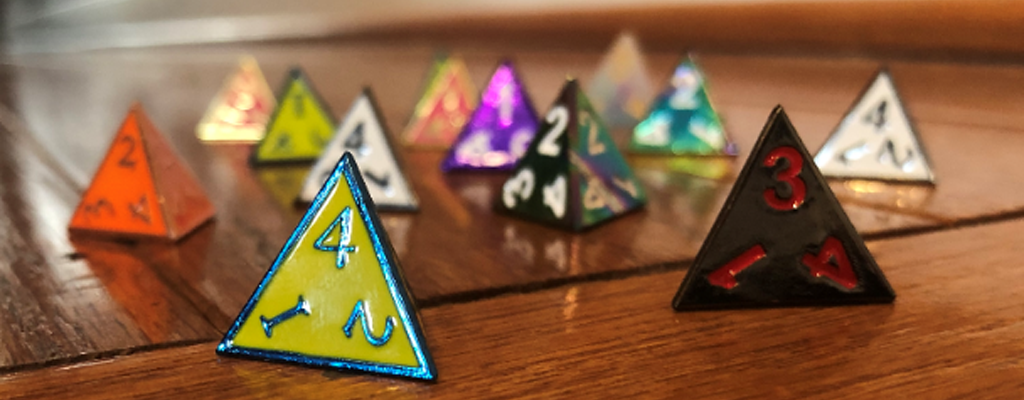
That said, the poet in me cannot be silenced. I will conclude this week’s newsletter with a poem I quickly wrote about the oddly-shaped dice that are associated with the world’s most famous role-playing game (if you don’t count running for political office).

Dice

The dice themselves 

are monsters, beasts 

with numbered backs, 

colorful pratfall experts, 

collision jockeys.

Those with many numbers

aspire to be marbles,

harnessing the jerky 

jubilant juggernaut

momentum of latitude;

whereas the short dice,

a child’s caltrops,

provoke abrupt halts,

pyramids tossed

into the desert

by Egyptian gods,

tombs inviting explorers,

the exact locations 

of the cursed treasures 

  • – – – – – – – – – – – – – – –

Thanks for reading!

Tonight’s Pub Quiz would be more fun if you could join us. Expect questions on topics I have raised above (aren’t curious to know which ones?), and on the following: tropical birds, fitness, candles, Fargo, Olivier Awards, pirates, vampires, tails, shows of hands, shrinking populations, odd numbers, steps, Presbyterians, legendary musicians, dream sequences, American colonists, mercilessness, occupations, comedians, monsters, John C. Reilly, films that win Oscars for their music, famous sermons, Transformers, submarines, Ohio, machine guns, world leaders and a poet, Saturday Night Live, American presidents, contact lenses, breakfast cereal, tall people in platform heels with little names, navies, current events, and Shakespeare.

Thanks to all the subscribers who support this effort on Patreon, including especially those who have upgraded to one of the higher tiers. The Original Vincibles deserve special thanks, as do members of the teams named Quizimodo, The Outside Agitators, and, of course, Bono’s Pro Bono Oboe Bonobos. They pay extra to keep this whole enterprise afloat, and I really appreciate it. By the way, did you know we once had regular teams named The Nights of Nii, The Wilhelm Screamers, and the Last Pig in Afghanistan? It’s true.

Here are three questions from last week’s quiz:

  1. Current Events – Names in the News. Sworn in today, what is the name of the new junior U.S. Senator from California?  
  1. Sports. To what NBA team was shooting guard James Harden recently traded? 
  1. Shakespeare. Which character in the Shakespeare play The Tempest says “My library was dukedom large enough”? 

Be safe, and stay inside, no matter what you hear from the Governor of California today!

Dr. Andy

P.S. “The only way you can write the truth is to assume that what you set down will never be read. Not by any other person, and not even by yourself at some later date. Otherwise you begin excusing yourself. You must see the writing as emerging like a long scroll of ink from the index finger of your right hand; you must see your left hand erasing it.” Margaret Atwood

P.P.S. Happy January 25th birthday to Kari Peterson, a longtime supporter of the Pub Quiz and of me. She is one of many friends who makes me grateful for the Pub Quiz – so many introductions to favorite people!

Kamala's Way by Dan Morain at The Avid Reader Bookstore
Kamala’s Way by Dan Morain at The Avid Reader Bookstore

Dear Friends of the Pub Quiz,

Happy Martin Luther King Day!

I feel lucky to know so many writers. Creative, thoughtful, witty, aware, writers make for good conversationalists. As friends, they sometimes disappear for long stretches at a time, and we must be patient with that, for we will all eventually benefit from their self-imposed separations. Some of them, I warrant, are appreciating the particular brand of isolation they have found in the Covid era. Fran Kafka once said “I need solitude for my writing; not ‘like a hermit’ – that wouldn’t be enough – but like a dead man.” Though his friends might have thought him strange Kafka certain advantages as a writer, such as not knowing the distraction of TikTok.

Because I host a lot of writers at my events (more than 75 in 2020, despite the challenges), I feel tempted, even persuaded, to buy all their books. Some of the authors I introduce are intense vendors of their work, all but insisting that everyone at an event go home with a copy of their latest publication. And as host and Master of Ceremonies, I have felt great gratification in discovering that an author’s load of books is lighter at the end of the evening. This dynamic is particularly notable for authors who write with the reader and the book buyer in mind. Mickey Spillane once said, “Nobody reads a mystery to get to the middle. They read it to get to the end. If it’s a letdown, they won’t buy anymore. The first page sells that book. The last page sells your next book.” 

Others authors are like secretive spies, mentioning a website URL or even book title only when pressed. That might be because at the end of a fine poetry reading, one feels that the performance itself was the prize. After seeing a play at The B Street Theatre in Sacramento, I relish the memory of the experience, and don’t feel the need to go buy the play afterwards. Similarly, a well-performed poem can be an embodiment of a cascading series of emotions, rather than just a recounting of words on a page. As Thomas Howard once said, “Everything depends on what is being enacted.”

So I try not to collect to many physical copies of books, as I did rather obsessively in the 1980s and 1990s, but I am reading more unassigned works than ever before, averaging more than 30 books a year, and that doesn’t even include all the poetry books I read. I’m grateful for this opportunity to read so much, for all the intellectual adventures I get to sample through the works of great authors. William Styron said that “A great book should leave you with many experiences, and slightly exhausted at the end. You live several lives while reading.” 

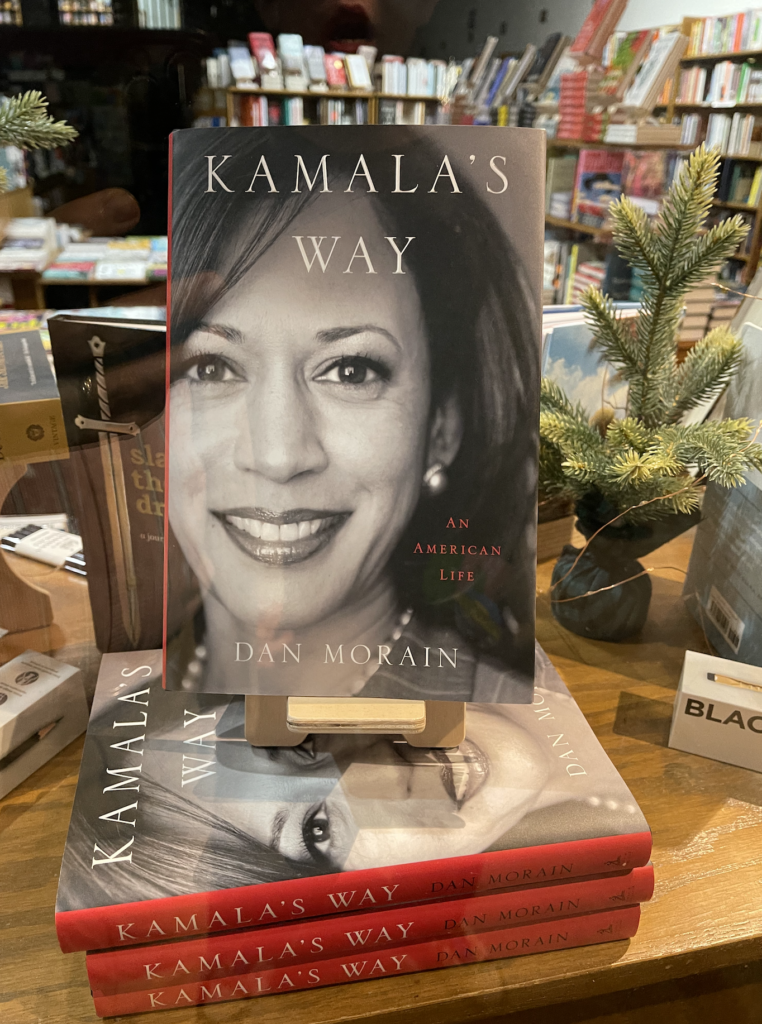
So although I can’t buy all the books of the poets who appear in my reading series and the authors who appear on my radio show (the way I just assume Terry Gross does when preparing for the interviews on Fresh Air), I do try to buy and read the books my friends write. Such was the case with the book published last week by Dan Morain, Kamala’s Way. This political biography of the Californian who becomes our Vice-President Wednesday calls upon not only Morain’s lunchtime meetings with the onetime California Attorney General, but also upon the significant journalistic coverage that Morain’s newspaper (for many years he was the Editorial Board Editor at the Sacramento Bee) and other mostly California newspapers have devoted to Harris as she played increasingly important roles in law enforcement and political leadership in California and as our junior U.S. Senator in Washington DC.

I was encouraged to discover that Kamala’s Way also reviews the important political (and criminal) challenges and controversies of the last 30 years, providing me historical and legislative context for many of the more prominent political figures who I learned about in local newscasts in the 1990s (back before cable when Kate and I used to watch the local news), and in the Sacramento Bee, a newspaper that we read daily during that same period. We lived just two blocks from the Old Governor’s Mansion when we moved to Sacramento in 1991, and thus about ten blocks from the state capitol, so we felt connected to the political life of the city. Also, culturally, there was much less going on in Sacramento in the early 1990s than today. State government was the main game in town. Kamala’s Way helped me connect the names I knew back then to the work of that same era’s most prominent political export: Kamala Harris.

The book explores the complexities of a political leader who has been seen as some as too ambitious and others as too calculating. Kamala’s Way explores why some people have been led to those conclusions, but it also presents anecdotes that attest to Harris’s humor, work ethic, and compassion. Many times Kamala Harris met with crime victims, aged activists in local hospitals, and disabled children to discuss their concerns and aspirations, usually with no reporters or even witnesses nearby. This sort of extra-political empathy raised my regard for our future-looking public servant who resigned from the U.S. Senate today, and who will take the oath of office on the west steps of the U.S. Capitol on Wednesday afternoon.

Dan Morain’s book is worth your time – I read it in just a few days. Kamala’s Way is available now at the Avid Reader bookstore in Davis and anywhere fine books are sold. Support your friendly neighborhood writers!

In addition to topics raised above, tonight’s Pub Quiz will feature questions on the following: pockets and buttons, business communication platforms, wizards, nets, people named Norman, purposes of silicon, surnames, signature sports, best pictures, roguish thieves, people born in Phoenix, Moses, Demitri Martin, health muses, new job titles, princes, justice(s), F words that almost rhyme, fog, microwaveable foods, vertical drafts, explorers, unexpected wings, the Rock and Roll Hall of Fame, rates of growth, cafes, George Clooney, coffee, and Shakespeare.

Speaking of writers, thanks for reading this far, and thanks to all the supporters of the Pub Quiz on Patreon. If you enjoy these newsletters, I’d appreciate it if you showed your support with other fans of the Pub Quiz. On Patreon, visitors and especially patrons will find bonus Pub Quiz questions, almost always with photographs! Thanks especially to The Original Vincibles, Quizimodo, and Bono’s Pro Bono Oboe Bonobos for their sustaining support. Because of the patronage of those teams, all of you benefit. Join them!

Thanks for your attention, and I hope you get to see the video of tonight’s Pub Quiz!

Dr. Andy

P.S. Dana Gioia, the former California Poet Laureate and former Chairman of the National Endowment for the Arts, will be my guest at Poetry Night this coming Thursday, January 21st. I’ve known Dana for 25 years, so I have convinced him to join us to read some poems, read from his new book, Studying with Miss Bishop: Memoirs from a Young Writer’s Life, and answer some of your questions. We all gather in my personal Zoom room this coming Thursday night at 8. Check out the Facebook event, and mark your calendar now!

P.P.S. Here are three questions from last week’s Pub Quiz:

  1. U.S. States. The 981 mile long Ohio River finds its way into the Mississippi River at the southern tip of what state that starts with the letter I?   
  1. Pop Culture – Music. What singer/songwriter wrote these lyrics in a song released in 1983? “You’re a vegetable, you’re a vegetable / Still they hate you, you’re a vegetable / You’re just a buffet, you’re a vegetable / They eat off of you, you’re a vegetable.” 
  1. Sports. In what state did Michael Jordan attend high school?  
The British Burn the Capitol 1814 by Allyn Cox

Dear Friends of the Pub Quiz,

I grew up in Washington, D.C. As Washingtonians, my family and I visited the Capitol less often than other National Mall buildings because we had no representative in Congress. Not residents of a state, Washingtonians live in a perpetual condition of democratic disenfranchisement. Originating in 1768, the complaint of “No Taxation without Representation” was addressed by the American Revolutionary War for all American citizens except for those living in the city named after the preeminent hero of that war.

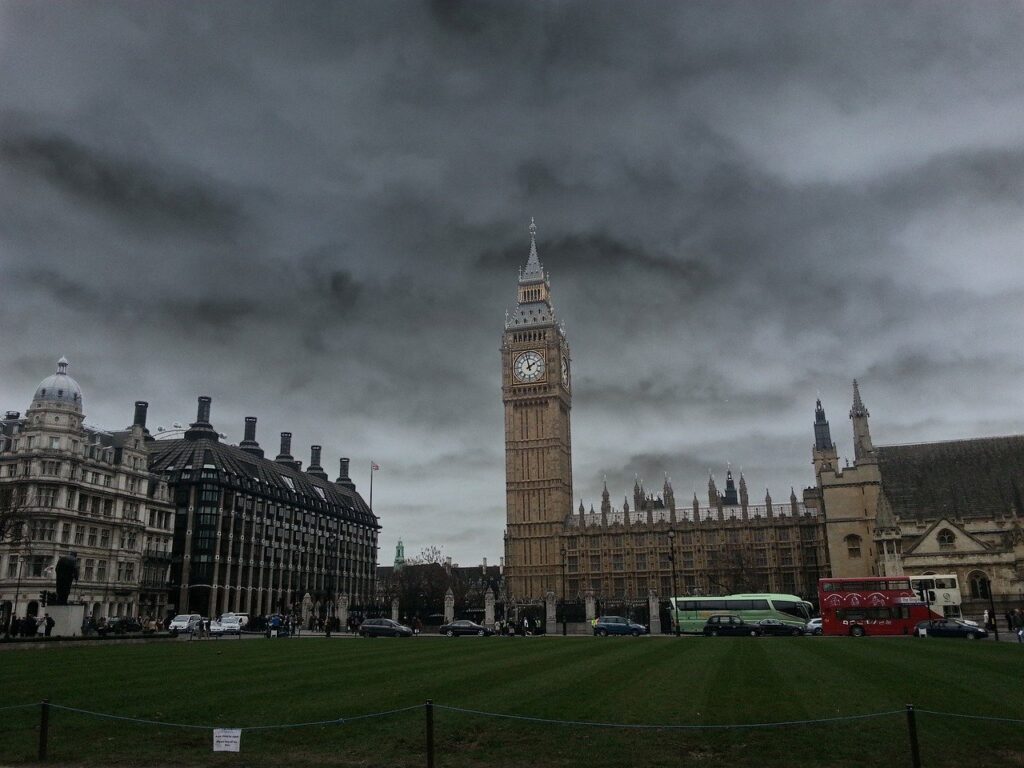
Nevertheless, we Washingtonians certainly appreciated the beauty and the majesty of the home of the U.S. Congress, in part because we saw the capitol so often, usually from afar. As a symbol, the U.S. Capitol is highly visible to residents for three important reasons. First, the grand dome was erected on what Thomas Jefferson named “Capitol Hill,” what is now a historic residential neighborhood where many members of Congress still own and rent homes. Pierre L’Enfant, who designed my hometown, once called the crest of the hill a “pedestal waiting for a monument,” and because of that high perch, the grand rotunda can be seen from many different locations in the city, including the top floors and roofs of the homes in my onetime DC neighborhood of Glover Park.

Second, because Pierre L’Enfant modeled the city on the grand avenues and the huge traffic circles of Paris, with the capitol foreseen to occupy the central hub of all the city’s spokes, as well as the prime meridian of the young country, many of the city’s grandest streets lead up to, or conclude at, the U.S. Capitol. For example, the Columbia Hospital for Women, where I was born (Al Gore and Duke Ellington were born there, too), used to abut Pennsylvania Avenue, and thus from the hospital you could see the U.S. Capitol, partially obscured by The White House. (I guess that in recent years, American democracy itself has been partially obscured by The White House.) Imagined as the center of the city, the U.S. Capitol marked the place where the D.C.’s unevenly-sized four quadrants converged. Not even needing numbers, the building’s address is merely “First Street SE, Washington DC.”

Finally, The Height of Buildings Act of 1899 ensured that buildings in cities like DC would not sprout up a bunch of skyscrapers whose top floors could not be reached safely or quickly by local firefighters. Congress subsequently passed The Height of Buildings Act of 1910 to limit the height of DC buildings in particular, and this is why the skyline in the Washington D.C. of the 1939 Jimmy Stewart drama Mr. Smith Goes to Washington or the 1951 Hitchcock favorite Strangers on a Train is so similar to the current look of the city. The 1910 act, which limits local construction projects to this day, ensures that the 288 foot tall U.S. Capitol is viewable from lower-slung buildings all over town. In comparison, at nine stories tall, the tallest building in Davis, Sproul Hall, would also be one of the taller buildings in D.C. if it were to be built in our nation’s capital.

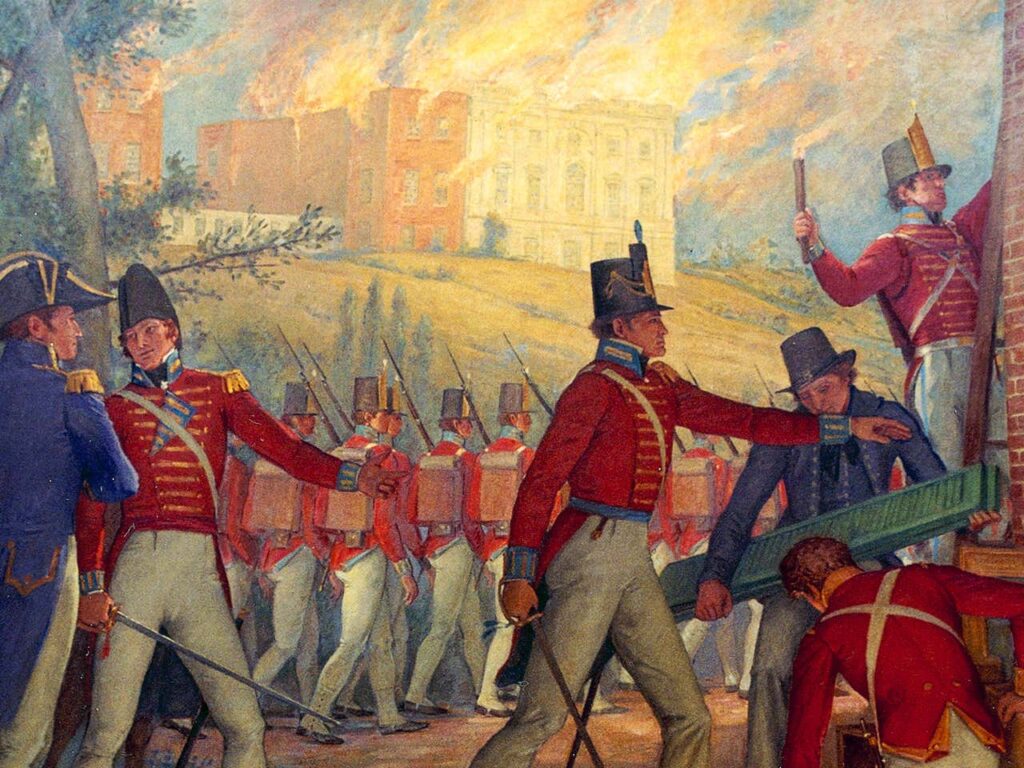
Stepping into the grand rotunda with Kate and our kids during the summer of 2019, I was struck all over again by the grandeur of the majestic U.S. Capitol. Even though I was surrounded by glorious 19th and 20th century art as a resident of DC in the 1970s and 1980s, as a returning Californian, I was left awestruck by the architecture, statuary, and grand murals. I’ve been thinking about one painting in particular, “British Burn the Capitol 1814” by Allyn Cox. It shows the first time that our Capitol was sacked, by British soldiers during the War of 1812. In the painting, the redcoats had returned, overrunning and setting ablaze our federal buildings, some still being built.

As I reflect on the events of January 6th, when again the capitol was overrun by what might be called domestic enemy combatants, as well as rioters, looters, and seditionists, my sadness is compounded when I consider the loss of life, and the desecration of our national symbol of American representative democracy. Donald Trump has convinced wide swaths of Americans to embrace his conspiracy theories and false claims about the U.S. electoral process. Political scientists and media figures are accusing Donald Trump of orchestrating stochastic terrorism, a phenomenon in which a demagogic leader demonizes a group of people, in this case Trump’s own vice president and Republicans in Congress, and then suggests that something should be done about the problem. Lone wolf terrorist acts often result. In this case, as has been thoroughly analyzed by political analyst and professor of journalism Seth Abramson, Trump presented not only an objective for his “army” of insurgents, but also Pennsylvania Avenue marching orders: a command to attack coming directly from their Commander in Chief. Tragedy and desecration were the result.

Thinking again of the War of 1812, and the wider resolve to exclude Trump from using his platform to inspire further sedition and violence, or from running for public office again, I am reminded of the words of Albert Gallatin (1761-1849), our country’s longest-serving Secretary of the Treasury and the founder of New York University. One of the negotiators of the Treaty of Ghent that ended the War of 1812, the war that last saw the Capitol attacked, Gallatin said, “The war has renewed and reinstated the national feelings and character which the Revolution had given, and which were daily lessened . . . They are more Americans; they feel and act more as a nation; and I hope that the permanency of the Union is thereby better secured.”

Whenever I visit my mom’s condo, which is less than a mile from where Officer Brian Sicknick was killed last Wednesday, I am filled with pride and wonderment by the vistas, the architecture, and the momentous history of my hometown. This recent terrible episode at the Capitol, and the anti-democratic pronouncements of Trump and the absolutist and often white supremacist beliefs of his followers, remind us that at certain times in our nation’s history our democracy has been fragile, even “under threat.” I look forward to brighter days. As January 20th inches ever closer, I hope that we shall soon enter a new era in which we will all better uphold and secure the democratic ideals of what Gallatin called our American Union.

Tonight’s Pub Quiz will feature questions on topics raised above, as well as on the following: southern cities, basketball heroes, American presidents, parades, leftover grains, Romeo and Juliet, New York bridges, fouls, acclaimed novels, biomolecules, Google maps, unpleasant drives, five-syllable places, film history, good men, jazz, dynasties celebrated in North America, public buildings, Beatles songs, bald children, the word “anteriorly,” the surreal quality of being a vegetable buffet, American rivers, John Cusack, Sherlock Holmes, nutritional patterns in computer science, current events, and Shakespeare.

Thanks to all of you who support the Pub Quiz and my continued sending of these newsletters. Those individuals and teams who support these efforts on Patreon, even at only $4 a month, help to ensure that I can continue this effort during these dark times. Thanks especially to the sustaining patrons of the Pub Quiz Newsletter: The Original Vincibles, Quizimodo, and Bono’s Pro Bono Oboe Bonobos. It might be said that all readers of this newsletter benefit from their generosity. If you would like to subscribe, and thus enjoy the unlocked illustrated bonus pub quiz questions posted on Patreon (including one this morning about Florida citrus), know that the first month of your dues will be donated to the Smith-Lemli-Opitz-Foundation or to a charity of your choosing. 

Stay safe, stay indoors, and stay ready to participate in this week’s Pub Quiz.

Dr. Andy

P.S. Here are three questions from last week’s quiz:

  1. Successful Actors. One actor’s films made $13 billion during the 2010s, more than any other actor. Name her.   
  1. Science. On average, what is the third-brightest natural object in the night sky after the Moon and Venus?  
  1. Books and Authors Who Were Born in Germany and who Died in Los Angeles. In 1986, Time Magazine called what poet who was the subject of numerous films, including the Mickey Rourke film Barfly, a “laureate of American lowlife”?  

P.P.S. Former California Poet Laureate and Chairman of the National Endowment for the Arts Dana Gioia will be coming to Poetry Night on January 21st at 8 PM. I hope you can join us that night via Zoom. Details to come.

P.P.P.S. “Love the art. Immerse yourself in it. Read as much as possible. Memorize poems that move or delight you. Search out friendships with other writers. Create your own community of writers. It doesn’t have to be large—two or three people will sustain you. Write or revise every day, even if only for an hour. Don’t postpone writing until some mythical moment arrives. Poetry begins in your real life or not at all. Poetry is not a career. It is a vocation, a dedication. It will transform your life, if you let it.” Dana Gioia

P.P.P.P.S. I’m glad you could join us for part of this sightseeing trip, Melissa Skorka! I hope you are happy and safe. We think of you often.

Dear Friends of the Pub Quiz,

In my memory, early January every year has always been starkly overcast, white sky from horizon to horizon like a blank slate.

Because of curtailment at UC Davis, people like myself who hold staff and administrative positions are required to take a bunch of vacation days between the winter holidays, no matter how much work we were getting done at home. This extra time away from typical academic duties gave me time to take stock and do some planning, as so many of us do at this time of year.

I haven’t published a book for a couple of years, to my chagrin, so 2021 will see me come out with at least one new book: The Determined Writer: Quotable Advice from Notable Authors. I spent about 40 hours researching and collecting quotations over the break, for I had set a goal of finding and recording at least 3,000 such quotations before January 1st, thus doubling the size of the book from 2019 to the end of 2020. 

I can become rather obsessive while working on writing projects. During the month before our 25th wedding anniversary back in 2017, I wrote much of a book of love poetry for my wife Kate, and thus at our anniversary dinner I could present her with the finished manuscript, titled 25. That was one of my more popular titles with my target audience. It had a printing run of one.

My hypergraphia this time led me to bust through my goal of 3,000 researched examples of writing advice, and as of January 4th, 2021, I currently have collected 3687 quotations. Now, at close to 150,000 words, even without a table of contents, chapter introductions, or the index, that would be too much for any writer to digest who wants to focus only on determination. Consequently, I plan for this extensive research to yield a number of books, including one that I will compile exclusively to give away to the students in my journalism classes.

Even though I have self-publishing templates and checklists from my friend Jane Friedman and others, it’ll take discipline for me to have this document ready be the end of the first quarter of 2021. And getting this book ready to share is just one category of 15 that I hope to attend to in the first quarter. For example, I want to walk five miles a day in this quarter, meditate for at least three hours a week, and have 25 Pub Quiz subscribers on Patreon by week 12. Do you think I can accomplish all that?

One book that is helping me focus on these projects is The 12 Week Year: Get More Done in 12 Weeks than Others Do in 12 Months by Brian P. Moran and Michael Lennington. As the title suggests, this book recommends that the productive writer, salesperson, or entrepreneur pretend that an entire year of projects and deadlines has been shrunk into 12 weeks. This means planning, prioritizing, streamlining, and focusing. Coincidentally, this is partly what my Determined Writer book will be about. How meta!

Moran and Lennington also require that those living in a 12-week year will sacrifice something pleasurable or distracting in order to accomplish something great. Because I have people at home with various health challenges and conditions, I am taking a break from my radio show until more of us are vaccinated, so that’s one sacrifice that I’m making. I’d like to say that I will maintain my general abjuration of the TV set, but three of us in my family are about to start watching the second season of The Mandalorian.

Fortunately for me and the other residents of our south Davis home, there is a “quality time with kids” category on my plan for the first quarter (or the first 12-week year) of 2021, so that will provide my justification to watch some TV. I’m lucky to love my job, to love my family, and to love the writing tasks that I have assigned myself this quarter. Will I be able to find the right balance? As Steve Jobs once said, “As with all matters of the heart, you’ll know when you find it.” Stay tuned.

By the way, all Patreon subscribers will receive a copy of The Determined Writer when it is published, so please do join us there if you haven’t already. If you are looking for something to read right after this newsletter, perhaps one of the Funeral Parlor Mysteries by Pub Quiz regular and Patreon patron Lilian Bell will strike your fancy? At only $1.99 each, both If the Coffin Fits and A Grave Issue are Kindle Monthly Deals for January.

Did you know that I add a few bonus visual Pub Quiz questions every week on Patreon, some of which you can see even if you are not a subscriber? I so appreciate all my Patreon subscribers for making this enterprise, including Original Vincibles and the other teams that subscribe to video and audio versions of the Quiz. I also want to thank the Sunrise Rotary Club for inviting me to add a live Pub Quiz to their recent holiday fundraiser. Just as I donated the first-month of subscription support back to Rotary, any of you who arrange for new or upgraded subscriptions can let me know to what non-profit you would like your first month’s “dues” to be donated. Win-Win-Win!

In addition to topics raised above, tonight’s Pub Quiz will feature questions on the following topics: political numbers, restaurant chains, InnovaFeed, banknotes, smartphones, the Davenport West Falcons, royal reigns, old names, big dreams in Georgia, people born in Germany, bright objects, successful actors, stockpiles, world culture, flowers, magic tricks, numbers that are divisible by 13, dot equinox printers, European cities, podcasters, nicknames, unanswered questions, people whose last names start with B, taxonomy, unpaid officiants, rhythm and blues groups, the three P’s in Philippines, trampolines, and Shakespeare.

Happy 20th birthday to my son Jukie! Check out this heartwarming YouTube video my wife Kate made to celebrate his special day. It features at least two unruly Covid beards.

And happy New Year to you. I hope you and your families continue to experience good health and peace.

Dr. Andy

P.S. Here are three questions from the last Pub Quiz of 2020:

  1. Radio Shows. What radio show, recorded live, used to be sponsored by Powdermilk Biscuits?  
  1. Science. What is a rosella? Is it an ailment, a bird, or a plankton?  
  1. Books and Authors. Coming in at 768 pages, what was the title of the best-selling book of 2020? 

P.P.S. My dad used to take phone calls from Lady Bird Johnson, the former First Lady, who once said, “Encourage and support your kids because children are apt to live up to what you believe of them.”

Thanks to all sponsors of the Pub Quiz and these newsletters.


Dear Friends of the Pub Quiz,

I received the most delightful and unexpected text from my friend Gretchen this morning! Gretchen and I don’t text often. I am an occasional advisor and longtime supporter of the Smith-Lemli-Opitz Foundation, of which she is the (volunteer) president, but mostly Gretchen knows me as the husband of her good friend, Kate Duren.

The day today was dark and overcast, but this morning’s text was full of images of wonderous fabrics and textiles! The text started with six images of beautiful swatches with transcendent patterns. One had horizontal lines grey, white, and brown, like a close-up view of the hide of an African antelope, such as an impala or a klipspringer. Another featured Southwestern patterns resembling intricately-tiled mosaics of turquoise, black, and grey. Another offered black and brown concentric circles, such as what one might find in a sedate version of a canvas by Wassily Kandinsky.

The brightly-colored semi-attached iridescent fish scales on another pattern reminded me of that section at the end of the Elizabeth Bishop poem “The Fish”:

where oil had spread a rainbow

around the rusted engine

to the bailer rusted orange,

the sun-cracked thwarts,

the oarlocks on their strings,

the gunnels—until everything

was rainbow, rainbow, rainbow!

Gretchen asked me, “Which do you like?,” and I responded, “I love ALL of them!” I then added that “The one with purple flower petals is my favorite” and that “I also like the pattern of temple jade and black. That’s mesmerizing.”

Gretchen wrote back: “The iridescent sequins see one is so amazing I would put it all over my office if I could. But instead I’ll probably graduate my kids from college and save the money. But it’s so cool.”

We could have chatted like this all morning, but soon my phone rang, and I answered, but without caller ID, I would have had no idea who was snorting and guffawing on the other line, unable to catch her breath. Evidently Gretchen had meant to send these images to her boss, also named Andy, for an office redecoration project. Although the colorful fabric images were not meant for my eyes, she appreciated that I jumped right in to answer her questions and offer my opinions, despite not having been privy to the first half of the conversation.

In some ways, 2020 has been like this. We all received a March message we weren’t expecting, and we had to adjust accordingly. For some of us, the move to online work and socializing was as straightforward as picking out favorite textile patterns. For others, it was more like an earthquake that ruptured gas lines and left us in unwelcome darkness. And for those who have lost relatives to Covid, as we have, the darkness is deeper, and the lows lower. Aren’t all of us eager for Friday?

I write to you on the cusp of a new year, another year that will tax our energy, our resilience, our compassion, and perhaps our skills of improvisation. If we are indeed towards the end of the tunnel, I hope that when we emerge we can all blink away the tears of our losses and revel at an iridescent new day’s rainbow, rainbow, rainbow.

You are invited to join us for tonight’s Pub Quiz. In addition to topics raised above, expect questions on countries whose names start with I, galliwasps, Star Trek, bottled water, the saxophone, snow sculptures, winter, The New York Mets, memoirs, Australian exports, biscuits, railway stations, Alfred Hitchcock, tree growth, islands, the verb “undertake,” the people that the rain rains upon, current events, responses to slavery, magnetism, a meaning of “freestyle,” Princess Diana, dragons, and Shakespeare.

Thanks as always to the Patreon sponsors of the Pub Quiz, especially the Original Vincibles. I have already picked out their book gift for January of 2021! I also get significant support from Bono’s Pro-bono Oboe Bonobos, Quzzimodo, The Mavens, Portraits, The Outside Agitators, Quizzers with Attitude, and perhaps YOU! If you gain value from these newsletters, or if you want more regular trivia in your life in 2021, I would love to welcome you or your team to the list of sponsors.

Thanks, and Happy New Year!

Dr. Andy

P.S. Here are three questions from last week’s Pub Quiz:

  1. Cloths and Textiles. What monosyllabic J word is the name of the plant or fiber used to make burlap, hessian or gunny cloth?  
  1. Comedians Named Tig. Of all comedians named Tig, what is the last name of the most famous one?  
  1. Pop Culture – Music. What rapper had a small role in the film Uncut Gems and had number one hits in Canada and the US with the songs “The Hills” and “Can’t Feel My Face”?  

P.P.S. “When suffering knocks at your door and you say there is no seat for him, he tells you not to worry because he has brought his own stool.” Chinua Achebe

Dear Friends of the Pub Quiz,

I am so grateful to all of you. To have readers and Pub Quiz players continue to follow my thoughts and competitions during the Pub Quiz interregnum and now that we have re-launched virtually is a blessing to me and a testament to the community we have formed together. The author G.K. Chesterton said that “gratitude is happiness doubled by wonder,” and that’s certainly how I feel when I consider everything that we have been through as a nation, and will continue to go through until we are widely vaccinated and can reach something approximating herd immunity to the coronavirus, perhaps as early as the end of next summer.

Always one to look for silver linings, I encountered two people last week who have been given opportunities by the Covid-19 lockdown. In each case, the unlikely hero is the most-downloaded app of 2020 (as we found out at a recent Pub Quiz): Zoom.

Thursday night I hosted a poetry reading with a poet (and improvisational bass player) from Sacramento, Lob Instagon; a indelicate and talented barfly Canadian poet named Wolfgang Carstens; and Todd Cirillo, the widely-published (12 books!) poet and publishing house founder who helped to originate the After Hours Poetry Movement in his home of New Orleans.

Cirillo revealed to the 40 or so people in the Zoom room that he appreciated the chance to meet with all of us to share some poems, for he had mostly been lying around in bed since his positive Covid-19 diagnosis. All of us realized that under normal circumstances, this talented writer and performer could not have summoned the energy actually to travel to an event, and that it would not have been safe for him or for others for him to do so. Yet on this evening, his work commute brought him only to his couch and his laptop, enabling him to connect meaningfully with a crowd of admirers without fear of infecting them. Zoom enabled a gathering that would have been otherwise geographically and epidemiologically impossible. And the poetry was masterful!

The poetry reading took place this past Thursday. On the previous Friday, I met with a number of faculty while wearing my hat of Academic Director of Academic Technology Services at UC Davis. Chairing a meeting of DOLCE, a faculty forum I founded whose acronym means “Discussing Online Learning and Collaborative Education,” I got to introduce two speakers, a faculty member who is using advanced software to facilitate discussions and engagement in his large biology classes, and a graduate student who spoke about ways that we faculty can make our learning management system, UC Davis Canvas, more accessible to all users, including deaf and blind users.

One of the attendees was a faculty colleague who has been known to work on her laptop Monday evenings while sitting at the bar at de Vere’s Irish Pub, the beloved neighborhood gathering place and Pub Quiz sponsor that has suspended operations while we all wait for the vaccine to come to all Davisites. This colleague doesn’t participate in the Quiz, however, for she has been deaf since birth, and your quizmaster regrettably provides no subtitles (though I could hand out a paper copy of the Quiz during such circumstances).

In our faculty forum, this colleague revealed that as an expert in reading lips (even though she is entirely deaf, she is so adept at lip-reading that she can even tell when a conversation partner speaks with an accent), she has felt entirely isolated since we’ve all (necessarily) started wearing masks. She said that she has never felt disabled in her life, but going to the store, the office, or the post office, for the first time in her life, she identifies as disabled.

But not on Zoom! If she were to teach her high-enrollment classes in a physical UC Davis classroom (this is a hypothetical, for I don’t foresee students returning to our classrooms before fall), she would have no way to engage with them. But like the poet Todd Cirillo, she found Zoom to be just the communication medium she needed. With the help of the AI transcription service Otter (viewable at https://otter.ai/), this colleague was able to keep up with our Zoom conversation that featured dozens of fast-thinking and fast-talking colleagues from across the disciplines. After hearing her insights, I’ve already reached out to see if she could present at our April DOLCE.

I keep my work meetings and poetry readings short (30 minutes) because of Zoom fatigue, a necessary condition for too many of us. And yet, in a year marked by darkness, illness, and death, we should be grateful for the ingenuity and technological tools that provide us tiny respites and meaningful connections, the connections that can sustain us as we gird ourselves for a holiday season in which hope can be discovered and fostered despite the absence of the warmth and hugs of our extended families and favorite friends.

Happy holidays to all of you. I am grateful for your friendship and support.

I hope you can participate in tonight’s Pub Quiz. It features a number of holiday-themed questions that I would be happy to share with you, even if you are not yet a subscriber. Send an email to your quizmaster at yourquizmaster@gmail.com, and I will dispatch you a copy. Perhaps you can share it with faraway relatives this holiday season via Zoom! Tonight’s Pub Quiz will feature questions on topics raised above, as well as Christmas trees, (P)olish words, daughters, winning tickets, overdue gestures, a series of big numbers, books written without electricity, metrics, hot spots, villains in vests, exchanged presents, audio experiences, angry goddesses, colorful birds, cloths and textiles, hills, unpleasant films, the meaning of superior, trains, boyfriends, lustrous nouns, snow songs, chess, soothsayers who are told to chill out, quantified bodies, sneezes, pre-microphone audible books, totaled buildings, Christmas films, and Shakespeare.

Thanks to all the patrons of the Pub Quiz, and especially to the Original Vincibles, who have made a sustaining commitment that keeps this entire enterprise going. I hope they are enjoying their most recent holiday gift from me. If you want to be added to my “nice” list, please consider joining the list of supporters on Patreon at https://www.patreon.com/yourquizmaster. If you want a Zoom Pub Quiz of your own, that can also be arranged. Also, if you are considering a really big gift for someone on your holiday gift list, consider sponsoring an entire year of the Pub Quiz in one fell discounted swoop. Details on Patreon.

Happy holidays, and I will see you next week!

Dr. Andy

P.S. Did you know that five questions from the previous week’s Pub Quiz appear in the Sunday Davis Enterprise every week? Here are three more for you to consider:

  1. Books and Authors. John Powers of NPR called the novel Tinker Tailor Soldier Spy the greatest spy story ever told. Name its author.    
  1. Countries of the World. What landlocked country of about 110 million people is one of the few African countries that never fell into the hands of colonizers, with the exception of when it was occupied for a few years under Italian dictator Mussolini in the 1930s?  
  1. World Capitals. What is the capital of Australia? (As you may know, I am obligated to ask this question once a year until you learn this fact for good)    

P.P.S. Thanks again to everyone who contributed to my ongoing fundraiser for the Smith-Lemli-Opitz Foundation. Because of your gifts (almost $2,000!), the board can now make plans to update the Foundation’s website. The need continues!

Thanks to everyone who supports the Pub Quiz on Patreon. The funds raised by all new December monthly sponsorships will be donated to charity. See below for details.

Dear Friends of the Pub Quiz,

I wonder to what extent this pandemic will help some of us wake up. 

A review of the demographic statistics of who is succumbing to Covid-19 will help to make more of us aware of the ways that our country’s ever deepening economic disparities affect who has access to health care. As a result, we might encourage lawmakers to support policies that widen access to basic care, as many European nations do. Boston University’s Antiracist Research Center Director Ibram X. Kendi wrote a piece in April’s Atlantic that reminds us who Covid affects the most.

A review of how we spend our evenings – formerly our Pub Quiz nights, our movie (theater) nights, and our Poetry Nights –, that is, at home, might awaken us to the importance of visual, literary, and performing arts. We might imagine a future in which we take better advantage of all the cultural offerings of our home towns, and support those who seek to bring us joy and cultural stimulation, whether it is provided by a busker outside a coffee shop or the Davis Shakespeare Ensemble in a packed house at the Veterans Memorial Theatre in Davis, California.

A review of how we have been forced to spend our time may reveal to us how we would prefer to spend our time. Disconnected from our old routines, we might discover new goals, whether they be a game night with our family or a new book project, and act accordingly. We might choose what to embrace, such as each other, once it is safe, and what to limit, such as our screen time, once our lives are not necessarily so mediated by our phones and computers. “To live is to be slowly born,” said Antoine de Saint-Exupery.

Speaking of phones, I recently bought myself a new smartphone and then set out for a walk with my son, Jukie. Not having yet connected to the cell network, my phone offered me no access to the audio books that keep Jukie and me company during our long walks, so I spent much of our time together trying out the camera. Because of something called a lidar scanner, the phone sees things at night that we cannot. For example, Friday night I took a picture of a grove of unilluminated trees growing along Putah Creek. While my aging eyes could see nothing but pitch blackness, my camera revealed the outlines of individual branches, silhouetted upon the night sky’s previously undetected starlight, beyond.

Wouldn’t it be wonderful if we all had such a magical device that could make us aware of the secret life of objects and people that otherwise live in the shadows, that could awaken us to both the depth and he nuance of the world around us? With training, perhaps that “device” might be our imaginations, or our awakening perceptions borne out of stillness, reflection, and ever-deepening compassion. 

The next afternoon, Jukie and I took another walk, this time in daylight, returning home at what my friend the professional photographer Melanie E. Rijkers calls “the golden hour.” Before I took a picture, I thought the sun was merely setting beneath the blanket of clouds on an overcast day, but the lens of the camera insisted that the world was full of red and orange light, as if fires had been set to illuminate the dusk.

The Dalai Lama once said that “A truly peaceful mind is very sensitive, very aware.” We have often noticed that Jukie is never so calm as when out for a long walk, his eyes examining the edges of distant clouds or the pruned branch in his hand. Without words, Jukie spends a lot of time either in center of his own perception, or wrapped in what the Mexican poet and diplomat Octavio Paz calls “the silence of memory.” Perhaps all of us become more peaceful when we take a break from our screens, to part our curtains of sensitivity and perception, and behold the nuanced diversity of shadows and lights that we typically pass by, unaware and unawakened.  

Thanks to everyone who donated to the little fundraiser that I announced via the newsletter and on Facebook a couple weeks ago. As I updated you earlier, I surpassed my goal of raising $500 for the Smith-Lemli-Opitz Foundation after a week, and in the ensuing weeks, readers of this newsletter donated more than a $1,000 more! If you would like to find an additional home for your tax-deductible giving before the end of the year, the Foundation would welcome your help. I will do my part by immediately sending any December money raised from new monthly Patreon sponsorships to the Foundation so that the volunteer staff there can continue to support affected families going through a tough time in 2020 and beyond.

I hope you get to play tonight’s quiz. Expect questions on angels, answers, editions, Italian-American poets, mature cells, alternatives to guns, naval escorts, textiles and fabrics, current events, Spanish words, American scholars, witches, long books, Dana Gioia, team names, illness, closers, landfill concerns, world capitals, rebuffed colonizers, oddball states, spies, games, falcons, clear coasts, everyday acids, two-syllable names, people who do not respond when their name is called in class, clever riddles, house-founders, and Shakespeare. Sadly, there will be no questions on the panoply of colors viewable in a Davis winter sunset, but you can play that game at home.

Thanks to all the sponsors of the Pub Quiz, including our new sponsor Meaghan. Our flagship sponsors, The Original Vincibles, will be receiving their monthly curated book gift before Christmas. What should it be this month? Time will tell.

Stay healthy!

Dr. Andy

P.S. Here are three questions from last week’s Pub Quiz: 

  1. Internet Culture. What was the most-downloaded iPhone app of 2020?  
  1. Santa’s Reindeer. When Santa’s reindeer line up in alphabetical order according to their first names, who comes last?  
  1. Pop Culture – Music. Born in 1966, what star of the film Poetic Justice holds the record for the most consecutive top-ten entries on the US Billboard Hot 100 singles chart by a female artist with 18?  

P.S. Perhaps no holiday gift would get more use and garner more gratitude than a yearly membership to the Pub Quiz with Dr. Andy. If you are looking to splurge for someone on your list, consider sponsoring with a yearly subscription. Details on Patreon.

Dear Friends of the Pub Quiz,

Thanks to all of you who support the Pub Quiz on Patreon.

Some things just can’t be done anymore. The restaurants reopened for indoor dining for a while, but most of us stayed outside, enjoying the warm summer and autumn evenings. Now winter seems almost upon us, and we are barred from entering restaurants where we used to huddle.

The furniture that used to invite us in to an eatery is stacked in the corner, as if the floor were being prepared for a thorough mopping, like so many of the touchable surfaces in our lives. These days, some restaurants block the entranceway with a table where we used to sit and eat, the other tables just waiting, seemingly as lonely as the wishful diners. Like a Dutch door (called a half-door in Ireland) that was once used to let the light in without inviting in the local livestock and poultry, these barriers let us only wistfully see into a restaurant, recalling where we used to converse unhurriedly with friends. We may not enter.

Now entire restaurants function as mere antechambers outside the kitchen, a place where staff loaf until the next customer shows up for takeout. They wish they had more to do. As Helen Hayes once said, “If you rest, you rust.” Even the tables outside the Tex-Mex restaurant that my son Jukie and I use to incentivize our long walks offer little comfort: every other one tells us THIS TABLE IS NOT IN USE. I fear more such signs will not be affixed outside the restaurants themselves.

Like restaurants, the public busses are running, but empty. Soon they may both be running on empty, as well. With our widespread use of Zoom, bicycling, and farmers markets, the citizens of Davis will fare better during this crisis than those who fill big cities or who have long commutes to in-person jobs. We fear the carpool, and so many of us would not dare step upon a bus or a subway car. This pandemic may change public transportation forever. As yesterday’s New York Times article by Christina Goldbaum and Will Wright put it, “Across the United States, public transportation systems are confronting an extraordinary financial crisis set off by the pandemic, which has starved transit agencies of huge amounts of revenue and threatens to cripple service for years.”

Meanwhile, we participate in simulacra of interaction, waving goodbye at the end of a Zoom conversation, shrugging a hello to a neighbor from 20 feet away, and watching others interact on TV, noting how closely the different characters on our binge-watched Netflix shows converse, living as they do in a world of casual hugs and handshakes. Every time Beth Harmon reaches across the chess table to shake hands with a grandmaster from Kentucky or Moscow, I want to yell “Don’t do it!” One can imagine a dystopian science fiction novel, or our America in 2022, where people wear their Covid non-infection documents pinned to their lapels, informing others that they have recently tested negative, or that they were willing to be vaccinated. As our hospitals continue to fill up, and then overflow, clearly we have more to fear than fear itself.

Two of my closest local friends are sick right now, but not, it has been understood, or confirmed, with Covid-19. One of them was Door-Dashed a container of soup by a friend. He says his throat feels like that of Smaug right after incinerating a local lake town. The other wrote this on Facebook last night: “A cold is nothing compared to what folks are dealing with. Briefly terrified, then got results and now just guilty about being in position to get anything and thinking about folks having to deal with COVID and losing loved ones— no more chances taken. I’ll do a socially distant outside thing without being part of any food/drink handoffs, etc., but back to my semi off grid for life again.”

While we miss the “grid,” I appreciate those people in my circles who are so careful that they “just guilty about being in position to get anything.” Concerned for our health, we distrust the entire world, seeing it as the equivalent of the Mark Watney’s Martian rock-scape, as an Erin Brockovich unregulated superfund site, or as a 1960s Las Vegas casino second-hand smokefest that is hosting one of Beth Harmon’s chess opens. Unsafe environments, all.

William S. Burroughs once said, “Panic is the sudden realization that everything around you is alive.” That might be amended today as the sudden realization that everything and everyone around you may be infected. Different people cast the blame in different directions, whether it be Donald Trump, horseshoe bats, spring-breaking college students who don’t heed CDC warnings, the people of Wuhan, or that guy at Costco who wears his mask under his nose. The politically paranoid are concerned about what our leaders and other conspirators are hiding, while epidemiologically paranoid people are worried about what their neighbors are sharing too freely. As Philip K. Dick puts it in his novel A Scanner Darkly, “Strange how paranoia can link up with reality now and then.”

In such a time, we call upon our inner resources and, perhaps in a mediated fashion, our family and friends. Some of us pursue creative projects, as I do. My distant friend the author Joyce Maynard once said “Telling my stories has allowed me to feel less alone in the world.” Some of us host Pub Quizzes. I agree with the poet John Ciardi: “Every game ever invented by mankind is a way of making things hard for the fun of it!” As someone who inspires, guides, and then assesses students for a living, I might describe teaching the same way. 

I hope you will enjoy tonight’s Pub Quiz. Playing it remotely may give you some short-term respite from the thoughts of isolation and healthy paranoia that informs this uncertain time in what is nevertheless a beautiful world.

Soon I shall start a tradition of choosing one question a week from the bonus trivia that I share on the Patreon page of the Pub Quiz. There seem to be a number of questions about musicians and composers there, and such will be the case with today’s Quiz. Expect also questions on topics raised above, and on pleasure designs, Wikipedia articles, doomed rebels, brotherhoods, George Washington, people who are often confused with their friends, the minute distinctions between zip and lark, accused actors, fictional command structures, insensibility, Oscar-nominees, original senators, holiday traditions, Hawaii, conspirators, draft picks, Nobel Laureates, the weather, smart seahorses, spies, Abraham Lincoln, population density, architectural materials, hilarious kidnappings, vegetarian nonagenarians, iPhone preferences, presidential elections, and Shakespeare.

Thanks to the Original Vincibles and all the other teams who support the Pub Quiz so generously. If you would like to give yourself or someone else the Pub Quiz as a gift (and what a generous and loving gift that would be), Patreon now lets Pub Quiz patrons buy an annual subscription at a 15% discount. I really appreciate all your help in keeping this outfit afloat, and thus keep me ready to offer some live events to local non-profits this holiday season.

Stay healthy, and I will be in touch next week.

Dr. Andy

P.S. Here are three questions from last week’s quiz:

  1. Batman. What actor has portrayed Batman/Bruce Wayne in the most live-action Batman movies, at four?  
  1. Science. Dawsonia, the tallest moss in the world, can grow to what height in inches? Is it 2 inches, 20 inches, 200 inches, or 2000 inches?  
  1. Books and Authors.  What American Nobel Prize winner said, “If there’s a book that you want to read, but it hasn’t been written yet, then you must write it.”  

Thanks to everyone who co-sponsors the Pub Quiz!

Dear Friends of the Pub Quiz,

In 2020, Covid-19 confirmed Einstein, reminding us that we are aging at different speeds. Find the photographic evidence of this on Facebook.

Some of us – I should say, some of you – seem not to age at all, remaining fixed in time like the “sylvan historian” frozen in pursuit on upon the Grecian urn that Keats (further) immortalized with his ode. You are doing something right if a picture of you from the Obama years closely mirrors a picture of you from today.

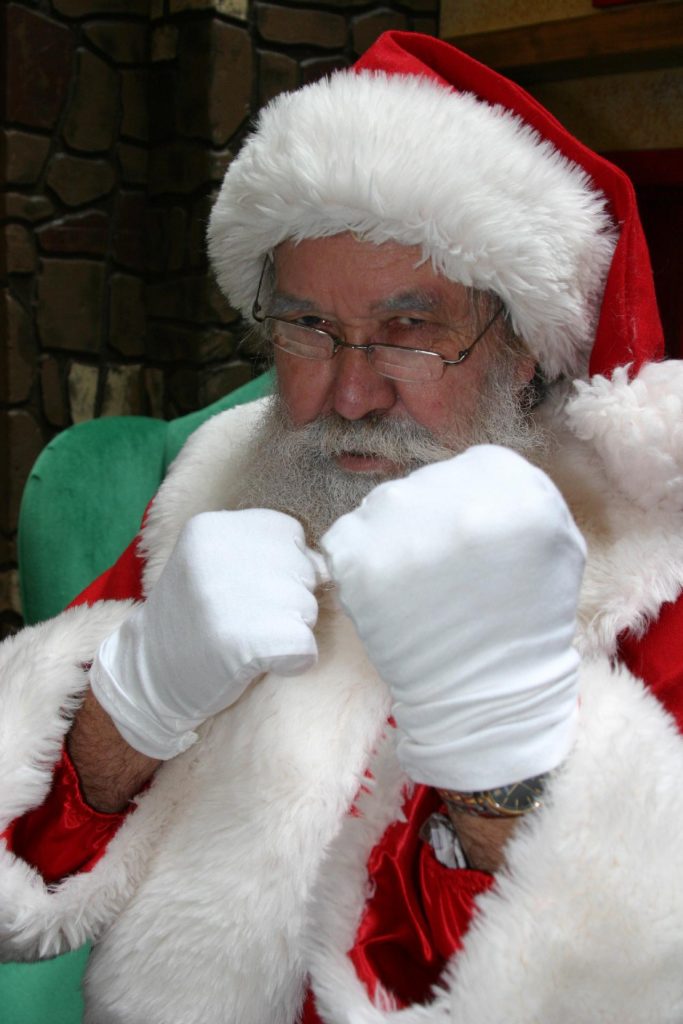
Others of us seem like we are on a fast track, not that this is a race one wants to win. For example, I feel like I have gained about five pounds since this time last month (the scale agrees with my assessment), and on our Thanksgiving Zoom session, my extended family helpfully remarked on how grey my unruly beard had grown. Every year I increasingly resemble Santa Claus.

While I would prefer to stave off Santahood merely by losing the five pounds I have gained since stepping back from the intense walking regimen that Jukie and I observed this summer, I also realize that to play Santa someday would be to participate in a family tradition. Towards the end of his life, my beloved Uncle Alan Ternes promised toys to many unsuspecting Vermont children; he had the kindest eyes one could imagine. And when my wife Kate was little girl, she had to be instructed not to speak the word “Grandpa” while visiting Santa at Gimbels Department Store in Milwaukee, Wisconsin. Her Grandpa Carl Duren had the belly, the low voice with a German accent, and the white beard: a convincing Santa!

But what strikes me most about personal transformations in 2020 is not the growing rotundity of my peers who have necessarily let their gym memberships lapse, but the rapid evolution of all their teenagers. As I did when I was moving from elementary school (where I was one of the shortest boys in the class) to high school (where I felt like I was a foot taller), my son Truman has grown more than six inches this year. In 2020, he passed up his sister Geneva, and then his brother Jukie, and then his mom, and, probably by the time you read this, his dad.

And how strange that Truman has not seen a single junior high or high school friend since the last day of in-person school on Friday, March 13th. Will they be able to recognize him at the post-vaccination reunions next year? Will he be able to recognize any of them, or their younger siblings? Just yesterday Kate remarked to me that it must be the younger sister of one of Truman’s friends in the family pictures posted on Facebook – by process of elimination, it couldn’t be anyone else – but it’s still difficult to understand how someone could mature so much in just a year.

We should be receptive to such feelings of awe, of amazement, of delight in the evidence of growth and accomplishment in our overlapping circles of friends and family. Albert Einstein knew that relativity is (perhaps by definition) a state of mind as well as an increasingly provable theory in astrophysics. He offered this advice: “Do not grow old, no matter how long you live. Never cease to stand like curious children before the Great Mystery into which we were born.”

I hope such curiosity guides you this week, and for the rest of the year. Dark forces stand arrayed against us, so we will need to foster curiosity, amazement, and sufficient socially distant joy in all the ways we can until we can once again raise a toast together. When next we congregate, we will no doubt reorient ourselves to our friends’ changing faces and hear stories about our rapidly-developing children as they prepare for the world that we have wrought for them. 

I want to thank all of you who donated in response to my little fundraiser last week for the Smith-Lemli-Opitz Foundation. With your help, I was able to raise over $500 for the Foundation, and thereby support its work on behalf of kids (and some adults) who have the same syndrome as my son Jukie. The need is ongoing, and the donations are tax-deductible. Thanks especially to Jim Grellas of Eldorado Hills. He is one of the most civic-minded and generous friends I have. 

Thanks also to all of you who support the Pub Quiz by becoming patrons on Patreon, including especially The Original Vincibles, who prompted me to start video-recording quizzes. As today is Cyber Monday, I will offer an informal sale. For the month of December only, all new and ongoing patrons will enjoy Pub Quiz offerings at two tiers above their level of support. People supporting the Quiz at the $4 tier will receive print quizzes this month, while everyone supporting the Quiz at the $20 or higher tiers will receive video quizzes, this month. I invite you to subscribe, if only for a month, to see what you have been missing, or to consider upgrading your subscription. Also, all subscribers will eventually receive a digital copy of my 2021 book, The Determined Writer, which is filled with wise quotations and advice from established authors on how you can sustain your writing habit.

OK, here are the hints. Tonight expect questions on science fiction franchises, animals that provide comedic relief, medics, the anticipation of obstacles, balloons, World War I, people named Chris, future secretaries, musical kings, Neil Sedaka, comedians, Disney, velvety substances, mixtapes, third choices in the face of apparent binaries, Syracuse, doors, Athenians, co-players, writing compulsions, impressive green growers, Batman, Stans, juniors, 30-second tributes, public service announcements, and Shakespeare. 

Happy December to you. “See” you next week!

Dr. Andy

P.S. Here are three questions from last week’s quiz.

  1. Film. What Pixar film ends with these words? “There are those who say fate is something beyond our command. That destiny is not our own, but I know better. Our fate lives within us. You only have to be brave enough to see it.” 
  1. American Comedians. The first-ever Kennedy Center Mark Twain Prize for American Humor was presented to the man who was listed at number one on Comedy Central’s list of all-time greatest stand-up comedians. Name him.  
  1. Science. Ionic, covalent, and metallic are all kinds of what?  

P.S. One more quotation from Einstein: “In one’s youth every person and every event appear to be unique. With age one becomes much more aware that similar events recur. Later on, one is less often delighted or surprised, but also less disappointed than in earlier years.”